Showing posts with label linked data. Show all posts

Friday, April 4, 2014

Agro-Know in the EDF 2014

The European Data Forum (EDF) 2014 took place between 19-20 of March 2014 and it was only one of the data-related events that would take place during the 6-month Greek presidency of the EU Council. According to the website of the event, "The European Data Forum (EDF) is an annual meeting place for industry, research, policy makers, and community initiatives to discuss the challenges and opportunities of data in Europe, especially in the light of recent developments such as Open Data, Linked Data and Big Data". This is at the heart of what we are currently working on in AK; we are getting deeper and deeper in the open, linked and big data, always in the agricultural context. This means that there was no way that the AK team would not be represented at the event.

The event was collocated with the Europeana Cloud Plenary, which was attended by my colleagues +Theodore Mathioudakis+Effie Tsiflidou and +Andreas Drakos who are contributing to this effort. Andreas also helped with the Agro-Know booth that was setup at the EDF2014 and which was full of brochures of Organic.Lingua, as the sponsoring project of this activity, agINFRA and of course Agro-Know ones.

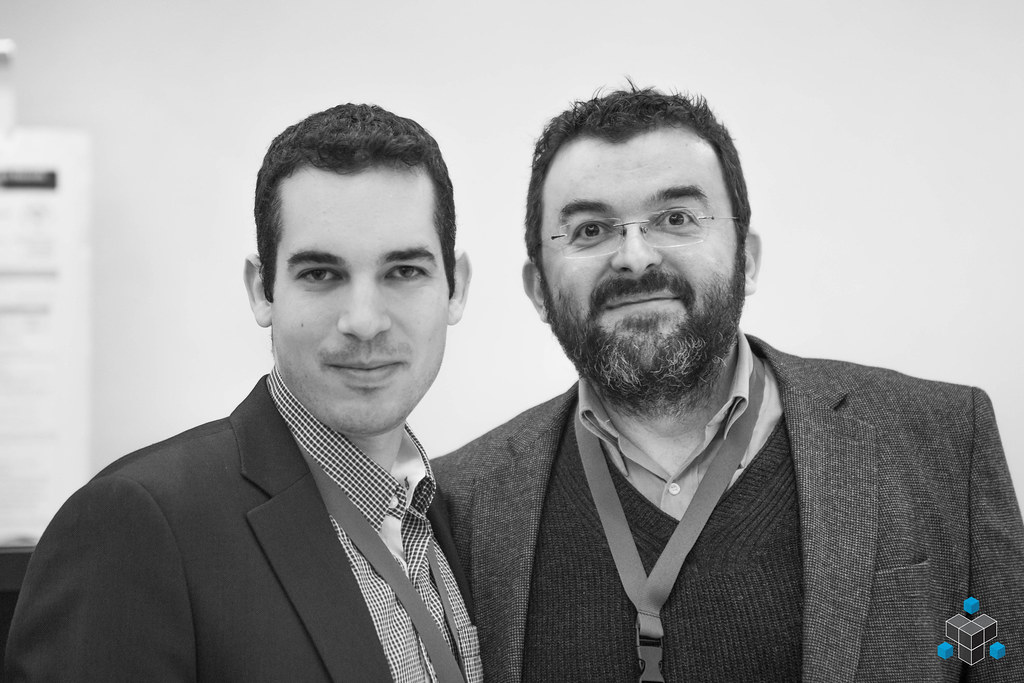
Andreas & Vassilis @ EDF2014
(source: https://www.flickr.com/photos/lod2/13433089254/in/set-72157642967653084/)
Even though I did not have the time to actually attend the speeches of the first day of the forum (unfortunately I could not attend the second day - the full programme is available here), I had a great time being there and meeting people who were interested in the AK products; at the same time, I had the time to take a look around and see what the other booths were about, finding interesting people, projects and products. I had the pleasure to meet Karel Charvat again (after the EFITA 2011 Conference), one of the most active persons that I know, actively involved in several initiatives. Among  the other participants, I got engaged in a discussion with Natalia Manola from Athina Research Center, a person actively involved in several data-related projects like DRIVER, OpenAIRE and OpenAIREPlus. Our first meeting was during the RDA 2nd Plenary Meeting in Washington D.C., last September. Last but not least, I had the pleasure to meet Dr. Christopher Brewster from the Aston Business School of the Aston University, UK - we had the opportunity to meet again during the next day at the AK office.


Created with flickr slideshow.


I also got to see +Sarven Capadisli, one of the people I admire for their work in linked data; this was the same case with Deirde Lee from DERI, Ireland, an old time acquaintance from a joint project with GRNET back in 2010. Both of them were engaged in conversations almost during the whole day so I did not find the appropriate time to get to know them better.

Overall it was a really interesting experience which provided us with the opportunity to expose our work to a related and wide audience (yes, the AK booth got busy at some points!) and to get to know interesting people working in similar topics and with whom we could establish collaborations in the near future. Andreas and Elena were there during the 2nd day of the event which was as useful as the first one.

Post-processing EDF2014 (info from the official web site)

Thursday, April 3, 2014

Food for thought: Agricultural Knowledge and Innovation Systems Towards 2020

(blog post initially posted at the Agro-Know blog)

We recently came across a really interesting publication by the European Commission’s Standing Committee on Agricultural Research (SCAR), titled "Agricultural Knowledge and Innovation Systems Towards 2020". The publication is available through the EU Bookshop, which is always a valuable source of  policy documents and reports.
SCAR was established back in 1974 and is responsible for the coordination of agricultural research efforts across the European Research Area, including questions of advisory services, education, training and innovation. SCAR set up a Strategic Working Group (SWG) of civil servants from the European Commission and the EU Member States to reflect on the Agricultural Knowledge and Innovation Systems (AKIS) - you can find a really interesting publication on AKIS, titled "Agricultural Knowledge and Innovation Systems in transition Findings of the SCAR Collaborative Working Group on AKIS" in the OECD iLibrary. SCAR consists of more than twenty (20) Collaborative Working Groups (CWGs) and Strategic Working Groups (SWGs) formed by Member & Associated State representatives. The role and the structure of the WGs are described in the report that we are referring to.

Cover of the "Agricultural knowledge and innovation systems towards 2020" report
The report itself is based on the need for revisions to be implemented in the current approach followed by AKIS, in order to ensure that it will meet the requirements for actually feeding an increased number of people in the following years making the best use of the available resources. In this direction, the repost reflects on "how innovation could be organised in the European research and innovation policy, using the framework of the European Innovation Partnership for Agricultural Productivity and Sustainability, and how this could be connected to agricultural policy and the Horizon 2020 research framework programme". The role of ICT in this context is really important and highlighted through the document, along with the role of the innovation which is a necessary component of the whole process. The report is providing interesting aspects on topics such as agricultural research policies and innovation in agricultural research, proposes approaches for engaging the agricultural researchers in targeted research & innovation, discusses alternative approaches and revisions to the existing ones, proposes approaches for stimulating the entrepneurship; all these filtered through the experiences of the 37 member countries represented in SCAR. However, the most relevant part for what we are working on in Agro-Know is presented in Chapter 6 of the document.
Chapter 6 is developed by the International Centre for Research in Organic Food Systems (ICROFS), co-authored by Ilse Rasmussen, an Agro-Know long-time friend and colleague in projects. The chapter focuses on the role that ICT in general and more specifically the social media may have in the transformation of AKIS and the innovation approaches proposed throughout the document. In fact, this chapter provides a useful overview of the hardware (e.g. mobile devices such as smartphones and tablets), software (such as software tools and platforms) and other aspects, which are described and analysed in some cases.  I am always interested to see commonly used platforms like Facebook, Flickr, Slideshare and Twitter used for serving agricultural knowledge sharing purposes - in some cases in a unique way, such as AgChat. In Agro-Know, we massively use such tools for the dissemination of the projects that we participate in and apart from that, for the dissemination of the AK-related news and events - and it seems that even these free (but widely used) tools are doing a great work. Additional ICT tools, such as the Flash Meeting platform, Google Hangouts and other platforms are also frequently used for virtual project meetings, online Workshops and delivering presentations; the Webinars @ AIMS series is a fine example of using an online platform for such purposes. Apart from that, there are platforms serving online course management and delivery for various levels of education, such as the agriMoodle platform, which is also developed by Agro-Know - in fact this refers to a number of Moodle components developed by AK for meeting the requirements of the agricultural learning communities.
The VOA3R platform for networking agricultural researchers, students and practitioners, providing virtual space for creating user communities, sharing resources and networking and on top of that access to million of agricultural research publications is another example mentioned in the report. We feel proud as AK to have been involved in each development, adaptation (under the GRNET umbrella) and also have plans to adapt it to meet specific requirements of existing communities and reuse it in this way.
agINFRA_logo_newThe low adoption of the ICT tools in agriculture, which is highlighted in the report, was something that we have also faced in the projects that we have been involved. For example, in at least two cases, there were agricultural training curricula developed, organized and made available through online course management platforms; however, access to the courses by the end users was usually limited due to various reasons including the lack of appropriate equipment, the lack of a stable internet connection and last but not least the lack of basic knowledge of using a computer and/or the software used for the delivery of the courses. Other issues such as the language barriers which did not allow users to access resources in other languages than their own were solved by solid solutions proposed by projects like the Organic.Lingua, which transformed the Organic.Edunet Web portal into a fully-multilingual portal which serves a relatively high number of languages through automatic translation features and cross-language information retrieval through a fully multilingual user interface. Other issues, such as the agricultural information scattered in several different databases, repositories and websites is currently being investigated (and solved) by the aggregation and linked agricultural open data approach and the integrated cloud/grid based services proposed by the agINFRA project. This is being taken one step further by the SemaGrow project, that aims to enhance the real-time performance of the global agricultural data infrastructures, by proposing a linked data-based approach. Agro-Know is actively involved in these projects and the last two have been discussed during the G8 conference on open data for agriculture about one year ago, as two of the most promising ones funded by the European Commission.
Agro-Know is also involved in initiatives such as the Global Open Data for Agriculture and Nutrition (GODAN), the Coherence in Information for Agricultural Research for Development (CIARD) and the Global Food Safety Partnership (GFSP), while it also closely follows other related networks and initiatives, such as the Research Data Alliance (RDA) and more specifically the Agriculture Data Interoperability Interest Group and the Wheat Data Interoperability Working Group. All these initiatives have more or less a common goal; to identify the requirements of the agricultural community related to access to agricultural data and to allow and/or to enhance access to open and linked data, making use of infrastructures that can support the management of large volumes of information and knowledge and disseminate related open access policies and information between stakeholders. CIARD aims to "to develop common standards, share knowledge and contribute to coherent, effective and open institutional approaches to agricultural knowledge" and could be the link between the individual agricultural data providers, individual researchers, policy makers and other stakeholders, and the data infrastructures that are available for facilitating access to agricultural resources. In this direction , the CIARD R.I.N.G. (Routemap to Information Nodes and Gateways) acts as a global directory of web-based information services and datasets for agricultural research for development and could provide this link that could also be a key component of the processes proposed by the report. More information about the RING can be found in the CIARD RING handbook (PDF).

These are only some examples of existing tools, services and initiatives which can be used in this large-scale effort towards the reformation of the AKIS mentioned in the report. It is really important that all these initiatives previously mentioned are taking into consideration the previous work done in this context so that existing material can be adapted, adopted and reused in order to meet the requirements of the constantly growing sector of the agricultural information and data management. The upcoming "Global Consultation on Open Agricultural Knowledge for Development", a  joint CIARD/GODAN meeting in Rome (22-24/4/2014), will provide an opportunity for the members of these two large initiatives to meet, exchange ideas and find some common ground for joining forces and working toward opening up access to agricultural knowledge and information.

Friday, March 7, 2014

Some thoughts on linking data sources / Bringing down the data silos

Agriculture and silos are two terms which play nice together, when referring to agricultural products; silos provide a nice mean of storing large volumes of harvested crops and provide a controlled environment for their post-harvesting management. However, when referring to agricultural data, one may safely claim that the data silos are dead. In fact, they exist but it is only a matter of time before they are either linked with existing backbones or they eventually disappear. Nikos Manouselis has already presented this "data silos" issue very nicely in a really interesting presentation - don't you agree?


Let me express my personal experiences here: My first contact with EU funded educational and research projects was the Organic.Edunet eContentPlus project, which managed to create a network of content providers on organic agriculture, agroecology and other green topics. These content providers followed a unique methodology for creating metadata records for their educational resources (=harmonization) and these metadata became available through a single point of access, which is the Organic.Edunet Web portal. This was a case of harmonization, networking and public exposure.


Then other projects (ICT-PSP, FP7) came in which I was also involved, like VOA3R, Organic.Lingua and agINFRA. What do these projects have in common? All of them were based or at least included large volumes of work on metadata harmonization, linking between different data sources, making data and metadata public. They managed to interconnect various digital data sources like institutional repositories, digital libraries, databases and educational repositories, applying a harmonization layer (e.g. the application of a common metadata standard/schema, the use of common vocabularies and other KOSs etc), providing a linked data layer for linking heterogeneous data sources and aggregating data and metadata from the homogeneous ones. In fact, this linked agricultural data layer is in my opinion one of the most interesting and important outcomes of the agINFRA project. Using KOS (Knowledge Organization Systems) as the backbone, various heterogeneous data sources can be linked as long as they are published online. Another related case was the mapping between the Organic.Edunet ontology and the AGROVOC thesaurus, which took place in the context of the Organic.Lingua project, which was another step in the direction towards linked data. I also feel really glad to be (even partially) involved in a work that it taking place towards the publication of germplasm and other biodiversity data as linked data, something that will allow the linking of these resources to other types of data like bibliographic and educational resources.


There are also cases of linking on a higher, global level compared to the project-based one; the case of the Research Data Alliance (RDA which aims to enhance the accessibility of research data and enable all stakeholders to get access to them. RDA provide a mean for projects like the ones mentioned earlier and other initiatives (like FAO, CIARD, IFPRI and INRA, just to mention a few) to join their forces, share the effort and resources and make a leap forward. Another case is the Global Food Safety Partnership (GFSP), which aims to provide a centralized mean of access to food safety capacity building, by engaging stakeholders from both the public and the private sector. Global Open Data for Agriculture and Nutrition (GODAN) is another global initiative which aims to support global efforts to make agricultural and nutritionally relevant data available, accessible, and usable for unrestricted use worldwide through the participation of public and private sector bodies. The G8 International Conference on Open Data for Agriculture which took place in April 2013 boosted the development and progress of such initiatives by highlighting the need for opening access to data related to agriculture by setting the landscape and define possible next steps in this direction. It managed to identify the needs and engage key stakeholders, among others.


Taking all these into consideration, it is hard for anyone to believe that in this era of linking and interlinking there is still space for data silos. While there are also cases where data cannot be publicly exposed and shared (e.g. patents, privately funded research work, personal data to name a few), the approach of linking and openly publishing/exposing data seems to be the only way towards ensuring the sustainability of these data and the involvement of all stakeholders. In the end, it is up to each data manager individually to decide if he/she will jump on the train and be a part of the future or just remain a part of the history. ;-)

Saturday, December 21, 2013

1st International e-Conference on Germplasm Data Interoperability: Overview

Germplasm_e-Conf_web

The 1st International e-Conference on Germplasm Data Interoperability is now over. It consisted of four (4) sessions which took place between 6 and 20 of December 2013 and was co-organized by Bioversity International, the Food and Agriculture Organization of the United NationsAgro-Know Technologies and supported by the agINFRA EU project.  The aim of the e-Conference was to bring together stakeholders in the area of plant germplasm and traits. The participants were encouraged to discuss the current status of the interoperability between the different data sources and resources, such as the metadata schemas and classification systems used. In this direction, the e-Conference aimed to focus on the Linked Data approach to be followed in order to enable the linking of data from heterogeneous data sources and in various data formats.

Indeed, the e-Conference managed to bring together various stakeholders including:

The e-Conference had the following structure:
  1. Session 1 (6/12/2013, Synchronous): The vision of Linked Germplasm Data (VideoGoogle Event page)
  2. Session 2 (11/12/2013, Synchronous): Data providers' perspective on current status & use of data and metadata for germplasm (VideoGoogle event page)
  3. Session 3 (19/12/2013, Asynchronous): Set up an infrastructure for germplasm data (Google event page)
  4. Session 4 (20/12/2013, Synchronous): Standard and metatadata for bringing germplasm data to breeding/in situ/on farm data (VideoGoogle event page)

All presentations are available at the website of the e-Conference. The AK team was actively involved in the organization of the event (both Giannis and me were in the Organizing Committee, which had a lot of work to do: from creating the program for the four sessions to finding the most appropriate tool/platform for the deployment of the e-Conference, let alone numerous emails/invitations/testing etc.!) as well as the actual implementation (I made three presentations in the first three sessions/Giannis also made one, and the introductions in Sessions 1 & 2!). The participation of AK was focused on the aims, objectives and outcomes of the agINFRA Germplasm Working Group, which has been working towards the harmonization of the germplasm standards as well as the development of a linked germplasm data approach.


The e-Conference was implemented using Google Hangouts, which allowed the presenters to share screens/slides and discuss while the audience could show a live stream of the presentations and comment in the page of the video or the event. We had some technical issues during the sessions (e.g. screen sharing not always working, full-screen sharing of presentations not working etc.) but in the end it was the content that mattered.

The comments received led some really interesting discussions and in fact there have been some of them which are going to drive things in the next months and move some steps forward towards the linking of the existing germplasm data sources and the work towards the adoption of common standards in all cases (where possible).

Overall, it was a really interesting and fruitful experience, which I hope that will enable the collaboration between the various stakeholders who actually participated in the meeting and will provide a "vehicle" for repeating the e-Conference during 2014, probably in a less formal way, enabling the frequent meeting of the stakeholders (e.g. in the form of e-seminars or workshops). As I mentioned during the e-Conference, I felt really privileged to have the opportunity to sit (at least virtually) next to such important people, who have been actively involved in the biodiversity and germplasm context during the last years and I feel that I have a lot to learn from them.

Friday, December 6, 2013

1st International e-Conference on Germplasm Data Interoperability: Session 1

Session 1 of the 1st International e-Conference on Germplasm Data Interoperability themed "The vision of Linked Germplasm Data" is now over. It was deployed using Google Hangouts, thanks to +Luca Matteis who set everything up for us. It was the first time that we used this platform for deploying a Conference, so we came across with some issues but they were solved on the fly.

The session started with a very quick introduction to the Conference by me; I felt really lucky to be able to participate to the same meeting with people who have spent many years in the biodiversity and germplasm domain and I was really honored to be asked to make the introduction to the e-Conference (and obviously too nervous to do so!). Then +Eliza Arnaud from Bioversity International made a keynote speech on "Interoperability of Agricultural Diversity Data". The next presentation came from +Michael Marus (CGIAR) (ICT Manager of CGIAR) who presented the "Data Management Landscape", sharing the CGIAR experiences on the topic. It was really interesting to know that CGIAR has adopted Open Access policy for its data, and of course related to the linked open data approach proposed by the e-Conference. Next was +Donald Hobern, (GBIF Director), who made an interesting presentation of the Global Biodiversity Information Outlook and discussed several data sharing issues in the biodiversity area. Then it was my turn to present the agINFRA Germplasm Working Group, a group which aims to enhance the interoperability between different germplasm data sources by developing and deploying a linked data approach. The links of the group with the Research Data Alliance (RDA) related groups were highlighted and the next steps were presented. 


The last presentation of the 1st Session was made by +Luca Matteis from Bioversity International, who presented the TDWG group of interest on ‘Semantics for Biodiversity’.

Session 1 closed with a short discussion on topics related to the theme of the session, driven by questions posed by the participants/audience of the e-Conference. The recording of the 1st Session is available through YouTube as it was automatically recorded; another convenience provided by Hangouts, while the presentations are available through the event's website.


I admit that I was pretty pleased with the result, despite the fact that I was rather nervous for sever reasons (e.g. the use of a platform that we haven't used in the past, my participation in a Conference about biodiversity and germplasm for the first time etc.). I believe that all went well in the end and that we will all be more prepared and relaxed during the Session 2, which will take place on 11/12/2013. Until then, stay tuned!

Wednesday, December 4, 2013

International e-Conference on Germplasm Data Interoperability


The “International e-Conference on Germplasm Data Interoperability” will take place between December 6th and December 20th, 2013. The aim of this e-Conference is to bring in contact stakeholders in the area of plant germplasm and traits and discuss the current status of the interoperability between the different data sources and resources, such as the metadata schemas and classification systems used. In this direction, it aims to focus on the linked data approach to be followed in order to enable the linking of data from heterogeneous data sources and in various data formats.
The e-Conference will consist of both synchronous and asynchronous sessions, facilitating the engagement of participants in both online and offline discussions and including real-time presentations using web-based tools. The event is jointly organized by Bioversity InternationalFood and Agriculture Organization of the United Nations (FAO) and Agro-Know Technologies and supported by the agINFRA EU project. Major players in the biodiversity area, including the Consultative Group on International Agricultural Research (CGIAR), the Global Biodiversity Information Facility (GBIF), EURISCO and GENESYS will be invited and involved, along with the Agricultural Data Interoperability Interest Group of the Research Data Alliance (RDA). The participants will also sessions on germplasm data providers as well as the technical infrastructure need for linking the various germplasm data sources.
According to the tendative agenda, the e-Conference will consist of four (4) sessions, each one of which will be allocated in one week in the aforementioned period:
  1. The vision of Linked Germplasm Data (6/12/2013, synchronous)
  2. Status of data and metadata for germplasm (11/12/2013, synchronous)
  3. Setting up an infrastructure for the Germplasm Data (11-19/12/2013, asynchronous)
  4. Semantic standards and metadata needed for bridging the germplasm data to the breeding/in situ/on farm data (20/12/2013, synchronous)
The synchronous sessions will consist of real-time presentations and discussions between the participants while in the case of the asynchronous session, it will consist of a number of presentations available offline, which can be commented and discussed between the participants. The expected audience of this e-Conference is bioinformatics and biodiversity researchers, linked data experts and stakeholders working with linked data.
You can find additional information at the e-Conference website, including the registration form.

Thursday, September 19, 2013

RDA 2nd Plenary Meeting: Day 1

The first day of the 2nd Plenary Meeting of RDA is over. It was dedicated to interesting key-note speeches, presentations on the status and progress made during the previous months, affiliation/liaisons with other organizations / initiatives. More specifically, the meeting started with a nice buffet breakfast, which also provided the opportunity to the participants to get to know each other and start matching faces to names. I was surprised to see and get to talk to Phil Archer from W3C, as I have been using the W3C documentation on Linked Data as a prototype for the work done towards the publication of the agINFRA data as Linked Data. We had a really nice discussion about the fact that publishing data as Linked Data is not as easy as it should be; we both expect that things will change for the better in the next period.

The National Academy of Sciences

The meeting was hosted at the National Academy of Sciences and started with Plenary I, which consisted of keynote speeches from various people activated in the context of the Research Data Alliance. After the first coffee break, Herman Stehouwer chaired a session (Plenary II) dedicated to the progress of RDA during the last months, such as the progress of the various Working and Interest Groups of RDA. The networking lunch provided another opportunity for chatting and networking, as well as tasting the tasty dishes.

Plenary III included discussions related to affiliation between RDA and various related organizations and initiatives. It started by an interesting discussion led by a panel which included, among others, a really important Greek person; Kostas Glinos, the Head of the e-Infrastructure division of the European Commission. During the coffee break we had a short discussion, only to realize that we both come from the same Greek island (Naxos)! What a coincidence, especially if one takes into consideration that the introduction was made by Natalia Manola from the OpenAIRE project who also comes from Naxos! We are not talking about the Greek lobby, but a more specific one ;-)

The discussion was followed by discussion of representatives from affiliated organizations and initiatives, such as W3C, CODATA, DataCite and ESIP. The first part of the meeting ended with Plenary IV, which included the Technical Advisory Board (TAB) in a discussion about WGs and IGs, as well as a nice presentation of the candidates who are interested to become members of TAB.

Nice animation automatically created by Google, by merging a number of my photos

After a short 1 1/2 hour break, we moved to Washington Marriott for the poster session. There we were provided with space for putting up our posters and brochures and had the opportunity to check what each one of the RDA meeting participants was actually involved in. The agINFRA team was represented by +Johannes Keizer (FAO), Devika Madalli (ISI) and me. The poster session was collocated with a well-thought reception. The drinks and light atmosphere allowed the participants to enjoy themselves and get engaged to discussions not limited to the RDA meeting. The reception was sponsored by Microsoft and in fact there was a short speech by Tony Hey, Vice President of Microsoft Research Connections. I was really hoping that there will be a pack of Microsoft Surface Tablets in the room as well, to be distributed to the participants (at least the ones who use Windows Phones!) but of course this did not happen... :-S

That was the end of the day - and there were still things to be done for the next day! I have uploaded some photos from the 1st day of the meeting here. You can also check out the heavy tweeting that took place during the Plenary using the hashtag #rdaplenary and of course by following RDA at Twitter: @resdatall

The full program of the RDA 2nd Plenary Meeting is available here.