Showing posts with label open access. Show all posts

Tuesday, November 17, 2015

Report from the Community Workshop on the Open Science Cloud


On November 13th, 2015, a community workshop on the Open Science Cloud titled "Shaping the Open Science Cloud of the Future" took place in Bari, Italy. Agro-Know was invited as a data-powered SME in order to contribute its expertise in serving the agri-food research community - other communities were represented as well.

This provided us with excellent opportunity to present how three different user types could benefit from the envisaged Ope Science Cloud:
  1. Agri-food researchers: I have have spent 13 years in the Agricultural University of Athens; two of them for my MSc. and almost 5 for my PhD. I didn't have any kind of infrastructure suporting me as a researcher back then: I recall copying my data from the lab desktop computer - no laptops back then - using an external parallel Zip drive using 100MB disks (a painfully slow process) or an almost faulty SCSI CD recorder which frequently provided us with lemon copies of the data. When I wanted to share data with our Austrian colleagues I had to create copies of the CDs, check their integrity and then send them to Austria using regular postal service...this makes me (and researchers like me who may have access to the necessary tools and platforms but they do not know how to make use of them) a potential user of the Open Science Cloud, as
    an individual researcher.
  2. A data-powered SME: Agro-Know is working closely with agri-food researchers; we understand their needs and serve them by developing data-powered services. Our AKstem product is a fine example, as it provides a cloud-based web app that supports e.g. content providers who wish to publish their research publications through the FAO AGRIS bibliographic database; both the help desk and the metadata ingestion processes are supported by AKstem. In addition, researchers who wish to apply for funding through any of the Horizon 2020 agri-food calls can get support in terms of describing, developing and implementing the mandatory Open Access and Data Management Plan through AKstem. Such services require cloud-based hosting, storage and data services thus making Agro-Know an SME that is a potential customer/user of the Open Science Cloud offerings.
  3. A global research data hub: AK is only one of the entities behind agINFRA, which currently involves major players in agri-food research at a global level, including (but not limited to) UN FAO (Global), CGIAR (Global), CABI (UK), GODAN (Global), USDA NAL & AGRICOLA (US), OADA (US), CAAS (China) and EMBRAPA (Brasil). INFRA has evolved from an FP7 project to a global atlas of agri-food research. It embraces all types of information related to agri-food research, such as research data and publications, profiles of researchers, organizations and projects activated in specific research contexts, domain-specific standards, software tools, platforms, thematic repositories, registries and indexes and anything else. However, agINFRA does not aim to be yet another registry or catalog of services and entities: instead, it creates a semantic layer providing rich information about each one of these entities and uses vocabularies for classifying them. In this way, these resources are not only more easily retrieved by queries but related heterogeneous resources are linked and therefore presented together after related queries. agINFRA embraces all types of data providers, no matter how big or small they are - the latter usually have limited technical technical and financial capacity for publishing and sharing their data and this is where agINFRA and its dedicated help desk shines.


A large and ever growing network of agri-food data managers, the FAO AIMS community, supports researchers by openly sharing their knowledge through the AIMS platform in blog posts, webinars, discussion as well as in meetings, such as the ones of the Agricultural Data Interoperability Group of the Research Data Alliance. As a result, agINFRA can test, validate and deploy data usage scenarios that include heterogeneous data types from various data sources all over the world. You should keep in mind that agriculture is a complex science, covering thematic areas that range from traditional crop/animal/food science to food safety, food security, forestry, viticulture and wheat research etc. - all these thematic areas produce and make use of a wealth of heterogeneous data such as physical measurements, sensor data, environmental parameters, weather and soil data, soil maps, images, outcomes of DNA/RNA/protein analysis, antibodies, agricultural trials. These highlight the increased need for cloud and grid-based services for these communities to be served and this highlights the role of agINFRA as a potential customer/user of the Open Science Cloud offerings.

After presenting the big picture, I went back to describing the work of a researcher, who apart from conducting his research, he needs to spend time looking for information on the following:
  • Guidance on publishing his research as Open Access; what are the institutional and project policies, what are the available domain-specific repositories to deposit his publications and aggregators etc.;
  • Help on where and how to store his data online using a free cloud service for sharing, managing and preserving his data;
  • Identify other researchers working on the same research area, related organiations and initiatives/projects etc.
  • Funding opportunities to support his research;
  • Other...
Searching for such information and ensuring that he always has the latest versions in his hands, consume valuable time that he could dedicate to his work.


So our vision as Agro-Know and agINFRA in terms of implementing the Open Science Framework in our case is for us to be able to support agri-food researchers in the aforementioned activities using cloud-based, customized and open services, thus saving them time that can be allocated in what they know how to do well: their research.

Friday, October 24, 2014

CGIAR Open Access mandate: Work in progress in the case of ICARDA

Agro-Know has a long time involvement in Open Access through its participation in related EU-funded projects (such as VOA3R and agINFRA), its participation and contribution in related initiatives and events and more lately through our active involvement in the FAO AGRIS Network (Agro-Know is hosting & responsible for the Data Processing Unit of the traditional AGRIS service) but also through the expertise and experience of each team members (such as agricultural domain experts, information scientists and librarians, software engineers and web developers etc.). In this context, almost five months after the CGIAR presentation, Agro-Know made a contact with the International Center for Agricultural Research in the Dry Areas (ICARDA), one of the 15 CGIAR Centers and it was agreed that Agro-Know would be responsible for the following:
  • Provide an overview of the current situation of ICARDA and the Dryland Systems program regarding information available, repositories and related processes and workflows;
  • Recommend the optimal approach for ICARDA and Dryland Systems, in terms of technology, skills, processes and responsibilities in the organizations;
  • Taking responsibility to prepare the ICARDA and Dryland Systems Open Access Plan, following the Guidelines set out by the CGIAR Consortium.
ICARDA staff during the briefing session on OA

First meeting

The first step of this process was a week-long visit (between 3-9 of September 2014) to the ICARDA headquarters, which are now in Amman, Jordan. During this visit, Johannes Keizer from FAO and me had the opportunity to meet with the Communications, Documentation and Information Services (CODIS) team led (then) by Mr. Michael Devlin. The aim of this first visit was:
  1. to meet the CODIS team and other ICARDA/Dryland Systems staff that would be involved in the processes related to the Open Access implementation plan;
  2. to evaluate the current status of the ICARDA/Dryland Systems metadata management workflows and infrastructure;
  3. collect as much information as possible related to the structure, the status and the requirements related to the design of the open access implementation plan;
  4. to provide all the necessary initial information for setting up the basic workflows and tools and initiate some basic processes;
  5. to inform ICARDA directors and other key staff about the benefits of Open Access, discuss any objections they had and briefly describe their involvement in the new processes;
  6. to inform the ICARDA staff about our initial findings and suggestions for the next steps through a briefing session on the last day of our visit.
(L-R) Me, Jack Durrell (ICARDA), Johannes Keizer (FAO) & Michael Devlin (ICARDA)
Indeed, during the visit, we had the opportunity to arrange focused, individual meetings with several of the staff members of ICARDA, including program directors, information managers as well as with people with a more technical background and role (but still currently involved in the information management processes), and inform them about the CGIAR Open Access Policy and plans, providing at the same time information on the advantages of Open Access as well as responding to any questions. At the same time, through focused interviews, we collected feedback needed for compiling our report, such as the structure of the teams, the types of information products available, the thematics covered by the information products of ICARDA and Dryland Systems etc. All feedback received was documented and was taken into consideration, along with the related CGIAR guidelines, in the preparation of the workflows and documentation for the implementation of the Open Access policy for the case of ICARDA. Our visit concluded with an Open Access briefing presentation to the ICARDA staff, during which we briefly presented our findings and considerations for the next steps of the OA implementation.

Working on the Open Access plan for ICARDA & Dryland Systems

After getting back to the Agro-Know office, a working group (Development Team, as we like to call it) was formed, that would focus on the specific task; the group consists of information managers with experience in agricultural information management, people with experience in Open Access, agricultural domain experts and a project manager for coordinating all activities within the team. By sharing all notes and related documentation from the visit to ICARDA, we completed the first part of the requirements' collection and moved to the next phase, which was the documentation of the current status and our proposed revisions regarding the set up of the infrastructure and workflows to support the implementation of the Open Access policy in the case of ICARDA and Dryland Systems. So far, we have collaboratively worked (with the precious help and feedback from the CODIS team) on the development of a first draft version of the document that was shared some days ago, and we are currently working on the next steps, including the definition of the metadata elements and controlled vocabularies to be used in the case of the ICARDA and Dryland Systems repositories.

The next steps

The next steps include regular communication with the CODIS team and other people to be involved in the process (for clarifying aspects that are not clear to us yet), completing all missing information and polishing the document, as well as a second visit to the ICARDA headquarters (supporting the testing phase of our proposed workflows) that will focus on the following:
  • a number of face-to-face meetings with key ICARDA staff, for fine-tuning the information already available in the plan;
  • meetings with the CODIS team for hands-on sessions and testing of the proposed metadata management workflows;
  • a hands-on seminar with the focal points from each ICARDA team to be involved in the OA implementation processes (e.g. information managers), clarifying the tasks that need to be done from their side as a part of their work.
These will help us finalize the design of the processes involved in the OA implementation plan and ensure their proper functionality of the proposed workflows before the deadline which is set by the CGIAR Consortium by December 15th, 2014. After that, everything will be properly set up for the actual implementation of the CGIAR Open Access mandate in the case of ICARDA, which is expected to be start even before this deadline. In the meantime, Jack Durrell from the ICARDA CODIS team has prepared a related presentation regarding the needs and status of the Open Access status and progress in the case of ICARDA and Dryland Systems.


Saturday, October 20, 2012

VOA3R 6th project meeting and Open Access Workshop


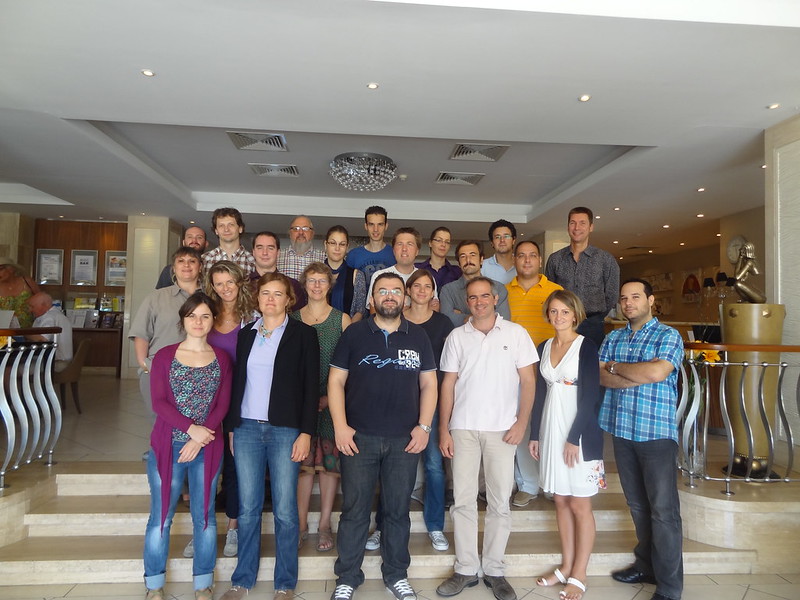
VOA3R Family Photo @ Cyprus
I had the opportunity to visit Cyprus for the first time during October 15-17, for the 6th project meeting of the VOA3R project. In addition, we have worked closely with George Adamides, the local host from Agricultural Research Institute (ARI) and we managed to organize a Workshop on "Open Access and Agricultural Repositories Workshop" right after the meeting, on October 18th, 2012.
The meeting was successful, since there was active participation and long discussions on pending issues, in order to make sure that everything will be on time, just 8 months before the end of the project.

Workshop participants working
on the VOA3R portal
The aim of the Workshop was to bring in touch stakeholders from Cyprus (researchers, students, practitioners etc. in the area of agriculture and agricultural research) in order to create and support a network, as well as to present the tools and services developed by related EU projects, like VOA3R and agINFRA, that could be used in order to facilitate the daily research work of the participants. It was rather successful, as it was attended by about 10 Cypriot stakeholders, mainly (if not all) researchers. I was facilitating the Workshop, making an introductory presentation and introducing each presenter before his presentation, which was really nice since all speakers were colleagues and friends of mine.
Imma Subirats from FAO/AIMS made a long but really interesting presentation about Open Access, which was followed by two case studies of Open Access repositories: The SLU Epsilon repository (presented by Urban Ericsson from SLU) and Organic Eprints (presented by Ilse Rasmussen from ICROFS), both based on Eprints software. Then there was a presentation of the repository tools used in Open Access repositories, like the AgriOcean DSpace (by Dirk Leinders from University of Hasselt) and Eprints (by Alejandro Engelmann from SLU). The following session was a hands-on session on the VOA3R portal, as a networking platform for researchers, practitioners and students in the agricultural context. For collecting the feedback we used both the online questionnaire as well as some additional focused ones provided by the UAH team. After a really interesting lunch break (I really loved the buffet lunch at Atlantica Miramare Hotel!), it was time for another interactive session, supported by the agINFRA project, which included a short presentation of the project and its expected outcomes as well as a discussion during which we tried to identify the needs of the participants as regards the tools, services and infrastructure used, barriers they face regarding the open access to content and other aspects. You may find additional information about the Workshop in my post in the FAO/AIMS website.

In general it was a fruitful workshop and I feel really grateful to the people who got involved in it and dedicated their time in order to prepare and present their presentations. I felt really glad that we had the opportunity to engage some stakeholders from Cyprus in such a discussion about Open Access and repositories and I really enjoyed the related discussions that we had with the brave ones who stayed until the end of the Workshop. I also hope that I will have the opportunity to visit Cyprus again in the near future, as due to the lack of time I did not have the opportunity to go around and see things!

Monday, October 8, 2012

Open Access Week @ AIMS: AK's contribution

I have to admit that this was a really nice surprise: I can see myself at the FAO AIMS (Agricultural Information Management Standards) portal! This is due to a work on our collaboration with ISKME on the Green OER Commons microsite and collection, in the context of the Open Access Week @ AIMS that my colleague Madalina Ungur and me submitted some time ago and was accepted for presentation through a webinar that will take place on 25/10/2012.

Even though I will not be able to attend the webinar (as I will be facilitating the Workshop on Agricultural Education, Methods, Practices and Technologies" (AgEdWS12) on the same day), it was still really nice for me to see my name featured at the FAO AIMS portal. As I am an agronomist myself, I know what FAO means in my research area and I could never even imagine that some years ago, while I was still studying. For us, FAO was something bigger than life, with its huge organization and publications/courses/materials etc. that could be used as a basis for our own assignments & research.

The full description of our work, titled "OER Commons Green: Aggregating Best-in-Class Green Open Educational Resources" can be found here.

Tuesday, February 21, 2012

Open Education Week - Only 10 days to go!

I am reposting a press release for an event that is really important for the open access / open education community, regarding the Open Education Week, organized by the The OpenCourseWare Consortium:


OPENCOURSEWARE CONSORTIUM DECLARES FIRST ANNUAL OPEN EDUCATION WEEK FOR MARCH 5-10, 2012
Efforts to Expand Access to Education and Knowledge to be Featured in Global Events

CAMBRIDGE, Mass., – (February 21, 2012) –The OpenCourseWare Consortium announces today the first annual Open Education Week from March 5-10, 2012.  Open Education Week is a global event that seeks to raise awareness about the benefits of free and open sharing in education, especially Open Educational Resources (OER). OER are high-quality, free and open educational materials that offer opportunities for people anywhere in the world to share, use and reuse. 
“The vision of the open education movement is to create a world in which the desire to learn is fully met by the opportunity to do so, where everyone, everywhere, is able to access affordable, educationally and culturally appropriate opportunities to gain whatever knowledge or training they desire. The movement encompasses producing, sharing, using and modifying content, as well as innovative models of educational delivery,” said Mary Lou Forward, executive director of the OpenCourseWare Consortium. “Open Education Week will showcase projects, resources, people and ideas so that people around the world can see the breadth of what has been accomplished already, and participate in discussions about the future of the movement.”
Open Education Week is being coordinated by the OpenCourseWare Consortium.  The event will take place online and in different locations around the world, with opportunities to participate in webinars, discussions and live events. Projects and events will be featured from institutions and organizations from around the world, including: University of Cape Town, University of Michigan, Universidad Politécnica de Madrid, University of California, Irvine, Delft University of Technology, and Creative Commons. Participation is free and open to all. Visit www.openeducationweek.org and follow @openeducationwk for more information.
About The OpencCourseWare Consortium: The OpenCourseWare Consortium (OCWC) is a community of more than 250 universities and associated organizations worldwide. The mission of the OCWC and its member institutions is to advance formal and informal learning for educators and self-learners around the world through the sharing and use of free, open, high-quality education materials packaged as courses readily accessible on a digital platform.  The Consortium showcases its members to a global audience and provides information and training through webinars, newsletters, and free and open materials. For more information, visit http://www.ocwconsortium.org.