Saturday, April 13, 2013

LAK 2013 / LACRO 2013

The last days at the office have been really busy but quiet; a large part of the team (mostly the technical part of it) was participating at the International Learning Analytics & Knowledge Conference 2013, which took place between 8-12 April 2013 at Leuven, Belgium. Our team was represented there with a paper titled "Aggregating Social and Usage Datasets for Learning Analytics: Data-oriented Challenges, which was co-authored by Katja Niemann, Giannis Stoitsis, Georgis Chinis, Nikos Manouselis and Martin Wolpers and through the participation in the Open Discovery Space workshop on "Communities Analytics through the Open Socially Empowered e-Learning Portal".

Workshop 4: Learning Object Analytics for Collections, Repositories & Federations (LAKRO 2013), which was a part of the LAK 2013 and took place on the 9th of April was of special interest for our team, as it was organized and attended by good friends and it was actually close to what we are working on in AK. We work with digital collections, mostly educational, therefore learning analytics is a powerful tool that we try to exploit in several cases.

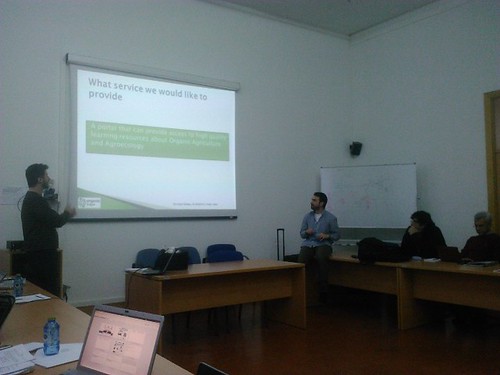
My friend and colleague Theo who actually participate in the Conference has uploaded a really nice photo during the LAK 2013 Conference, which I really loved at first sight:


I was lucky enough to have a really interesting publication titled "Applying analytics for a learning portal: the Organic.Edunet case study" in the Proceedings of the 1st International Conference on Learning Analytics and Knowledge (LAK 2011), which was the first of the series. The presentation was made by Nikos Palavitsinis, who actually participated in the Conference; the presentation can be found here. It was a really interesting experience and a really important publication for me!

Monday, April 1, 2013

Sunday, March 31, 2013

agINFRA users' meeting, 26-27/3/2013

AK hosted the agINFRA users' meeting in Athens, between 26 and 27 of March, 2013. The meeting was attended by the majority of the agINFRA data providers and gave the opportunity for discussion about the next steps in the context of WP5, which is related to data aggregation. I was really involved in this meeting, as it was an excellent opportunity for me to collect feedback on the D5.2 "agINFRA data integration methodology and workflow" and D5.3 "Conceptual specification of linked agricultural data integration layer", which were ongoing during this period but still there was input missing.

Hands-on session during the meeting
As regards D5.2, we had a great time with the data providers trying to depict their own (meta)data management workflows using flipchart sheets and markers and at the same time trying to see which of the collections we could use at this first metadata ingestion step. In D5.3 things were less fun, as we had to discuss about any type of Knowledge Organization System (KOS) such as controlled vocabularies, ontologies and thesauri which is used by the data providers for the classification of the resources but has not been published yet. This will be a challenging task, requiring a cloud-based installation of a KOS management tool and guidance of the partners in uploading their KOSs and linking to existing KOSs, which are already published, in order to facilitate the mapping between the different KOSs.

On top of that, we got to discuss about the tools which may be used for the uploading and puiblication of KOS as well as about the agINFRA integrated services from the users' point of view. As a user I found all discussions to be really useful :-)

The meeting was also an excellent opportunity for me to see again old friends like +Imma Subirats but mostly to meet new people like Davika, +Giovanni L'Abate, Ivana, David and +Valeria Pesce, with whom I have exchanged a lot of emails during the last months but never got to meet them in real life. Even though I was pretty ill during the two days of the meeting (high-fever, probably a flu), I got the chance to get to meet everyone slightly better. On the other hand I missed the opportunity to get to meet Guntram and Jane who did not finally make it to the meeting, people with whom we have exchanged a lot of emails but never had the chance to meet.

A big thank you goes to all those who got involved in the organization of the meeting (I know how hard it is) as well as to those who managed to travel to Athens and provided their feedback during the tow days of the meeting!

Tuesday, March 12, 2013

Agro-Know in the Open Education Week 2013


Open Education Week is taking place from 11-15 March 2013 online and in locally hosted events around the world. The purpose of Open Education Week is to raise awareness of the open education movement and opportunities it creates in teaching and learning worldwide. Participation in all events and use of all resources are free an open to everyone.

Agro-Know will be there, with a presentation from my colleague +Madalina Ungur, titled: "OER Commons Green: A Unique Lens on Open Environmental Education", on Wednesday 13/3/2013 at 17:00 GMT. The presentation will be about OER Commons Green, a micro-site on green open educational resources jointly curated by Agro-Know Technologies (Greece) in collaboration with the Institute for the Study of Knowledge Management in Education (US).


Participation is free and we will be glad to see you there!

Thursday, February 28, 2013

School of Open will launch during Open Education Week

The School of Open is launching during Open Education Week, March 11-15. A community of volunteers from P2PU, Creative Commons, Open.Michigan, and Wikimedia will offer free online courses on copyright, CC licenses, Wikipedia, open science, open data, open video formats, and more.


Get notified when it is open for sign-up here . Read more about the launch at the Creative Commons blog post.

You may also spread the word by retweeting the following tweet:

Tuesday, February 26, 2013

Organic.Lingua 5th Project Meeting

The 5th project meeting of Organic.Lingua took place between 20-22/2/2013 at the premises of University of Alcala, in the lovely Alcala de Henares, Spain. It was my second time there and I surely enjoyed it more than the first time. It was also my first time in the project to appear as a member of the UAH team, as I will be offering my services to UAH for the next months in the context of the Organic.Lingua project :-)

Strange to be on the other side of the lens!
The meeting took place some weeks before the 2nd review meeting of the project, so there were important things to be discussed and issues to be clarified before that. As usually, a lot of time was devoted to the technical aspects of the project (mostly machine translation components and CLIR services) along with the core software tools such as MoKi and UGC component. The main issue of the meeting were the revisions in the Organic.Edunet Web portal (which should be publicly available pretty soon), as it is the core component of the project.

I had the opportunity to present the revised Organic.Edunet IEEE LOM AP, the status of the content population (both topics are among my favorite ones!) as well as present the AgLR tool to the user partners, as a part of the user trials that they are going to host in various countries, such as France, UK, Estonia and Turkey.


This time we also had some free time (by limiting the number of hours for rest of course!), which we enjoyed with beers and tapas (in the evening), thanks to our good friend David. On top of that, we had some really nice time at a more classy restaurant, in a joint dinner which almost all partners joined. My evenings were also challenging as I had to fix my netbook, the performance of which suffered after upgrading Windows 7 Home Premium to Windows 8 Pro... low memory issues rendered the netbook almost unusable, when I needed to prepare slides, respond to urgent emails and keep the minutes of the meeting at the same time. Installing various Linux distributions did not solve the problem...


The meeting ended with a lot of tasks to be taken care of in the next weeks. For me this includes deliverables, reports, work in AgLR, communication, deadlines etc. After all, these are the ingredients that keep the work interesting ;-)

Additional info about the meeting along with more photos can be found in the IERU blog of the UAH team.

Friday, February 15, 2013

New start for the new year

It seems that this year will be a really busy one: There have been some internal changes in AK, which are reflected on the tasks undertaken by each team member, the introduction of various tools in our workflows is expected to make things more organized and internal meetings are really frequent and lengthy. Things look (even) more professional now so we'd better keep in a good shape!

I have to admit that I was involved in a variety of tasks, which is not always a good thing as I tend to get distracted by that or to do several things at the same time. It seems that during the first weeks of 2013 I will start focusing on the writing of deliverables related to content population/aggregation, work on the corresponding workflows and contribute to the aggregation of new collections in existing and new pools. Apart from that, I am working closely with the AgLR team, bug hunting, working on revisions and creating metadata samples. But this is only a small sample again...

Another task is my involvement in various publications. There are some ideas about new papers to be submitted in journals and workshops/conferences, something that I really enjoy... when I have enough free time, which is rather uncommon during the last months! I also realized that I really enjoy analyzing collections and digital repositories based on the metadata used and how they are used by various content providers; the results are usually interesting and highlight differences in the approach followed by each content provider.

I realized that in 2012 I got involved in a wide variety of tasks that were not exactly in my area of expertise, such as administration of course management platforms, blogs and wikis, mailing lists, updating web sites using the Joomla interface etc. However, even though I love being involved with such tools, sometimes this was really time-consuming and kept me from doing my main work.

Flying all over Europe - photos taken with my LG Optimus 7
What I keep enjoying when working with EU projects is the diversity of tasks; analysis of collections, metadata quality evaluation sessions (I am not really fond of that, I have to admit), deliverables, reports, publications, participation in project meetings and workshops/conferences all over Europe, spending time in various cities, meeting people and getting around airports, flying all over Europe... the list could go on and on!

Monday, December 24, 2012

Overview of my 2012

It seems that there goes this year as well... it has been a long and rather successful year, full of trips, meetings, tasks and tight deadlines. I took some time to go through the major events that I participated in during 2012 and here is a short list:
  1. 5th ISLE project meeting (23-27/4/2012, Newport, UK): Held at the Harper Adams University College, it was my first time in the UK for a project (my second one overall) and I was amazed by the landscape (and the awful weather...), as well as by the facilities and organization of the hosting institution. The meeting was combined with an Action Collab session facilitated by Sam and Megan from ISKME, as always.
  2. BioVeL MS6 Workshop (9-11/5/2012, Gothenburg, Sweden): My first time in Sweden and the first time to be among the BioVeL consortium. I participated on behalf of the agINFRA project, which also works with similar workflows as the ones used by BioVeL. I had a great time in the Workshop, meeting a lot of interesting people (I was always fond of biodiversity anyway, let alone combining it with software tools!) and did a litlle bit of sightseeing as well. My suitcase was for once more left behind while changing flights at CDG airport, France, but I managed to survive anyway. Since then, I keep an eye on the progress of the BioVeL project.
  3. 5th VOA3R project meeting (29-31/5/2012, Paris, France): The meeting was hosted by ACTA Info & INRA. It was my first time in Paris but I have to admit that I didn't really enjoy it, due to several factors. I also realized how expensive hotels in Paris are... more than 100 euros per night for a two-star hotel, including a really poor (not buffet) breakfast. Despite the bad weather, I managed to see almost all sights of Paris in just one evening, thanks to a really active colleague!
  4. 4th Organic.Lingua project meeting (18-20/9/2012, Paris, France): Wow, visiting Paris for the second time in 3 months! Things were serious there, as I had to present a lot of different aspects of the project (including stuff that I was not involved in). Due to the pressure and obligations for this meeting, I totally forgot that it was my birthday, which I accidentally celebrated with a colleague of mine & a fine bottle of French wine in a small but cozy French restaurant. No sightseeing this time, due to total lack of time...
  5. 6th VOA3R project meeting (15-18/10/2012, Limassol, Cyprus): My first time in Cyprus, where October was like summer! The city was full of tourists and transportation was an issue, but it was really nice to be there. Apart from our contribution (as GRNET) to the meeting, we also supported the organization of the Workshop on Open Access & Agricultural Repositories with the help of our good friend George Adamides from ARI, which I found really interesting. Bonus: I got to meet accidentally my good friend Petros from CUT, a colleague in the ISLE Erasmus Network! You may find more info about the Workshop at the FAO/AIMS website.
  6. Workshop on Agricultural Education, Methods, Practices and Technologies" (AgEdWS12) (25/10/2012, Pollenzo, Bra, Italy): I was responsible for the organization of the workshop and made a couple of presentations. It was hosted by the University of Gastronomic Sciences in a lovely landscape and building. I believe that despite the limited time that we had to prepare for the Workshop, we did a nice job with the organization and agenda. As it was collocated with Green Ideas 2012, I got to meet a lot of friends too and there was a warm feeling during these two days. The hotel was really nice, too. You may find more information about the workshop at the FAO/AIMS website.
  7. Herbal.Mednet Kick-off meting (22-23/11/2012, Alcala de Henares, Spain): It was my first time in Spain and my poor Spanish proved to be valuable for daily communication. even though I am not a member of the consortium, I was participating as an Organic.Lingua member, in order to present the concept of agriMoodle, which is going to be used for the training courses to be developed by the project. I loved Alcala de Henares, which is a traditional town with apparent medieval influences. I have a feeling that I will be a frequent visitor of this town in the future!
  8. EdReNe 9th Thematic Seminar (10-11/12/2012, The Hague, Netherlands): I was informed about EdReNe by a colleague of mine and was really anxious to initiate a communication and make sure that Agro-Know becomes a member of this interesting and active network. I was really glad to participate in the seminar and make a presentation about the Organic.Edunet network of learning repositories. I was also glad to make some really interesting connections and participate in some really interesting discussions, mainly during the social dinner... I could not believe how beneficial these events could be! By the way, kudos to the organizers of the workshop for the selection of the Rootz for the social event: wide variety of beers and tasty dishes made communication much easier! It was my first time in the Netherlands and I got in love with the Hague!
In the meantime, I managed to find some time for some publications, based on the outcomes of the things that I am actually working on:
  1. Geser G., Jaques Y., Manouselis N., Protonotarios V., Keizer J. and Sicilia M. (2012) Building Blocks for a Data Infrastructure and Services to Empower Agricultural Research Communities. In: Agris on-line Papers in Economics and Informatics, Volume IV, Number 4, 2012, http://online.agris.cz/archive/2012/04/. PDF direct: http://online.agris.cz/files/2012/agris_on-line_2012_4_geser_jaques_manouselis_protonotarios_keizer_sicilia.pdf
  2. Protonotarios, V., Papakonstantinou, K., Giannikopoulou, V., Toader, M. and Roman, Gh.V. (2012) Involving rural communities in organic agriculture-related EU initiatives: The case of the Organic.Balkanet LdV project. International Journal of Agricultural and Environmental Information Systems, Special Issue on "Online Information Systems and eServices for Rural Development" (accepted)
  3. Bouranis D.L., Chorianopoulou S.N., Siyiannis V.F., Protonotarios V.E., Koufos C. and Maniou P. (2012) Changes in nutrient allocation between roots and shoots of young maize plants during sulfate deprivation. Journal of Plant Nutrition and Soil Science, 175, 499-510.
  4. Thanopoulos, Ch., Protonotarios, V., and Stoitsis, G. (2012) Online Web portal of competence-based training opportunities for Organic Agriculture. Agris on-line Papers in Economics and Informatics, Volume IV, Number 1, 2012, pp. 49-63. ISSN 1804-1930.
  5. Toader, M., Roman, G.V. and Protonotarios, V. (2012) The Use of Metadata in the Description of e-Learning Content for Organic Agriculture. In J.-M. Dodero, M. Palomo-Duarte and P. Karampiperis (Eds.), Metadata and Semantics Research, Communications in Computer and Information Science 2012, pp 313-324, DOI: 10.1007/978-3-642-35233-1_30, Springer.
  6. Protonotarios, V., Ungur, M., Ebner, H. and Manouselis, N. (2012) Green Education using Open Educational Resources (OER): Setting up a Green OER Repository. Proceedings of the SPDECE-2012: 9th Multidisciplinary Symposium on the Design and Evaluation of Digital Content for Education. June 13-15, 2012, Cadiz, Spain.
  7. Protonotarios, V., Katrakilis, A., Stoitsis, G., Psochios, Y., Chiodo, E., Aguado., P. and Armutlieva, C. (2012). Innovation in the Teaching of Sustainable Development in Europe: The Case of ISLE Erasmus Network. Proceedings of SPDECE-2012: 9th Multidisciplinary Symposium on the Design and Evaluation of Digital Content for Education. June 13-15, 2012, Cadiz, Spain. 
So, what I really worked on during 2012?
  • Organic.Lingua: Mostly content population but also on other aspects of the project (e.g. the White Paper, dissemination activities, contribution in the user trials etc.). My main focus is to support the multilingual content population of the project with the existing content providers, as well as extend the network and engage new content providers. We are currently working on the revision of our approach and the whole package of Organic.Edunet, so major changes are expected next year.
  • agINFRA: I always feel confused with my role in this project... I am supporting the content population task, contributing in other aspects like metadata analysis, workflow analysis etc. I try to follow and contribute but I don't always find it an easy task...it is a big project with big tasks and expectations.
  • VOA3R: Coordination of the content population. The addition of my colleague Effie in the GRNET team of VOA3R proved to be an excellent option, as the communication and outcomes were significantly enhanced after she started working on this project. On top of that, Effie is a real metadata expert, due to her studies as a librarian/information specialist, so she greatly supported metadata-related tasks of the project. The project ends at the end of May 2013 and the content population is one of the major aspects of this project, therefore we need to ensure that all goes well there.
  • ISLE: Our role in ISLE is always limited, as we as AK are dissemination partners. Even though I love dissemination activities, I found myself lagging behind the tasks of this project therefore the contribution of my colleague Valia was a relief. She took over the update of the project website and the project's social media channels (e.g. Facebook page, Twitter, Flickr), the newsletters etc.
Now that I see all these listed here, I can say that 2012 has been a really busy year for me but still leaves some space for an even more busy 2013!

Thursday, December 13, 2012

EdReNe 9th Thematic Seminar

I only recently found out about the existence of the EdReNe (Educational Repositories Network) Thematic Network, which looked really close to what we (as Agro-Know) are involved with in the context of our EU-funded projects like Organic.Lingua, VOA3R and agINFRA, as well as with the Organic.Edunet network. The aim of the EdReNe network is to bring together these web-based repositories of learning resources with content owners and other stakeholders within education in order to share, develop and document strategies, experiences, practices, solutions, advice, procedures etc. on the organisation, structuring and functionality of repositories. The overall goal is to improve the provision of and access to learning resources.

The 9th EdReNe Seminar took place in the Hague, Netherlands, between 10 & 11 of December 2012, hosted by the Open University. The Seminar was themed "Digitisation of the curriculum" and included a number of presentations plus 2 keynote speeches related to various aspects of digital collections and repositories, both from a user and a technical point of view. The Seminar was attended by almost 50 participants from 11 countries, all of them involved in the context of educational repositories such as project and content managers, teachers, technology experts, curriculum and content developers etc. The full version of the agenda of the seminar is available here.

I participated in the Seminar as a member of the Organic.Lingua project and made a presentation titled: "Developing a network of content providers: The case of Organic.Edunet". The presentation provided information on the Organic.Edunet network, the tools and workflows used within the network and focused on the multilinguality aspects provided by the Organic.Lingua project. The presentation included information about the current content providers of the network, the Organic.Edunet IEEE LOM metadata application profile and OA-AE ontology, as well as the Organic.Edunet Web portal. The presentation was well-accepted and there were some questions about e.g. the lack of the Dutch localization and resources, as well as the factors of the success of this portal (presenting the analytics of the portal always draws the attention of the audience - I have noticed that quite a few times in the past!). It was only the second thematic network presented in the Seminar, as the rest of the presentations were more general, discussing tools and applications for a wider audience. You can find almost all the presentations delivered during the Seminar here.

I had a really good time meeting various people who are working on more or less the same area as we do, exchange ideas and find common ground for potential collaboration in the future. Even though I liked most of the presentations of the seminar, I especially liked the following ones:
  • EUscreen, by Erwin Verbruggen, which described an EU project that had to do with large collections of audiovisual material. In fact, one of the tools used for the metadata curation was the one that we also try these days, called MINT. In addition, the EUscreen project made an excellent use of Web 2.0 tools, which I really liked.
  • Connecting the dots: the pieces we need to digitalize the curriculum, by Dr. Fredrik Paulsson, as he detailed the use of the educational metadata, other than the IEEE LOM ones, which I found really interesting.
  • Elevplan in Denmark : 10 years use of digitized curriculum in vocational education, by Folmer Kjær, which described a web-based educational documentation and planning tool for VET, in which we are also interested due to our involvement in EU projects that develop training curricula (in the agricultural context).
  • I also liked a presentation by Wim Muskee, who presented an automated way to create metadata records for Wikipedia articles, based on the classification already existing in Wikipedia and enriched with algorithms that provided keywords and other information, based on the frequency of specific terms in the text. It provided almost the same results as the crawler that we started using for the same purpose (creating metadata records for resources that are not described with metadata but are available online) but following a different approach.
Unfortunately I missed the majority of the presentations made on the second day of the seminar, as I had to rush to the airport in order to catch my flight back to Athens. I hope that the presentations will soon be available online, through the EdReNe website. After this short experience, I have to admit that I am already looking forward to the next EdReNe seminar!

Saturday, December 1, 2012

Brand-new publication on Metadata - MTSR 2012

It is now official: the paper that I co-wrote with Prof. Roman and and Dr. Maria Toader from the University of Agronomic Science and Veterinary Medicine - Bucureşti, titled: "The Use of Metadata in the Description of e-Learning Content for Organic Agriculture", was accepted in the Fifth International Workshop "Metadata and Semantics for Agriculture, Food and Environment" of the 6th Metadata and Semantics Research Conference (MTSR 2012) and now published in the Springer Proceedings of the MTSR 2012 Conference.

The paper is about a part of the outcomes of the Organic.Balkanet project, and more specifically the training curriculum of the project, and how educational metadata were used for the description of the courses included in this curriculum. The metadata part described in the paper was a long, time consuming and error-prone process, so the results were rather poor; however, we managed to have a first version that was later elaborated and improved by other stakeholders. The paper was also a dissemination activity of the Organic.Lingua project, as the translation and multilinguality issues mentioned in the paper are in the heart of the project. In addition, everything related to Organic.Edunet is now a part of the Organic.Lingua project (including the new collections added to the Organic.Edunet network).

My colleague Nikos Manolis who traveled to Cadiz, Spain and participated in the Conference made the presentation on behalf of the authors. Unfortunately, I could not participate in the Conference due to other obligations at that time but still I was glad to know that my submission was presented. I am really looking forward to receiving feedback on how it went and if there were any questions about that. The paper is also a part of the VOA3R Controlled Experiment for Reviewing Lifecycle Services, so anyone is invited to visit the blog hosting the experiment and review my paper (among others), so that a related (and fruitful) discussion can be initiated.