Showing posts with label Agro-Know. Show all posts

Wednesday, November 11, 2015

It's one of these days...

...where people just disappear from the office, traveling at the same time and participating in (interesting!) events all over Europe:

...and I am packing my stuff for Bari, Italy, where I will participate in the Community Workshop on the Open Science Cloud: Shaping the Open Science Cloud of the Future on Friday 13/11.

It's been quite a long time since I last saw this happening and a long time since my last business trip (it must be more than one year, if I exclude a domestic one).

I am sure that the Agro-Know office will be fully packed again on Monday. :-)

A photo posted by Agro-Know (@agroknow) on

Wednesday, September 2, 2015

Change of role - change of signature

I took some time today to revise my email signature, in order for it to reflect my new role in the team - Senior Project Manager! It feels strange to see this revision in the signature, even though I adapted in my new role pretty quickly; after all, I am no stranger to project management! I spent several years in the past supporting the management (and mostly the implementation) of several of our projects and have flown thousands of miles traveling all over Europe in order to represent Agro-Know (and not only) in project meetings, Conferences and Workshops

I also did the corresponding revisions in my Agro-Know wiki profile; I still have to revise the text on the corresponding website Team page. Small but still significant revisions.

Thursday, August 20, 2015

Agro-Know and social media: The progress in one year

One of the nice things in Agro-Know is the fact that you have the opportunity to get involved in various interesting tasks and change the focus of your work (which is good in some cases). In this context, I had the opportunity to focus on Agro-Know's marketing activities, tools and strategy; something that I have really enjoyed (at this point, I spend more time in the Project Management Department of Agro-Know, supporting its Director Nikos Marianos in various tasks).

As a Marketing & Networks Manager of Agro-Know I had the opportunity to combine my domain-specific expertise that allowed me to identify of at least the basic concepts, the main stakeholders and the identification of topics of interest, with a basic (at least) knowledge of the use of social media and marketing tools. Skills like communication, writing and copywriting/copyediting, desktop research and analysis of data, even photography and networking are also the ones that are needed for such a position and I tried to work on them; in fact, I still do as I am really interested in this kind of work - I even got invited to an interview by Agora MedSpring about the use of social media on the dissemination of information and knowledge.

What I did during this year was to focus on something that I really enjoyed; social media. Starting with our (almost inactive) Twitter account and also the fresh Facebook page of Agro-Know, I worked not only on trying to share quality content that would bring value to the company but also to identify the audience that would be interested in this content and build a community of engaged users. My aim was to create a buzz around the Agro-Know brand and share news related to the activities and outcomes of Agro-Know as well as quality content on agrifood information and knowledge management, covering topics such as open access and open data, linked open data, research outcomes, EU-funded research projects and proposals, interviews with people that work on these topics etc. At the same time, I tried to provide an insight on Agro-Know as a team, providing information on its members, activities in the office, internal culture and a more informal side of Agro-Know - just to show its human aspect.

Number of Twitter followers


At the same time, I experimented with Agro-Know's Google+ page (which is updated more or less like the Facebook one), I tried to keep the Flickr and Slideshare accounts updated and introduced a new tool, Instagram (which started as an informal experiment and now it's another tool in our social media arsenal). On top of that, I dedicated time and effort in transforming Agro-Know's LinkedIn page, which currently features 155 followers.

Number of Facebook likes
Number of followers on LinkedIn


However, the main source of content was published through the Wordpress-based Agro-Know blogwhich allows us to share news, updates, events and even personal opinions on topics of interest. Even though it is not as teamwork as I would like it to be, I believe that it has great potential as long as it is frequently updated with quality content. It can and should be used by everyone in the team (we also invite guest bloggers to contribute!) to share their work, concerns and ideas on what we are working on.


AK blog page views for the last year


The analytics of all the aforementioned tools used show that indeed the numbers are growing; likes and followers are increased, the same goes for retweets and shares, blog subscriptions are constantly growing etc. In addition, taking advantage of major events and using their special hashtags, participation in related online conversations can boost engagement and reach. But how does this affect Agro-Know (in a positive way)?

I am afraid that I do not have the answer to this question; it seems that it is really hard to identify the impact that all this time and effort put in our social media have in the progress of the company. I know that our social media presence is appreciated by several people that I /we admire and appreciate their own work but we cannot go further than that.

What I have noticed during this year is the fact that while sharing and liking seems to go pretty well (after all, it is only a matter of pressing a button in all cases), we receive no feedback on our content; only a few responses/comments have been received to our (currently) 200 blog posts (most of them within the team), our tweets very rarely get responses (not referring to retweets but to replies) and no comments appear below our Facebook posts. Some of the possible factors include

  • the lack of time for commenting and replying; in contrast to liking/retweeting and sharing, responding takes time for putting thoughts in order and expressing them in a logical way, 
  • the abundance of information constantly shared through social media and blogs, 
  • the high number of content sources that potential stakeholders need to access;
  • the lack of interest in general and 
  • (hopefully not!) the low quality of the content.

Information and knowledge sharing, especially in the agrifood sector, is a hot topic nowadays and I can see several vacancies related to this context (something that highlights the need for staff with specific skills). My experience so far shows that there is a wealth of information and knowledge to be shared and at the same time a long way to go for ensuring the optimal sharing of this content. At the same time, there are multiple platforms that share similar content and this renders the identification of quality content harder, as a content consumer needs to access multiple content sources. Aggregators like Agrifeeds partially solve the problem, by aggregating feeds from multiple sources (mostly blogs and websites) and offering user-defined RSS feeds, but still content shared through social media is not available through Agrifeeds. 

Ideally, a platform allowing users to select the feeds they want from a predefined list or to add their own sources; something like Agrifeeds or the most widely known Feedly do but with more options and a better, more user-friendly interface. Even though this solution would (partially) solve the problem of multiple content sources and lack of time, still there's not much that can be done in terms of lack of interest as well as the low quality of the content. 

In the end, the same question remains unanswered: Does it worth the effort and cost for working on the dissemination of agrifood research outcomes and other news? Does this actually pay back in any way?

P.S. What I didn't do during this year? I did not put enough time on updating the printed marketing material of Agro-Know (after all the changes in the team and focus of our work were constant and significant so it would have been obsolete in a short time), neither on our corporate website (which surely needs a nice facelift in terms of content). As regards printed material, I believe that it shouldn't be the main marketing tool; as for the website...revisions are on their way!

Thursday, August 13, 2015

Agro-Know team lineup: August 2015

After some changes in the Agro-Know team which took place during the previous months, this is our current team lineup:


As a result to these changes, there have been some changes in the internal organization and structure so I found myself supporting Nikos Marianos in the Project Management Dept. of Agro-Know; my work consists mostly on working on various deliverables for various projects that Agro-Know participates in. At the same time, I still devote some time on a daily basis for updating the social media of Agro-Know and other marketing and networking activities.

I miss my ex-colleagues, as I have been working with some of them for several years and they have been part of the family; at the same time, most of them had the chance to explore new business opportunities. It's not always easy to work with a smaller team, but it seems that is is more flexible in this way. Still I wish all the guys (and girls) the best for finding a brand new working environment, hopefully even better than the one of Agro-Know!

Sunday, February 1, 2015

A really busy January is over

I can't believe that it has been more than one month since I last wrote something in my blog... it seems that my work absorbs most of my productive time and many of the things that I would blog about are already posted in the Agro-Know blog anyway (by me).

Well, January is officially over and there were a lot of work-related updates: First of all, there is a new team member in the Marketing team (that I am leading - or at least I try to); Alexandros seems like a talented and creative person that is currently doing his internship in Agro-Know, helping me out with marketing-related activities, such as the social media and the marketing material (which needs a face lift, I have to admit). It is a challenge for me to guide him through the team's needs and provide him with the knowledge and space that he needs in order to deploy his creativity and fresh ideas!

Apart from that, I have been focusing my work during January on the branding- and marketing-related activities of a new product that Agro-Know plans to deploy in the next weeks/months. These activities include:
  • the work on the product's logo with George, a talented, external (out of the Agro-Know team) graphic designer;
  • the development of a Drupal-based landing page for the product with the help of an external team of web developer;
  • the work related to the registration of the trademark of the new product (name and logo), in collaboration with the company's lawyer (Periklis, also a great guy);
  • the development of a methodology based on the AARRR (Startup metrics for pirates!) in order to measure the acquisition of new customers and the conversion funnel (?);
  • reading about SEO, conversion funnels, Call-to-action & conversion techniques, leads and copywriting and other unfamiliar terms and methodologies
This alone seems to be challenging, as it involves a lot of preparation related to work that I am not familiar with; however, getting to learn about such things helps me broaden my (already broad) knowledge obtained through my work with Agro-Know (including metadata & their management, digital repositories, information management, knowledge organization systems, linked data, big data, social media, open access & open data, etc.).

Last but not least, I am working on two publications (one for the Open Repositories 2015 Conference and another for the Open Knowledge in Agricultural Development (OKAD)) to be submitted in the next days and doing some work for the text for the website of the Wheat Data Interoperability Working Group of RDA (of which I am a member) and completed the Greek translation of the Pisa Declaration on Policy Development for Grey Literature Resources - a movement that I really endorse :-)

I have a feeling that February will be a key month for my work, as the deployment of this new Agro-Know product is expected and this will be affected in a high degree by my personal contribution. At the same time, my collaboration with my new team member is a stake that I need to win, as this will be a win-win situation for both sides; the team will gain a long-term new member and I will have more free time to focus on more high-level aspects of my work.

Saturday, November 1, 2014

Changes in the Agro-Know team

Over the last six months there have been several changes regarding the Agro-Know team; Giota, Angeliki and Thodoris left the team during the summer of 2014 for different reasons; it was a friendly break-up and we still have a great time when we meet (usually with a round of beers!) even though time is limited and opportunities for meeting outside the working hours are scarce due to personal obligations. None of them was a team member since the beginning but still their departure left gaps that we had to work on; on the other hand Mada stopped working for Agro-Know by the beginning of October while Nikos (+Nikos Palavitsinis) has already published his farewell to Agro-Know. Both of them were in the team since it all started, and this was something different. These departures were also planned but still...

At the same time, the Agro-Know team was enhanced with several new members during the same period:
  • The Project Management team was enhanced with two new project managers (Apostolos and Katerina);
  • The Data team welcomed a new intern, Patrycja (data management assistant);
  • The Business Development team grew by two members, with the addition of Thodoris and Thanos;
  • The Technical team was enhanced with the recruitment of Giorgos (data ingestion associate) and Panagis (UX/UI expert);
  • The Admin team welcomed Athina (Administrative Assistant) and Popi (Culture & Talent Development Assistant)
  • Two new interns joined the AK team for helping us with the Food and Water Quality themes (Lito and Maria respectively)
You can find information about the Agro-Know team in the Agro-Know wiki.
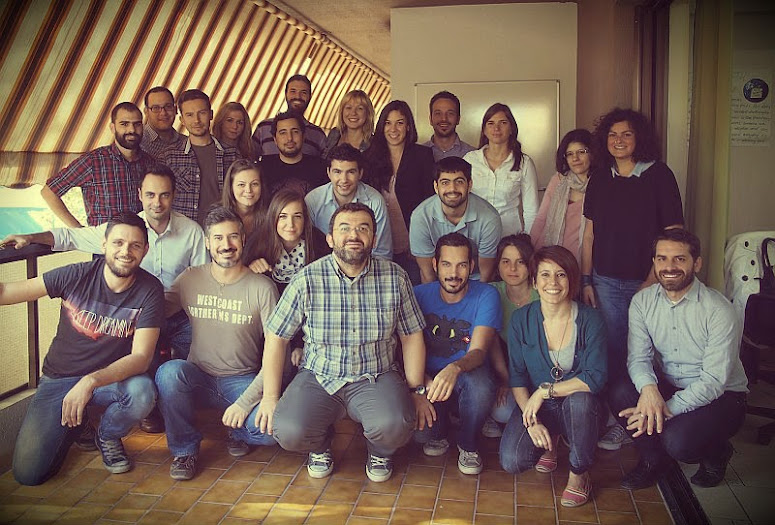
The Agro-Know team, October 2014. We are missing Giannis and Laura (both of them traveling at the time of the photo shooting)

This means that a lot of new blood runs in the veins of Agro-Know now; of course we miss some of our experienced ex-colleagues but we hope that the new team members will make up for it with their fresh ideas and enthusiasm. The new situation is challenging, as a lot of new people need to be trained not only in terms of their work tasks but also in terms of the mentality and culture of Agro-Know; a factor that is actually more important than it looks/sounds as there is also the possibility that some people might not fit.

There used to be a special "chemistry" among the Agro-Know team members; especially those of us who started together when we got in the Agro-Know offices for the first time in January 2011 went through some hard times, a fact that brought us closer. We managed to evolve a rather unorganized team into a well-defined organization throughout , with well-defined processes, where a lot of time-consuming processes are now automatically taking place and are taken for granted. As the team grows bigger with new members joining, we tend to lose our chemistry due to growing responsibilities, lack of time and the fact that processes now are more formal and "professional". New members are not aware of all that and all they see is this new, well-defined and organized situation; this does not allow them to see the background behind everything but only the strictly professional side.

However, this is a bet that we need to win, as the proper functionality of the team is heavily based on this special relation between us all. We need to embrace our new colleagues and help them understand things, integrate quickly and help them understand and integrate in the Agro-Know culture in order to ensure that the team will remain strong and work as it used to do for the last years. This is mostly a responsibility of the initial members (to help our new colleagues on and of course of the new members to understand and respect in order to keep things going as they should...

Thursday, October 2, 2014

Agro-Know internal training: Using the Agro-Know blog

Following up on the AK trainings' topic, my time came for organizing and delivering a seminar to my colleagues. The seminar was about using the Agro-Know Wordpress-based blog, in an effort for me to persuade my colleagues to start sharing their news and updates through this corporate blog. The effort for delivering the course was a long story but for several reasons it was always postponed. This time we managed to organize everything in only a couple of days and on Moday I found myself presenting my slides before nine of my colleagues who expressed interest in attending the seminar - I would like to thank each one of them for their interest in the specific training.
The process was the usual one: Describing the seminar through a Trello card in the dedicated board for the AK trainings, deciding on the most appropriate day and time through a Doodle poll and delivering the seminar face to face in the Agro-Know meeting room.


Through my slides I tried to provide a short introduction to blogs and blogging, describe our Wordpress installation and then went straight to the point: How could one get ideas to write about in the blog and how to actually use the Wordpress environment for transforming his/her ideas into an interesting blog post. As I am currently maintaining three blogs (one personal, one professional and the Agro-Know blog), apparently I have no issue finding topics for my posts but still I understand anyone who gets stuck in this part so I tried to provide some ideas on getting ideas for a blog post. In addition, I demonstrated how a boring text-only post can be much more interesting through the embedding of multimedia files (e.g. images, presentations, videos, even tweets and Facebook posts).

vprot_Wordpress_seminar

The presentation was nothing special or fancy; each slide was mostly based on my personal experience while I got some ideas from related posts and websites I have visited during the last years. However, I hope that through this presentation my colleagues will be motivated to be more actively involved in the blog, contributing their own parts both as blog posts and comments in existing posts, leading to creative discussions. I have to admit, that encouraging my friends to start blogging is one of the biggest challenges I face as I am really keen on seeing the Agro-Know blog being even more frequently updated with the contribution of everyone in the team!

P.S. Special thanks to Dimitra for pushing me with that (I was rather disappointed from my previous attempts to organize the training) and for taking the only photo from the event as well as to Athina who took care of the practicalities and helped me a lot!

Sunday, June 22, 2014

Making a (brand new) start in Agro-Know

Let's start with the basics: I am an agronomist with a PhD in Agricultural Biotechnology and I have experience in metadata and digital repositories, as well as related stuff. Due to some internal re-organization in Agro-Know I have recently switched to another position, moving from the data team to the business development one. This means that I have to finish all my data-related pending tasks and delegate the ongoing ones to my colleagues in the data team. From now on, I will deal with issues related to the marketing of Agro-Know, related networks, the social media of AK as well as marketing material.

I have to admit that it is rather awkward, as I have been working with metadata, digital collections and related topics since I started working with EU projects, some 5 years ago. At the same time, it is really challenging, as I will get to work more on stuff that I really like, such as blogging, social media etc., while I will also check my ability on handling stuff like printed marketing material, communication with graphic designers and web developers, stuff that I am not really comfortable with. I guess that this transition is fully compliant (and a result I would say) of the fact that in AK everyone gets the opportunity to be more involved in what he/she really likes and less in things that he/she would rather avoid - see the related blog post here.

It is strange how I ended up in this new placement; through my involvement with the dissemination of the projects that AK was involved using social media and the fact that I keep this blog for describing mostly what I am dealing with in my working days, I was eventually made responsible for the AK blog, then for the AK Twitter account, the rest of the AK social media channels and now I find myself in a totally different position in the company.

In any case, this change of responsibilities is combined with a change of working space; I will get to move in one of the more quiet rooms of AK which is pretty cool! I will miss direct communication with my colleagues but I admit that I enjoy the silence more than most of my colleagues... :-P


In addition, this will be an opportunity for me to spend some time on getting rid of things that tend to accumulate on my desk but I don't use; a part of them will be data-related deliverables, notes etc. but I suppose that I will be surprised by what I will find among my stuff!


Messy desk, and this is only a part of it!


Saturday, April 5, 2014

Meeting Christopher Brewster

As mentioned in my previous post, I had the pleasure to meet Dr. Christopher Brewster at the European Data Forum 2014, which was held in Athens, Greece between 19-20/3/2014. Dr. Brewster is a lecturer at Aston Business School, UK and among the variety of his research interests, there are two that we share; Knowledge Representation , Semantic Web and Agriculture and Food Supply Chains (well, it seems that they are at least three!). Among others, he was actively involved in the Smart Agri-Food project  and is currently involved in the FI Space project.

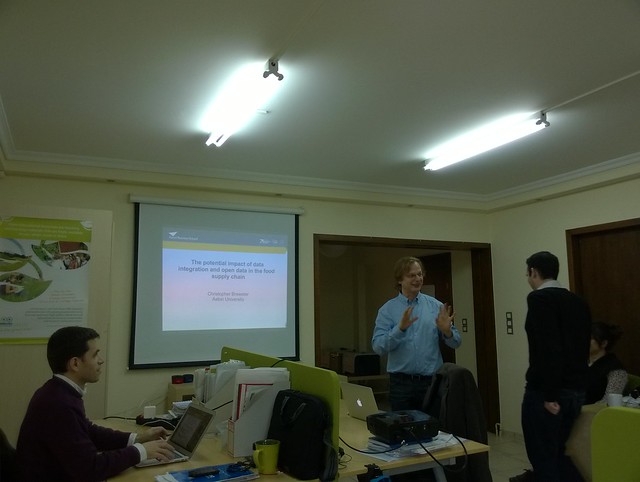
Dr. Brewster during the presentation

Dr. Brewster was kind enough to accept our invitation and visit the AK offices on Friday 21/3/2014, where he made a really interesting presentation, titled "The potential impact of data integration and open data in the food supply chain". The presentation discusses the issue of food supply chain data, taking into consideration aspects such as open food data, mentioning data platforms, initiatives and standards, legislation, the status in various EU countries etc. After the presentation we had the opportunity to spend some time talking about the issues highlighted in his presentation and present our feedback on these and I hope that we will have the opportunity to collaborate in the near future.

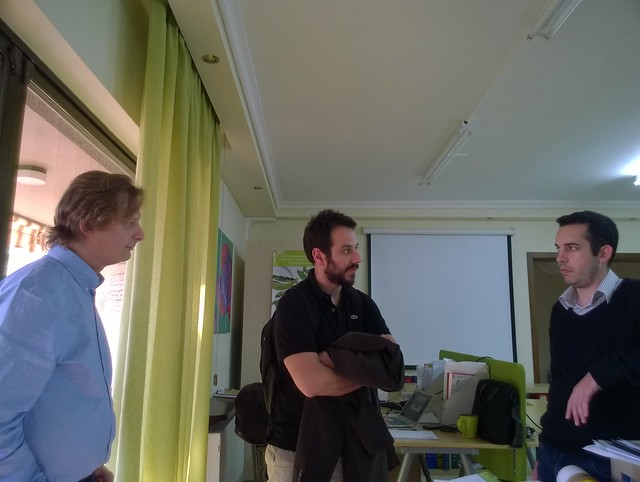
Dr. Brewster, Nikos and Andreas exploring possibilities for collaboration

Tuesday, February 25, 2014

About the Agro-Know blog: First three months

It was about three months ago (end of November 2013) when we had a discussion with +Nikos Manouselis about various AK-related stuff and I was delighted to hear that he was in fond of starting our corporate blog - not only that, but he would leave everything to me to design and implement. It seems that Nikos has been following my blog (the one that you are reading now) for the last months, he liked it and he would like to see something similar for AK.

In about 10 days we had everything up and running, with the precious technical help of my colleague Stauros Gkinis: the latest version of Wordpress was installed in one of the AK-owned servers and an FTP was setup for installing themes and plugins. Since we opted for a self-hosted blog, we had to skip my favorite Blogspot or even the promising and easier to use Tumblr. It took me some days to set up and customize the Wordpress installation by selecting a green theme (related to the scope of the blog), install plugins for sharing posts through social media, set up an analytics account for the blog etc. On November 27th, 2013 the blog was online and public! Of course a number of revisions were performed until now, based on the actual use of the blog, and more are expected to take place eventually. I like to experiment with new interfaces and plugins and as an admin of the blog, I have the opportunity to do so every now and then.


The content of the blog consists of posts about AK-related events, reports from project meetings and trips, interviews with friends of AK as well as interviews with the AK team members (who are asked to expose themselves in the "Know Agro-Know" series!). I should not leave out the really interesting posts with personal views, usually on topics that the AK team is working on, like open and linked data, green topics etc.

I was recently informed that the blog had to be placed in a more powerful server due to increased traffic which caused issues to the proper functionality of the other services hosted in the same server; that was good news! Indeed, in less than three months from its launch, the blog has 48 blog posts from 9 different authors and 37 comments. It has received almost 1,500 visits and more than 3,200 pageviews from about 500 unique visitors coming from 34 different countries. The best part: More than 66% of the visitors are returning ones, meaning that they like what they see and they come back to check!


I am proud of what the blog has achieved so far and I am sure that it will get better and better day by day with the precious help of all collaborators; the more it will be used, the better it will be. You can check out the Agro-Know blog here.


Thursday, January 30, 2014

AK celebrates with the New Year's cake: To kopi ti pita!

One of the nice Greek traditions is the celebration which takes after the New Year's day (in the next weeks/months in fact), where a family gathers and celebrates the New Year by sharing equally cut pieces of a special cake. This cake is called "New Year's cake" internationally and "Vasilopita" in Greece. In this direction, AK as a big family who respects traditions, had this nice little celebration in the office last Tuesday, where everyone participated and partied.
AK New Year's cake
The nice thing is that each vasilopita contains a coin; this coin not only brings a year of good luck to the one who will find it in his piece of the cake, but is usually accompanied by a nice present! This year Dimitra found the lucky coin in her piece (she was also the one who brought the cake to the office; strange coincidence, huh?) and apart from the luck she got a nice present from our good friends at Orbita travel agency.
The lucky coin!
There was a small party at the office, including long-time-missed informal discussions and we got to see almost all the team again (apart from Mada, who was greatly missed...); even Babis made an appearance after a couple of weeks on leave due to health issues! This provided the opportunity for another family photo, as you can imagine...
AK family photo - January 2014
Additional photos from the event (small selection; sorry for that!)
P.S. The "To kopi ti pita" part of the title (Kopi tis pitas in proper Greek) is an extremely common expression in Greece, while it is not a Greek phrase; instead, it was a bad moment of a foreigner jewellery seller who wanted to refer in the celebration during his Greek TV show but he failed to do so in proper Greek (of course we understand; it sounded Greek to him!). After that, he managed to make this expression the standard one when referring to the celebration.

Tuesday, January 14, 2014

Agro-Know on the move (Part II)

Well, today was one of these days, when a large part of the AK team is travelling on the same date. Nikos Manolis, Andreas and me found ourselves on the same flight without even knowing; my colleagues travelling to Budapest for the agINFRA project meeting while I was travelling to Birmingham for the Organic.Lingua 7th project meeting - both flights through Munich (the common part of our trips). Nikos Marianos had taken an earlier flight to the UK for the Organic.Lingua meeting, Giannis would join us on the following day while Babis had to cancel the trip he was sharing with Andreas and Nikos Manolis due to health issues. Needless to say that during the 14th-17th of January, the AK office was half-empty (or half-full, from an optimists point of view!).

I arrived earlier and managed to get in the lovely Aegean lounge at El. Venizelos airport, which provided a quiet environment, fast wireless internet and coffee/snacks; an ideal place to work before getting on board and much more convenient than the gate seats...

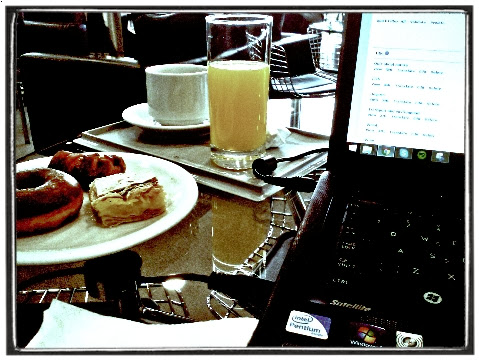
Working in the Aegean lounge

While waiting for boarding, we also met Dr. Vangelis Karkaletsis from NCSR Demokritos, a good friend and partner in the Semagrow FP7 project, who was travelling to Luxemburg for the "Info Day for Big Data and Language Technologies", a part of the Information and networking days - H2020 Work Programme 2014-2015, Connecting Europe Facility. These topics are in at the heart of what all three projects (agINFRA, Organic.Lingua and Semagrow) are working on.

We all flew together to Munich and then separated; I had to rush in order to catch my flight to Birmingham while Andreas and Nikos had some time to spend at the airport before boarding to their flight to Budapest. We all arrived to our destinations safe and well in the end, having some time for last minute preparations for our meetings.

Sunday, January 5, 2014

The relation between success and a Facebook account

Today I came across this tweet from a really funny account:
Then I thought that it is not only funny but also presents an interesting aspect; is really Facebook taking too much of our (precious) time? Is it worth spending quality time on Facebook (and other social media sites)?
Even for our daily routine, Facebook is a useful tool for disseminating our projects and their outcomes, present the updates of our work, share interesting links with people who usually belong to a common group or follow a page. It is a common practice to create a Facebook page or group for each one of our projects and use it to attract people who also use Facebook for professional reasons. I can recall the Facebook pages for agINFRAOrganic.EdunetVOA3ROrganic.Balkanet and of course ISLE (one of the most dynamic project pages), while we also maintain the Green Ideas Project page and the one for the Green Hackathon. Of course Agro-Know has its own Facebook page, which was rather recently launched and is now frequently updated.
On the other hand, Facebook started as a social media site which everyone used for sharing mostly their personal updates, personal photos etc. I notice that sometimes when I log in to Facebook to share a project update in the corresponding page, I see some notifications that I want to check, messages that I would like to respond etc. Generally, I believe that one could spend hours and more hours on Facebook for browsing news, updates and even chat. As a result, I tend to avoid using Facebook even for professional purposes, at least during the most productive hours of the day.
After all, Nikos and Giannis, both AK CEOs and people that I personally consider successful, do not have Facebook accounts (ok, Giannis has one, but it seems to be in hibernation). Is it just a coincidence or a fact, according to the aforementioned tweet? Have they consciously chosen to refrain from spending even the slightest amount of time in this social network and instead focus on their professional goals or are they just too busy to notice the Facebook avalanche?

Friday, December 20, 2013

The Agro-Know Christmas party – 2013 edition

Next an interactive session during which everyone was invited to say some nice words (not especially difficult) for a specific other colleague (it was kind of a lottery, person was defined by drawing a paper from a pool of similar papers). This was nice, it went out of saying typical things about each other and at some point things got rather emotional... we're a big family after all! This part also included some well-accepted corporate gifts - big thanks to AK for that!
The AK team - more like a big family!

Then it was time for the real party; everyone shut down their laptops and we headed to Kimolia Art Cafe. Nikos Pal. was already there expecting us. The well-know Red Room was booked for the AK team, along with additional tables in the next room (the AK team gets bigger and bigger). Everyone was relaxed so it was a nice opportunity for informal discussion (along with the usual boring discussions about projects etc!). Beers, home-made glühwein and cocktails were served, along with some really tasty snacks (you gotta try the club sandwich and chiabbata sandwiches). A lot of photos were taken but you have to live with these few ones for the time being until we process the rest - so please come back again! ;-)

The AK team wishes you merry Christmas!
Next week will be strange, as some people will be on vacations so the office will be half-empty; this made the specific timing the most appropriate available. Next family event? The new year's pie gathering, which is expected in early January 2013!

P.S. Stauros was already on holidays and was greatly missed (but frequently mentioned); on the other hand, we managed to have Mada participating in the first part of the event through Skype video call!

Monday, December 2, 2013

Intro Course to Big Data / "Introduction to Data Science for Agriculture"

The course "Introduction to Data Science for Agriculture", was held on Friday, November 29th, 2013 at the Institute of Informatics & Telecommunications (IIT) of the National Center for Scientific Research (N.C.S.R.) Demokritos, in Athens, Greece. It was the first part of a modular event which also consists of the following parts:
  • a Training Day which will be held on Thursday, December 12th, 2013 at the same venue, during which the participants will be trained on the tools and technologies to be used during the Athens Green Hackathon 2013 and
  • Athens Green Hackathon 2013, which will take place from Saturday, December 14th, 2013 to Sunday, December 15th, 2013 at the coLab Workspace in Athens, Greece.
You can find more information about the events at the Agro-Know wiki page.

Dr. Vangelis Karkaletsis (NCSR Demokritos)
The course started with an introduction by Dr. Vangelis Karkaletsis, Research Director of IIT of NCSR Demokritos, who provided an overview of the event and the background of IIT, followed by Angeliki Papageorgiou (Agro-Know Technologies, the organizer and contact person for the event) who explained the structure of the modular event and explained all necessary practicalities. The participants (about 35 people) had the opportunity to introduce themselves and explained why they chose to apply for the specific course. I was amazed by the fact that people with so different educational backgrounds were interested in the specific course; starting with agronomists, there were also mathematicians,statisticians, chemists and biologists, as well as web and software developers, ICT specialists and managers. This is exactly the audience that was needed for providing a trans-disciplinary dimension to the issue that we need to address during the hackathon; combining people with expertise in so different domains will surely provide really interesting ideas and outcomes for the hacking!

Angeliki Papageorgiou (Agro-Know Technologies)
Antonis Koukourikos (NCSR Demokritos)
The first presentation came from Antonis Koukourikos (Research Associate of NCSR Demokritos), who provided an interesting introduction to big data and their connection to linked data / semantic web. The case of the POWDER (Protocol for Web Description Resources), a protocol for publishing descriptions of (e.g. metadata about) Web resources using RDF, OWL, and HTTP developed by the IIT team and currently used in the SemaGrow project was also discussed.

Me, presenting the Drivetrain approach


The next presentation was delivered by me and discussed about data products and how they can be designed using a specific approach called "Drivetrain approach", also including a number of application case studies (outside the agricultural sector). My presentation was heavily based on an excellent report titled "Big Data Now" (2012) by O' Reilly, which as an amateur in the field of Big Data found excellent for providing an introduction. Related information can also be found in the O'Reilly web site, in the form of an easy-to-read article.


Dr. Charalampos Thanopoulos (AK)
The last presentation of the first day was delivered by my colleague in Agro-Know, Dr. Charalampos Thanopoulos, who discussed the issue of big and open data in agriculture. In addition, he provided a number of cases where data problems in agriculture were addressed with the use of the Drivetrain aproach. His presentation included really interesting data coming from various sources, as well as some nice case-studies of Greek companies activated in the agricultural sector.

After a short lunch break, it was time for the Creativity Workshop (an interactive session) on the development of (big) data products: Using the cases of Apivita and Stevia Hellas (two Greek companies) as a basis, participants were divided in two groups led by Angeliki and Babis respectively and were asked to provide ideas on the development of added value data services for the two companies, focusing on their websites. The session consisted of three parts:
  1. Identification of data types and formats which might be useful for each case;
  2. Discussion of current issues or ideas for improvement, in the form additional services for the customers of the two companies;
  3. Development of one idea per team (each group was divided in teams of 2-3 people), based on the ones already discussed. Design was depicted in A4 papers (initially) and flipchart sheets (at a later stage);
  4. Presentation of each team's idea to the participants of the event.
Participants of the Intro Course
During the Creativity Workshop 


Overall, I found it to be a really interesting experience, especially taking into consideration that this was my first presentation on big data. I really enjoyed discussions with participants, who brought fresh ideas and different approaches to the event. It was also really nice to see my colleagues Andreas Drakos (facilitating the interactive session) and Elena Kokoliou (documenting the process and supporting the organization) during the course, as their help and contributions were really valuable. I would also like to highlight the participation of Anne Bruinsma from the Netherlands who made this long trip in order to participate and explore opportunities for affiliation and future collaboration.

Friday, November 29, 2013

ODS Webinar 1: "Green Learning Network (GLN)"

The Open Discovery Space project (ODS) deployed a number of Webinars in order to allow stakeholders external to the project to get familiarized with the project itself and its outcomes. One of these webinars was titled "Green Learning Network (GLN)" and was of special interest to the Agro-Know team, as we are the ones actually working on this network, taking care of its various aspects like quality and expansion.


+Madalina Ungur was the facilitator of the specific Webinar, to which more than 70 people were registered and it was actually attended by a high percentage of them (exact number to be confirmed soon). Questions were made using Twitter and the "#ODSwebinar" hashtag, while the presentation itself can be found in Slideshare:


The recording (video) of the presentation can be found in YouTube:


Despite the fact that I am involved in GLN, I did not have the opportunity to attend the Webinar, as I was attending (and presenting at) the Big Data in Agriculture training course which also took place on Friday. However, I will try to keep myself up to date with everything that happened during the Webinar.

Sunday, November 10, 2013

About time management

Time management is really crucial when working with EU projects; there are deliverables to be delivered on time, communication to take place at certain points, coordination of tasks and people/teams, and any other task to be completed on a specific time. This means that every minute counts and so you need to be sure where to allocate your every minute, every day.

One example is the time spent during the business trips. We tend to travel quite often and sometimes the trips take a lot of time; let alone the time in between flights. You cannot be online during the flights and sometimes there's no internet available at the airport (at least not free wifi). This means that only offline tasks can take place during this time.

- Preparing slides for the presentation you are going to make or going through the presentation for any last-minute revisions
- Reading deliverables, papers and notes taken during the previous days
- Replying to emails and have them ready to be delivered as soon as internet is available
- jot down notes about the ongoing tasks, organizing work and planning future activities/tasks

I find the use of a paper notebook very convenient during flights,where space is limited (sometimes even for my small netbook). It helps me put down my ideas, create To-Do lists, organize my tasks etc. I can even go through the notes taken during internal meetings and propose ideas. I have spent time during flights to revise deliverables by noting comments in the printed version or read interesting publications printed before I left office. In other cases I used my netbook to go through the slides of a presentation and make revisions. I have to admit that I still prefer reading from hardcopies over the digital form of a document using a tablet or the netbook.

Working during a Conference: Keeping notes, taking photos and keeping hydrated.
When online, you can download emails and send the outgoing ones, check for information online, download documents and material you need when offline. This is really useful when you have ongoing communication and you need to respond ASAP. In this case, an online break at an airport between connecting flights allows for being updated on the latest responses to a communication through email.

Another thing to take into consideration is the reliability of digital devices. Sometimes it's useful to have a hardcopy of digital documents (like deliverables or maps), as battery-based devices tend to fail when you most need them. I have found myself in situations where the table ran out of battery while I was trying to check the map for going to the meeting place while in another case the netbook shut down while I was revising my presentation. On top of that, it's always easier to take notes on a printed document compared to its digital format.

I find it really important to take advantage of travel time in order to go forward with my tasks; otherwise, they will require additional time at the office (which sometimes is not an option) and I will probably find myself lagging behind the tasks and deadlines. The better a trip is organized in advance, the less time you need for getting to your final destination (e.g. hotel room, meeting place etc.) so there's more time for working on other stuff. This will also save you from frustration.

Working during the flight; a case of combining digital devices and hard copies in a limited workspace

Of course, when travelling to new places sightseeing is also an option that I cannot resist, especially when I have a nice guide to help me see what I would like to see and save me from wasted time wandering around. I like to blend with local people (e.g. always use public transportation and avoid taxis), visit the traditional (and not always the touristic) part of the places I visit and be a part of it instead of being an external observer. This is a luxury that I still allow myself to try!

Tuesday, November 5, 2013

Agro-Know on the move - Keep on travelling!

Ok, it is in the nature of our work to travel quite often (project meetings, dissemination events, participation in Conferences etc.), but sometimes this is getting too much (or too funny!); for example, due to our frequent trips, many of us in AK tend to be away from office at the same time and this week is one of these cases:
  • Andreas is currently in Australia, participating in the 3rd EU-Australia Research Infrastructures Workshop, which takes place between 4-8 November 2013, at Canberra, Melbourne, Australia.
  • Laura and Nikos are currently in Vilnius, Lithuania, in order to attend the ICT 2013 - Create, Connect, Grow, in Vilnius on 6-8 November 2013, focusing on Horizon 2020 - the EU's Framework Programme for Research and Innovation for 2014-2020.
  • Another Nikos and me are travelling to Brussels, Belgium in order to attend the 10th EdReNe Conference, which takes place between 7-8/11/2013 at the EUN premises.
I guess days like these are much quieter for those staying back at the office; I surely appreciate such days when I am at the office while others are travelling.

Lovely logo for the ICT 2013 Conference

This also reminded me of the summer of 2011, where I spent three weeks in a row out of office, travelling for the Organic.Balkanet project meeting in Maribor, Slovenia (28-30/6/2011), the ISLE summer school in Malta (4-8/7/2011) and the EFITA 2011 Conference in Prague, Czech Republic (11-14/7/2013). I only had the weekends in between in order to get back home, get some clean clothes and get back on the road again! 

I really love travelling so I do not mind; sometimes I find it amazing how automated this process has turned into so I can pack and get everything ready for a long trip in a couple of hours. My packing skills have also advanced over the years, allowing me to take only the necessary stuff with me (even though I am usually tempted to fill any space available in the suitcase with additional stuff, just in case). I know which airplane seat to choose and why, how to take advantage of the time during short and long flights (reading/taking notes/preparing my presentations and using my netbook respectively), what to do in between flights, how to select a nice hotel within the available budget, how to adapt to new environments, small hotel rooms, find the best way to travel from an airport to my hotel and vice-versa. Of course this takes some time in planning before the trip, explore available options, take notes and print maps but it worth every minute of it as it makes travelling much easier.

Working in the woods! Leuven, Belgium
Sometimes (unfortunately not frequently) I get to find some free time during the trips to go for long walks, sightseeing and taking photos; I usually find myself in such a tight schedule that I hardly find enough time to sleep. In any case, each trip is different and it's always an interesting experience to visit new places - challenging might also be an appropriate word for that! I have found myself working in benches in the woods (during the VOA3R preparations for the 2nd review meeting in Leuven), trying to connect to wifi in hotel lobbies after midnight, squeezing myself next to a snack dispenser in the Sofia airport in order to plug my netbook to the only power source available, working while relaxing in Star Alliance lounges, missing my only mean of transportation and looking for alternatives on the fly, trying to understand why I do not have a hotel room while I have the voucher in my hand and so on. These memories are not to be forgotten in any case ;-)