Friday, May 29, 2015

GODAN Discussion Paper presented at IODC 2015

Things are not always like this; I usually get involved in typical tasks that have impact within a research project or a community.

However, this time things were different: With some help from the Agro-Know team (that provided me with the time needed for working on that), a great collaboration with many people in a short time (about 20 days!) and really hard work we managed to deliver a decent GODAN Discussion (ex-White) Paper that was presented yesterday at the Open Data Conference 2015.

This morning I checked out what has happened during the 1st day of the Conference, mostly browsing through tweets. This one draw my attention - the first slide of the presentation about the GODAN Discussion Paper, presented by Liz Carolan from the Open Data Institute.

This was more than I expected: Seeing my name in a slide presented to the participants (which btw are really important stakeholders of a global community) of an International Conference like this one was a great honor: I have presented papers and concepts myself in similar cases, but seeing my name as one of the authors of the GODAN Discussion Paper was something much more than that - priceless I would say! :-)

That's it; I am sold!

Big thanks to everyone at the lovely ODI team but mostly to Fiona Smith for the excellent management & organization of the work that needed to be delivered in such a short time & Liz Carolan for believing in me. Big thanks also to Martin Parr (CABI) for his help whenever needed and the rest of the GODAN Secretariat (Ben and Ana), as well as to everyone who responded to my requests for input to the report. I know that there are things that could have been different in the paper (I already have some points in mind) but taking into consideration the tight deadline this was what could be delivered in this short time...

I hope that this will be the first step to something even bigger, as I saw some really promising requirements coming out of the related discussions during these days :-)

P.S. The Discussion Paper is now publicly available for download through the ODI website. Feel free to download, study and comment.

Friday, May 22, 2015

The GODAN White Paper is (almost) ready to go public

It has been more than one month since I started working as an external consultant/researcher for the GODAN White Paper, after my application for the corresponding GODAN/Open Data Institute call was accepted - this work is now over.


Since then, there has been a lot of work (and I mean a lot!) in the context of this report: I identified more than 30 use cases making use of open agri-food and nutrition data (less than half of them made it in the final version of the paper - I admit that some of them were weaker than the others), drafted additional parts of the paper, collected more than 40 related references (including publications, articles, blog posts, reports, presentations etc.), interviewed several people looking for substantial feedback in terms of insights and quotes for the potential and current issues of open agricultural data, compiled lists of open agri-food datasets, data sources and other types of resources (like repository software, data management software and other tools), collected quotes and other bits from the preliminary GODAN survey results  - this was a time-consuming analysis that was reported in about 35 pages, including text, lists and tables (also some images and screenshots at some point). Use cases were elaborated, revised & re-written, additional drafting of text was required in some instances, details were needed for vague use cases, formatting of text and so on.

What I really appreciated throughout this process was the fact that I had the opportunity to get close to some really important people working with open data, such as Dr. Daniel Jimenez from CIAT (The leader of the winning team of the United Nation's 2014 Big Data Climate Challenge), Dr. Glenn Hyman & Andrew Farrow from AgTrials, Gerber Roerink from GroenMonitor.nl (the last three through the precious introduction and help from SemaGrow partner Dr. Sander Janssen), Graham Mullier (Head Data Sciences, R&D IS at Syngenta), Christopher Brewster (an old friend from Aston University, with experience in open food data) as well as Dr. Shaun Hobbs, the Director of CABI's Plantwise Knowledge Bank (I hope I am not forgetting anyone here!). All of them have made a significant impact in their fields so I felt honored to have the opportunity to get in touch with them.

I also felt really glad to have the opportunity to work with the ODI team on the development of this report; Liz Carolan had the overview of the work and was the person connecting the team working on the report with both the GODAN Secretariat (CABI) and the ODI Execs, Fiona Smith was my project manager, ensuring that my contributions would always be according to the (tight) schedule and acting as my contact with the rest of team (and the GODAN partners several cases); on top of that, ensuring that all bits and pieces would nicely fit in the report, Anna Scott did her magic with copy editing - transforming typical text into high-quality, catchy and easy to read one, Ellen Broad contributing her open data policy parts and experience and there were even more involved! As you understand, this was a great collaborative work, which also included previous input from Tim Davies, and help from Ben Schaap and Ana Brandusescu (WUR/GODAN Secretariat through CABI). Big thanks to everyone for their contributions and help!

All work took place through a GDoc where everyone from the team was invited to work by drafting text, editing, suggesting and commenting; I found this to be a really efficient way of developing a document. Additional (and frequent) communication took place through emails and Skype calls; this allowed to stay connected with the rest of the team and ongoing work, despite the fact that I was remotely working (I didn't manage to visit the ODI headquarters, even though I'd love to).
The White Paper (which has now been renamed to Discussion Paper) is currently open for comments to the GODAN partners (sorry, not publicly available yet!) and is almost ready to go into printing; it will be publicly announced and presented during the Open Data Conference 2015, in Ottawa, Canada in less than one week (28-29/5/2015)!

If you ask me, it was a great experience that allowed to me to get in touch with some really nice and interesting people and contribute to a report that will have significant impact at a global level; what more could I ask for? :-)

Saturday, May 16, 2015

A discussion about CABI's Plantwise

Plantwise is a global programme, launched back in 2011, working to increase food security and improve rural livelihoods by reducing crop losses. Plantwise is led by CABI, an organization with over 100 years of experience in agricultural research. The Plantwise team is working closely with national agricultural advisory services and establishes and supports sustainable networks of "plant clinics", run by trained plant doctors, where farmers can find practical plant health advice. The whole approach is innovative and seems to have a significant impact so far.
At the core of Plantwise there is the The Plantwise Knowledge Bank: a huge database containing a wealth of knowledge related to plant pests (mostly in the form of factsheets), which provides country- or region-specific plant health information. What is interesting is that this knowledge is constantly updated; not only from the CABI side, which adds new resources related to plant pest infections, but also from the plant doctors who actually create new factsheets on a regular basis based on the incidences that they meet and address as part of their work

About one week ago I had the pleasure to get engaged in a really interesting discussion with Martin Parr, a man with many hats: he is the 
Operations Director for the Global Open Data for Agriculture and Nutrition Secretariat (GODAN), he also works in CABI’s Knowledge Services for International Development and last but not least, he is the Head of Open Data at CABI. Martin is a long time acquaintance (we first met during the RDA 3rd Plenary Meeting in Dublin, Ireland in March 2014, and then again one month later, during the CIARD/GODAN Joint Consultation in April 2014). Martin was kind enough to bring me in contact with Dr. Shaun Hobbs, Director of the Plantwise Knowledge Bank. The reason for this discussion was for me to get some information about the data sources of the Plantwise Knowledge Bank, the transformation of this data into Factsheets and then the sharing of the data with the plant doctors and farmers, that I could use for the research I was conducting in the context of the GODAN White Paper.


Plantwise + IPPC side event at CPM9 in Rome- April 2, 2014 from CABIslides

During the discussion I had the opportunity to get a lot of information on the sources and the use of data, the licenses, the agreements with governments for the use of governmental data and the combination of publicly available data with private ones, a fact that raised some issues for sharing the processed information. I was also guided through the process including the development of the Factsheets, their use by plant doctors in the plant clinics, the role of the tablets in the process (replacing paper and computers at the same time), the collection of data produced by the pant doctors and how they are used for keeping the Knowledge Bank updated and many other interesting things.
However, what impressed me most about this discussion was how passionate both of them were about their work and Plantwise in general and how knowledgeable they were, explaining every little detail to me, adding pieces every now and then, going into even more details and being excited about sharing their work with me. I felt really glad to be able to meet both Martin and Shaun and to be engaged in this interesting discussion.

If you want to learn more about Plantwise, you can check out the Plantwise website, Plantwise blog and social media (Facebook, Twitter and LinkedIn) - you can also check out the Plantwise Android app as well as a recent report on the use of digital technologies in the processes.


Saturday, April 25, 2015

Getting a contract for working on the GODAN White Paper

Back in early April 2015, the Open Data Institute (ODI) published a call for tenders "for an experienced researcher to work on a research report on the potential impacts of open data on global agriculture and nutrition". The researcher would support a team at the Open Data Institute (ODI), which would provide the guidance as well as the overall editorial oversight, leading this research initiative as part of the Global Open Data for Agriculture and Nutrition Initiative (GODAN). The researcher would have to "contribute research support to a high level White Paper report which will outline the potential for open data to be applied in the agriculture and nutrition sector, and compile any existing examples or case studies", as the call mentioned.

Agro-Know is one of the first GODAN partners and I have been involved in agricultural research for quite a long time (keep in mind that I have a PhD in Agricultural Biotechnology and I have spend almost 13 years in the Agricultural University of Athens); let alone the experience gained and connections made in this context through my 4,5 years of working for Agro-Know. To make a long story short, after a team discussion in Agro-Know, we decided that I should apply.What I needed was an updated CV, a costed proposal (also acting as a draft working plan - thanks to my colleague Babis for helping me with that) and some short text supporting my position. I took some time to prepare what was needed and sent everything within the deadline (7/4/2015).


I was surprised to receive feedback through email from the ODI team; mostly because I was on short vacations thanks to the Orthodox Easter and was more or less in idle mode. However, I responded quickly, provided some additional documents and clarifications on Good Friday and I was delighted to have a Skype call arranged on Clean Monday (or Ash Monday). There I had the pleasure to meet Liz Carolan and Fiona Smith from the ODI team and in fact be interviewed for the position. It seems that it went pretty well (I also enjoyed our discussion) so I was informed a couple of days later that we could start working on the GODAN White Paper together!

That was great news; it would be great for me to get to work for GODAN (even as a consultant/external researcher), a really important global initiative with tremendous potential and influence. I had the pleasure to attend (and actively contribute to a couple of sessions) the 1st CIARD/GODAN Joint Consultation meeting last April in Rome. I was amazed by the potential of this initiative, which was founded by the governments of US (USDA) and UK (DFID), among others, and had a clearly defined and high-level agenda.

The work for the GODAN White Paper will take place between 13/4 and 15/5, so there is pretty little time to work on something that important. This means that I need to understand really well what is expected from my side as work and input and prioritize work - make room in my packed schedule, too (and thanks to Agro-Know for that!). It seems that it's going to be a challenging but really interesting month ;-)

Sunday, March 29, 2015

Andreas leaves Agro-Know

A couple of weeks ago, our colleague Andreas announced that he would leave Agro-Know after exactly 2 years in the company; that was really sad, as +Andreas was one of the nicest persons in Agro-Know. Despite the fact that he joined Agro-Know a couple of years after we established our main offices, he quickly became one of those colleagues who contributed in this special connection between the Agro-Know team members and he was usually the one trying to find opportunities to celebrate and bring the team members even closer.

I still remember his first days in Agro-Know: Sitting at a desk between Babis and me, he was trying to get some hints on what he actually had to do, while Babis and me remained silent during (almost) the whole day (something that surely made him feel rather awkward)! It was back in a time where new team members were really few and seeing a new person in the team was quite something; we didn't have the opportunity to see new faces that often and we were somewhat reserved regarding our reactions towards new people.

Andreas started by supporting some small LdV projects that Agro-Know was participating in (like AGRICOM and ISLE), then he moved on by coordinating our participation in projects like Herbal.Mednet and he ended up directly supporting the coordination of large projects like agINFRA. He managed to evolve really quickly and meet the challenges of the position of a project manager in Agro-Know (which, trust me, is very demanding... been there, done that!). He was always a great guy to work with; calm, confident and always aware of what had to be done, by when etc. - he knew when to put effort in something and when to deliver it with the minimum effort needed so he was no source of overhead. He was a "jack of all trades", as he was always eager to work on anything related to his job, including project management, project deliverables, papers/submissions, contribution in events - literally anything that you may think of. He traveled a lot, met a lot of new people, represented Agro-Know and UAH in several occasions and he was creating opportunities for collaboration with new organizations.

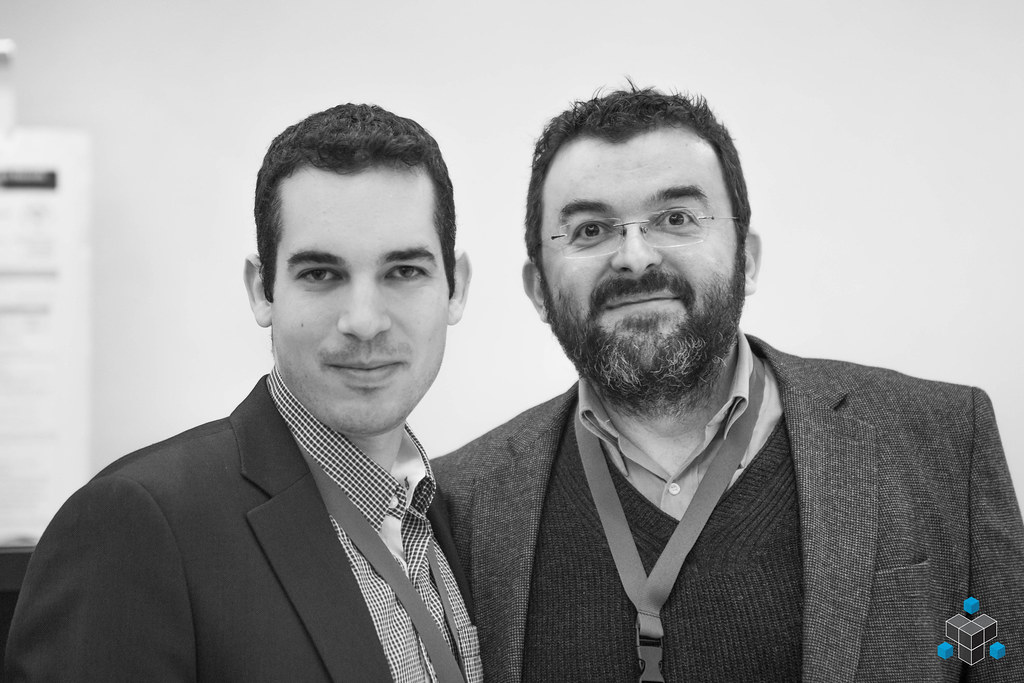
Andreas & me during EDF 2014 (source: https://www.flickr.com/photos/lod2/13433089254/in/set-72157642967653084) 

Andreas decided to leave Agro-Know for his own reasons. He explains some of them in a really nice farewell blog post on the Agro-Know blog (because he was also one of our top bloggers). I wouldn't want to go into details but the point is that it was a tough decision to leave Agro-Know and I totally understand that. We already miss him and I am sure that he also misses his Agro-Know colleagues; it is this special chemistry that exists mostly between the older members (and I am nor referring to age here!) and we try to pass it on to our numerous newer members as well. However, this change was for a good cause so we are all happy for Andreas.

His last day at the office was a celebration: He went on with his work, handing over anything needed to his Project Management team mates, sorted out some last-minute tasks, he made a really great presentation which was (among others) an overview of his 2 years in Agro-Know and ended with a lovely slideshow of images during this time. He was kind enough to share a home-made chocolate cake with us, combined with a marvelous bottle of Martini Asti (it was the first time I tasted it but surely not the last!).


During the last day of Andreas in Agro-Know

I just want to wish Andreas good luck with whatever he is doing and the best for his new ventures in a much larger company!

P.S. I feel that I have to mention that Andreas was also a Qwertee addict; we had made a number of joint orders during their Insanitee Sales and I am sure that this tradition will go on during the next months ;-)

Saturday, March 14, 2015

Info Day on the «Marie Sklodowska-Curie» actions in Horizon 2020

Marie Curie actions logoOn March 12, 2015, an Info Day on the funding opportunities of the Marie Sklodowska-Curie actions in the context of the Horizon 2020 was organized by the Centre for Research & Technology Hellas (CERTH), the Aristotle University of Thessaloniki, supported by the National Documentation Center (EKT) and hosted at the lovely premises of the Aristotle University Research Dissemination Center (KEDEA), at Thessaloniki, Greece. Since we at Agro-Know are putting our effort in various aspects and calls of the Horizon 2020 programme, we considered this an important event that would allow us to get in touch with the community (mostly researchers) that aims to submit proposals in the context of the Marie Sklodowska-Curie actions. In this context, Maritina and I travelled from Athens to Thessaloniki in order to attend the event and meet the researchers. For those not familiar with these actions, they aim to promote the mobility of researchers both within and outside Europe, transfer of knowledge and attraction of the best researchers from other countries to Europe.
Intro to the Infoday
The event started with a presentation about the EURAXESS Greece Network by Dr. Sanopoulos (CERTH) and the Enterprise Europe Network Hellas by Mrs. Piteli (Praxi Network). Both presentations aimed to provide participants with the required support tools that will allow their networking and increase their funding opportunities.
The second half of the event was dedicated to the presentation of the various Marie Curie funding opportunities through the H2020 programme. Mrs. Annouchka Nabokoff, Project adviser, European Commission, Research Executive Agency. Mrs. Nabokoff presented the various Marie Curie funding opportunities in details and responded to the numerous questions coming from the audience, mostly asking clarifications on the requirements for applying for these calls. You can find the agenda of the event in the EKT website.
Mrs. Nabokoff explaining the Marie Curie calls
The event provided us with the opportunity to contact directly Greek researchers (such as PhD candidates, research stuff and academia from various disciplines) who are interested in applying for funding in the context of the Marie Curie calls; not only we were able to better understand their needs in terms of applying for funding but they were also kind enough to complete a short questionnaire that we had prepared for the occasion,  aiming to collect feedback on how aware these researchers are of the Horizon 2020 Open Access Policy and the Open Research Data Pilot (see this PDF), and which are the major challenges that they meet when preparing a proposal to be funded by the Horizon 2020 programme. This feedback will allow us to fine-tune the services that we are currently preparing, aiming to serve people who would like to get support from experts with the description of an Open Access policy/plan for their proposal, with the implementation of an open access plan in their running research project etc.

Tuesday, March 10, 2015

RDA 5th Plenary Meeting

The 5th Plenary Meeting of the Research Data Alliance (RDA) is taking place at San Diego, CA, USA between 9-11 of March 2015. Following the tradition, Agro-Know is represented for once more at this great event by our colleague Giorgos Papoutsis, our  Data Ingestion Associate who is participating as a representative of the Big Data Europe Η2020 Project and he will focus his contributions to the Agricultural Data Interoperability Interest Group meeting, where he will present the case of the agINFRA project as a mean for connecting agricultural data through an open and participatory data infrastructure. It should be noted that Giorgos is also actively involved in the data ingestion processes of AGRIS.
Giorgos with RDA participants
Giorgos Papoutsis with Prof. Toshihiro Ashino (left) and our agINFRA partner Dr. Xuefu Zhang (right)
I have personally participated in the 2nd (Washington D.C.) and 3rd (Dublin, Ireland) RDA Plenary Meetings but for various reasons I was not able to attend this specific one. It came during a period were we were all busy with the development of our new solution for the Horizon 2020 Open Access Policy (aiming at both proposals and projects) so I missed the opportunity to get in touch with my colleagues attending the 5th meeting. From my previous experience, I can only say that the RDA Plenary meetings are a great opportunity to collaborate with great people all over the world, work on common issues, get updated on topics of interest and of course network!
Despite that fact, I am still closely following (and supporting remotely) the work of both the Agricultural Data Interoperability Interest Group (mostly through the agINFRA project contributions) but also the Wheat Data Interoperability Working Group, where a great handbook for people working with wheat research data is under preparation :-)

Friday, March 6, 2015

Special Track on Metadata and Semantics for Agriculture, Food & Environment (AgroSEM'15)

MTSR 2015 logoThe Special Track on Metadata and Semantics for Agriculture, Food & Environment (AgroSEM'15) will take place between 9-11 of September 2015, hosted at the Manchester Metropolitan University, Manchester, United Kingdom. As usually, the Special Track is collocated with the Metadata and Semantics Research (MTSR) Conference and this is also the case this year: The 8th Edition of the Special Track on Metadata and Semantics for Agriculture, Food & Environment is hosted as part of MTSR 2015.
This track aims to bring together researchers and practitioners that are dealing with theoretical, methodological, experimental and application-oriented aspects of knowledge engineering, applied to agriculture, food and environment. It aims to serve as a discussion forum where researchers and interested experts will present the results of their work, and establish liaisons with other groups that are working on related subjects. In addition, it aims to outline the rich potential of these subjects as an application field for advanced metadata- and semantic-driven systems and services.
If you want to submit your research paper, you will need to do so by May 19th 2015 (using the Springer LNCS style, PDF file submission).
If your paper is approved by the reviewers (and you have registered to the Conference), it will be included in the Conference Proceedings to be published by Springer in the Communications in Computer and Information Science (CCIS) book series (7899). CCIS is abstracted/indexed in DBLP, Google Scholar, EI-Compendex, Mathematical Reviews, SCImago, Scopus. CCIS volumes are also submitted for the inclusion in ISI Proceedings. 
I feel really happy about the fact that this year I am a member of the Special Track Program Committee - I have participated as an author/facilitator in previous instances of the AgroSEM Special Track and now I will get to support this event from a different perspective.
You can find more information about the Special Track and the submission process at the AgroSEM'15 web page

Monday, February 16, 2015

Crowdfunding: Current Status & Future Perspectives Workshop

Logo of the Greek National Documentation Center (EKT)On February 16th, 2015, the Greek National Documentation Center (EKT) organized a workshop titled "Crowdfunding: Current status & future perspectives" in the context of the Enterprise Europe Network-Hellas and supported by the European Commission, the European Crowdfunding Stakeholders Forum and the European Crowdfunding Network. I like to attend various events organized by EKT (and I would like to thank them for giving me the opportunity) and since Agro-Know considered this an interesting event as well, I managed to register on time in order to ensure my participation and bring some fresh ideas back to the office.
The workshop started with a short but interesting presentation of the Enterprise Europe Network Hellas by Georgia Tzenou (EKT, the coordinator of the Network in Greece) and consisted of three sessions:

Session 1: Crowdfunding in EU: Current Status & Good Practices

This session aimed to provide the current status of crowdfunding at a European level, through related networks and initiatives. It was facilitated by Georgia Tzenou (EKT) and consisted of the following presentations:
  • The European Crowdfunding Network (ECN): Oliver Gajda, the co-founder & Chairman of the European Crowdfunding Network AISBL and Executive Committee member at CF50 (the global think tank on crowdfunding) presented ECN and the issues related to the lack of  harmonized framework for defining crowdfunding  activities.
  • The Peer2Peer Finance Association: Samantha Ridler, the president of the Association presented the work of the association, focusing on the Peer-to-Peer Lending approach.
  • European Crowdfunding Stakeholders Forum (ECSF): Nikos Daskalakis, member of ECSF and IME/GSEVEE presented the role and activities of ECSF, a forum that aims to help the European Commission to "assist the Commission in developing policies for crowdfunding to flourish while taking into account the interest of contributors".
 
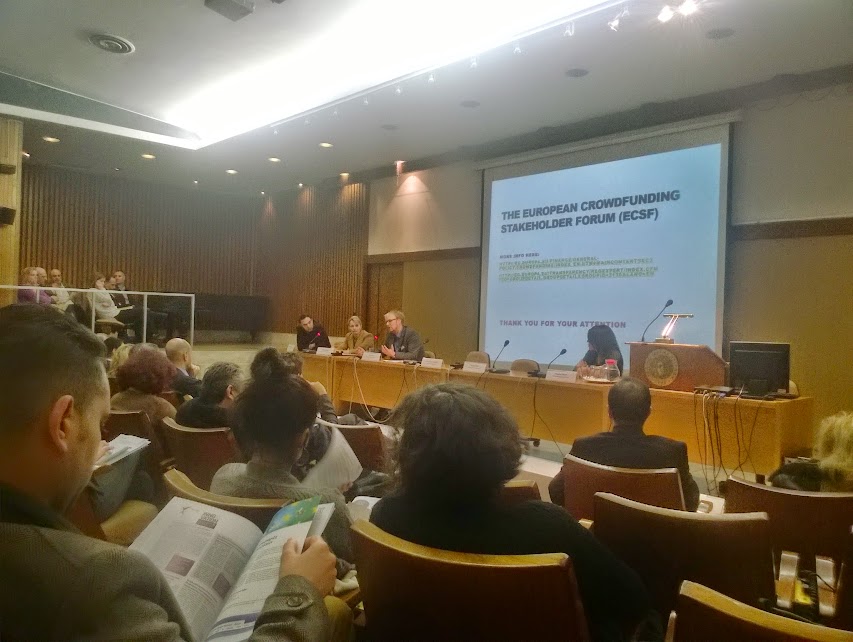
During the 1st session of the EKT Workshop on crowdfunding
During the 1st session of the Workshop

Session 2: Crowdfunding in Greece: Legal and Regulatory Framework

This session consisted of the following two presentations:
  • Nikos Kontizas presented the "Crowdfunding: Legal Challenges and the Situation in Greece", presenting the gaps regarding the legal framework of the crowdfunding activities in Greece
  • Dionysis Paraschis presented "Regulatory framework for the Crowdfunding market in Greece", representing the Hellenic Capital Market Commission and focusing on the Capital Market perspectives on this issue.

Session 3: Greek Crowdfunding Platforms

This session was facilitated by Iraklis Agiovlasitis (EKT) and was the most straightforward of all three; representatives of the 6 most active/well-known crowdfunding platforms in Greece were invited to present their platform and work and discuss the joint issues that rise due to the lack of a solid legal and operational framework, as discussed in the previous session. The following platforms were presented:
  • OpenCircle: The co-founder Xenophon Krokidis presented this advanced platform which aims to turn researchers into entrepreneurs. It works on the Equity Crowdfunding approach and aims mostly at investors wishing to invest their money in a commercial enterprise (e.g. a startup or a small business) or idea for a project as well as on entrepreneurs who wish to develop an innovative idea but they do not have the resources to do so. You will need a well-defined business plan and a strong team to support it in order to get through the initial steps. It seemed like the most professional and advanced solution, rendering it more suitable for more advanced ideas and investors.
  • Give & Fund: Giannis Chatzimpeis, the founder and Paralympian Athlete described the story behind the development of this platform and his own success story in raising funds for a specific food purpose. Give & Fund is a digital crowdfunding platform that allows everyone to create a fundraising page through a simple & safe process (and with no cost!). The platform also allows the interaction with social media, in order to further promote the project. The platform is based on donations from individuals.
  • Groopio: Dimitris Anagnostou, the founder of Groopio, the oldest crowdfunding platform in Greece presented the simple (and successful) approach of his platform, which aims to inspire and fuel creativity, by "raising capital in small amounts from a large group of people who want to support an idea or effort initiated by a person or organization". It seemed like the most informal but still more appealing and easy to use platform (along with Give & Fund).
  • Winnersfund: Konstantinos Parissis, the Founder of Winnersfund, presented the platform. His background as a Lawyer & Economist helped him understand the issues behind the crowdfunding activities and seems to have the solutions to them. The platform provides a complete solution to crowdfunding focusing on businesses; some of these seem to be in the agri-food production domain. I have the feeling that the specific platform is aiming at serious investors, having a similar (but not as advanced) as OpenCircle.
  • GreekFund: A Greek crowdfunding platform, presented by its executive partner Tasos Taskaris. The platform aims to support innovative business and societal initiatives that require funding,focusing on the Greek initiatives (something that becomes obvious not only from the intuitive Greek user interface but also from the lack of any information in English). What makes GreekFund special, is the involvement of a wide variety of groups that work collaboratively in the process including the creators (those with innovative ideas), the wise (those who produce new knowledge), necessary collaborators (experienced scientists and professionals, experts in marketing & advertising etc.) - you can read more here.
  • OneUp by Praxi: Pau Kidner, from the Praksis Business Coaching Center NGO, presented the OneUp initiative. The specific initiative has a strongly societal approach, aiming to provide the means to those with no funds and job to get the necessary tools through a 4-month program on entrepreneurship, in order to allow them stand back on their feet and be more competitive.
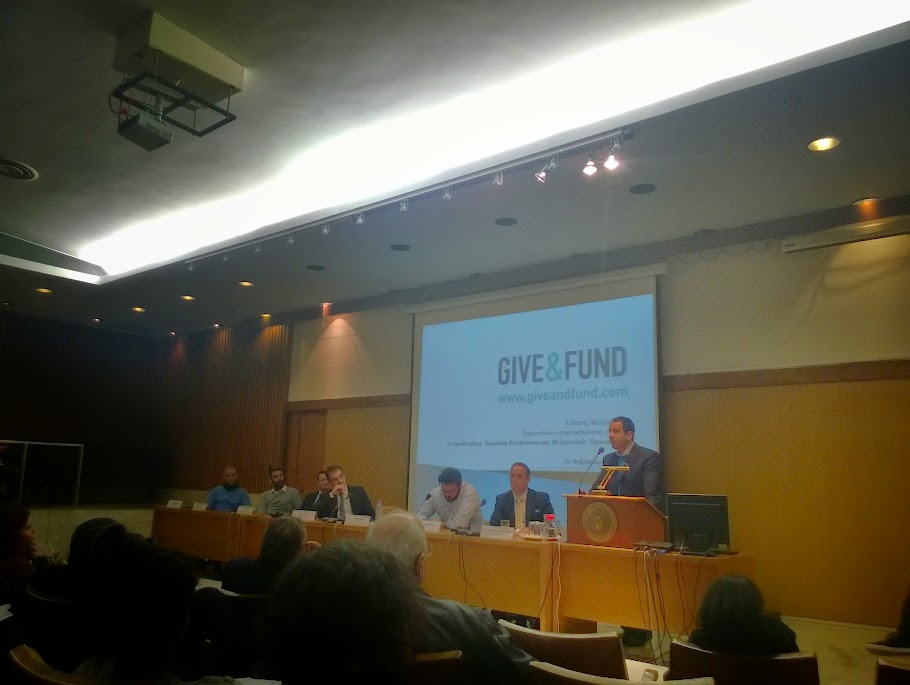
Presentation of the Give & Fund
On top of that, Stathis Athanasiou, a Greek director, presented his own successful story of raising funds for the development of his own film using Indiegogo; he presented both the advantages and the issues that he faced during the process.
Almost all speakers highlighted the common issues faced in the crowdfunding context, such as the lack of a clear framework for the proper operation of related activities, the risks that may be low but still exist (e.g. of funding a project that will not be completed) and the issues caused by the need of using online payment services (e.g. increased complexity and sense of insecurity). However, all founders agreed that there should be collaboration between the different platforms in order to support the development of a transparent and functional framework to meet the requirements of all different cases.
The event concluded with a discussion between the audience and the speakers of the last session, during which a lot of answers to practical questions were provided. It was really interesting to see the level of interest from the audience, especially after having the previous presentations setting up the context and raising the awareness about crowdfunding.
All in all, it was a really interesting workshop on an emerging topic. It successfully managed to provide all dimension to the subject (financial, legal, platforms and end-users) in a compact agenda, allowing at the same time interesting discussions and informing potential stakeholders about crowdfunding. It became obvious that even an SME like Agro-Know may benefit from related activities under specific conditions.
All presentations are already available through the event's web page.

Sunday, February 1, 2015

A really busy January is over

I can't believe that it has been more than one month since I last wrote something in my blog... it seems that my work absorbs most of my productive time and many of the things that I would blog about are already posted in the Agro-Know blog anyway (by me).

Well, January is officially over and there were a lot of work-related updates: First of all, there is a new team member in the Marketing team (that I am leading - or at least I try to); Alexandros seems like a talented and creative person that is currently doing his internship in Agro-Know, helping me out with marketing-related activities, such as the social media and the marketing material (which needs a face lift, I have to admit). It is a challenge for me to guide him through the team's needs and provide him with the knowledge and space that he needs in order to deploy his creativity and fresh ideas!

Apart from that, I have been focusing my work during January on the branding- and marketing-related activities of a new product that Agro-Know plans to deploy in the next weeks/months. These activities include:
  • the work on the product's logo with George, a talented, external (out of the Agro-Know team) graphic designer;
  • the development of a Drupal-based landing page for the product with the help of an external team of web developer;
  • the work related to the registration of the trademark of the new product (name and logo), in collaboration with the company's lawyer (Periklis, also a great guy);
  • the development of a methodology based on the AARRR (Startup metrics for pirates!) in order to measure the acquisition of new customers and the conversion funnel (?);
  • reading about SEO, conversion funnels, Call-to-action & conversion techniques, leads and copywriting and other unfamiliar terms and methodologies
This alone seems to be challenging, as it involves a lot of preparation related to work that I am not familiar with; however, getting to learn about such things helps me broaden my (already broad) knowledge obtained through my work with Agro-Know (including metadata & their management, digital repositories, information management, knowledge organization systems, linked data, big data, social media, open access & open data, etc.).

Last but not least, I am working on two publications (one for the Open Repositories 2015 Conference and another for the Open Knowledge in Agricultural Development (OKAD)) to be submitted in the next days and doing some work for the text for the website of the Wheat Data Interoperability Working Group of RDA (of which I am a member) and completed the Greek translation of the Pisa Declaration on Policy Development for Grey Literature Resources - a movement that I really endorse :-)

I have a feeling that February will be a key month for my work, as the deployment of this new Agro-Know product is expected and this will be affected in a high degree by my personal contribution. At the same time, my collaboration with my new team member is a stake that I need to win, as this will be a win-win situation for both sides; the team will gain a long-term new member and I will have more free time to focus on more high-level aspects of my work.