Thursday, December 19, 2019

Networking events redefined: The example of LIFE Cyclamen

Does your experience from a project's networking event include a typical (usually boring) set of presentations by the invited speakers followed by a Q&A session over a cup of coffee and slides of cake - all these taking place at a meeting room of a university or a hotel?

Well, we're talking about something totally different here!

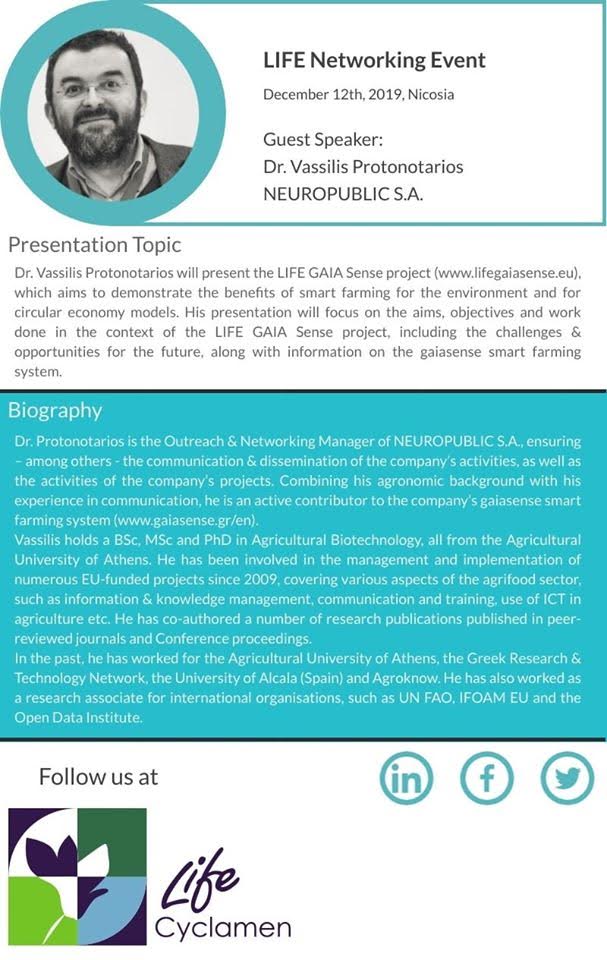
The LIFE Cyclamen project team was kind enough to invite me to their networking event that took place on December 12, 2019 at Nicosia, Cyprus. I would be one of the just three speakers and was asked to present the LIFE GAIA Sense project. It was like a follow-up from our recent contact during the Greek LIFE Task Force Networking Workshop, earlier in 2019.

There were no time slots, no agenda (at least not published), no strict starting time; just lots of dissemination and buzz around the event. The event would take place in the evening, starting at 18.00.

I was intrigued.

As I expected the audience to be diverse (and more focused on the environment) I prepared a new set of slides for the occasion, providing many definitions as simply as possible and avoiding the typical, full-text slides presenting the project.


The event took place at 1010 Hall, a carefully designed gallery-style hall which also included a large room suitable for presentations. We were welcomed by a cocktail-style reception, where we had the opportunity to go through a high number of project (and organizations') posters and discuss with the participants over a glass of wine (or two!). I personally had the opportunity to meet about a dozen people from various relevant (to my case) organizations - mostly research and academic institutions, with whom we exchanged experiences and ideas for future collaborations.

The number of people kept increasing and we finally were invited to the main hall of the place, where a projector was setup and people were seated at bar-style stools. We, the presenters, were presenting while standing - I love this, because it allows me to move from left to right and get close to the projection, highlighting on the screen parts of what I am presenting. I loved the setup!


The event concluded with a nice finger food buffet, with various local dishes and lots of drinks (both highly appreciated). This definitely helped in creating a relaxed atmosphere, where people had the opportunity to talk to the speakers and get more information on their presentations.

I was excited to have another half a dozen of participants approaching me one after the other and asking about various aspects of the LIFE GAIA Sense project and the gaiasense smart farming system, exploring opportunities for collaboration in the context of the same (or even another) LIFE project. I talked with people from the public sector, private companies, NGOs, LIFE project beneficiaries etc. exchanging information about our organizations, our work and potential collaboration.


I admit I didn't have the time to grab something to eat, as people kept coming one after the other. I am a foodie but trust me, I didn't mind at all! We talked about crops not yet covered by smart farming, production issues common between Cyprus and Greece, work of common interest in different projects, ideas for participation in common events etc.

What I especially liked was the fact that even though the attendance was not really high, participants were really into it and their vast majority got engaged in relevant discussions before and after the presentations. And in the end, this is what matters.

Not your typical networking event I guess!

Huge thanks to the LIFE Cyclamen team for the excellent communication, organization and dissemination of the event and for making this trip one of the best in my 10 years of traveling all over Europe - all my participation details were taken care of. And of course for inviting me to this special event :-)


Thursday, July 4, 2019

Networking workshop for Greek LIFE projects

In the context of the LIFE Project’s “Cyprus Capacity Building for LIFE – Cyclamen” delegation visit to Athens, the Greek LIFE Task Force organized a workshop on the networking of Greek LIFE projects. The event took place on Tuesday July 2 at the headquarters of the Green Fund at Villa Kazoulis.


I had the pleasure to participate in the Workshop on behalf of NEUROPUBLIC and present the LIFE GAIA Sense project, its objectives, the methodology it develops as well as the the progress it has made during its first year of operation.

LIFE GAIA Sense is a European project coordinated by NEUROPUBLIC, and co-funded by the LIFE Programme of the EC. The project is based on the gaiasense smart farming system and aims to present the way in which gaiasense contributes to the conservation of natural resources, to environmental protection and more generally, to circular economy models.


My presentation focused on gaiasense, with references to the system’s concept, its four dimensions, the role of technology, scientific results, data and human factor, as well as the benefits (environmental, financial etc.) resulting from its application.

After the end of the presentation I received a number of questions from the participants, who showed special interest in the approach followed by the project, as well as the gaiasense system. In addition, during the break, we discussed various opportunities for cooperation between LIFE GAIA Sense and other projects participating in the event, extending the system’s activity to new contexts and examining new potential applications.

I was impressed by the simplicity of the participants; it is something I also felt when meeting biodiversity researchers several years ago, when I participated in a BioVeL meeting. People seem to be more accessible and easy to approach compared to e.g. Horizon project partners - maybe I am mistaken.


This goes to the organizers of the meeting, who helped me feel comfortable among people I didn't know and a concept (the LIFE projects' ecosystem) that I was not familiar with.

I was also impressed by the venue; Villa Kazouli seems to have a long history and still looks fabulous.

Wednesday, June 26, 2019

Swedish Embassy’s workshop on sustainable agriculture

On Wednesday, June 19, the Embassy of Sweden in Athens, in collaboration with the University of Crete and the Consulate of Sweden in Heraklion, organized a Workshop on the sustainability of the agrifood sector, titled «Sustainable agriculture & food – our common future!» at the Chamber of Heraklion, Crete.

The aim of the Workshop was to highlight the challenges that the agrifood sector faces, including all stages from the field to the shelf, and the presentation of digital and technological solutions that contribute to addressing these challenges and to the sustainability of food production.

Credits: Embassy of Sweden/Orsia Fragkou
In this context, research and scientific outcomes were presented by institutions such as University of Crete and the Hellenic Agricultural Organization “Demeter”, on modern methods related to food safety through laboratory analyzes, plant protection, fisheries and aquaculture, and sustainable food production.

I had the pleasure to represent NEUROPUBLIC in the event, as one of the invited speakers, along with my colleague Dionysis Pantazatos, Project Manager. My participation, in the context of the second session of the Workshop, focused on the gaiasense smart farming system . My presentation highlighted the main features of the system and focused on how gaiasense contributes to the economic, environmental and social sustainability.

Credits: Embassy of Sweden/Theodore Karakassis
The event was attended, among others, by members of the academic community, researchers, representatives of agri-food businesses and related research projects, and was introduced by the Swedish Ambassador to Greece Charlotte Sammelin, and the Vice-Rector of Academic Affairs of the University of Crete Giannis Karakasis.

I also had the opportunity to join the Embassy's pop-up event, which preceded the Workshop. It was an informal event, during which I got to meet and talk to the Embassy's staff - including but not limited to Patrik Svensson, Counsellor and Deputy Head of Mission. Discussions took place over a cup of coffee and snacks and I learned a lot about the Embassy and its activities in Greece.

Special thanks to Sophia Keramida for the excellent communication and for organizing the event, as well as to all participants for contributing to the success of the event.

Thursday, March 28, 2019

When my online storage / syncing / backup system failed

To make a long story short: About two years ago, I purchased a Samsung smartphone and with it, I got an offer of 100GB of free OneDrive storage space. The catch: It would only be valid for 2 years. I activated it, thinking that I would never manage to make use of it, so it wouldn't hurt losing these 100GB after two years. I was wrong.

I have been using both Dropbox and OneDrive for storing and syncing my most important work files (so that I can access them anytime from any place) but still 100GB is an awful lot of space for me; if I recall well, I was using about 20 of my OneDrive's 30GB available back at that time. To me, having access to my files is crucial; no matter if I am at the office, at home or even on the road, I may have to access my files - both personal and work.


Since then, I made some important revisions in the way I used my free (maxed at 5.8GB) Dropbox account: I had to.move ALL my personal files from Dropbox to OneDrive (so that I maximized the space available for my work files) while using some OneDrive storage for my work, too. At the same time, I used my OneDrive storage space for syncing all photos and videos recorded through my Windows Phone.

Today, I needed to edit one of the files I keep on OneDrive, only to receive a message that I could not edit nor sync my files, as I have exceeded my free quota! What had happened is that not only had the 100GB Samsung offer expired, but I had managed to exceed my 30GB of free OneDrive storage (by about 4,5GB) in the meantime! The issue was apparently caused by me constantly shooting photos and videos with my Lumia smartphone, which led to an increased online backup / sync size while I kept adding work and personal files.

It took me more than a couple of hours to clean up the mess: I started by finding the biggest files, which were obviously the videos. I downloaded a batch of them, moved them to an external hard disk and kept an online backup on my YouTube channel. I also deleted some obsolete files (I even found some large map files and apps for my long-gone Windows 5.0 Mio P350 PDA / Pocket PC!) and duplicate ones, and downloaded my enormous collection of e-books.


In the end I managed to reduce my files to less than 30GB but still I needed to find a way to free more space for both my work and personal files that I keep online. This highlighted (for once more) the need for having (a) a reliable sync / online backup system and (b) a constant control over the files that need to be backed up and synced online (so that e.g. redundant and duplicate files will be removed ASAP).

I will surely have to rethink my sync / online backup approach (tools, workflows and files) so that I can exploit existing options and be as efficient as possible. I will probably have to include Google Drive in the picture, as it provides  enough storage and an easy to use desktop client for automating the process. I will only need time to do so - and time is scarce during this period... 

Saturday, February 9, 2019

Farewell to Google+

Google decided to shut down its Google+ platform on April 2nd, 2019, after yet another data breach (which may sound surprising for us taking into consideration the infrastructure of Google). It was a prominent but unfortunate platform, which allowed users to share content, interact, participate in online communities etc.; all backed up by a (almost) seamless operation with other Google products like YouTube, Photos, Blogger etc.
However, it seems that it never managed to live up to the expectations of their developers, being always in the shadow of Facebook in terms of data sharing.

But why am I bothered?

Google+ has been one of the tools I used for sharing updates, content etc. It was dead simple to do so, just pasting a link and you would come up with a preview and a box to share your thoughts on what you shared. Just like you do in Facebook, one would say. Yes, but it was WITHOUT using Facebook!

You see, in some corporate environments, Facebook is one of the websites that you don't have access to, because it is considered a major distraction (and in fact it is). So it was one of the few alternatives for content sharing.

On top of that, content sharing among selected contacts and groups of contacts was a breeze: There was the "Circles" concept, which you could use for grouping your contacts (e.g. family, friends, colleagues, professional connections, acquaintances etc.). By selecting the appropriate audience for each post, you could ensure that e.g. professional connections wouldn't see your family vacation photos and at the same time family wouldn't scratch their heads on the latest scientific research post you uploaded. I found much easier to use these Circles than Facebook's groups of connections.

Google+ was great for businesses, too, as it allows the creation of business profiles and pages, that could be easily linked to Google Maps and other Google tools.

In my case, I could also tag a specific Google user (and almost everyone has a Google account nowadays) in my blog posts by using a +Username and they would be notified of the post and mention - how cool is that? Everyone could then +1 (like) a post and comment using his Google+ profile. These features will be gone soon.

The next day; without Google+

I admit I haven't invested too much in my presence in Google+; I occasionally used it, mostly for sharing more professional content (while the personal one was mostly shared through Facebook). However, I was sorry to see it go, as it was always a good and reliable alternative.


My blog will surely be affected by this change, including comments left by others and comments left by me, +1 on posts etc. It is much time and effort going to waste.

I have tested other platforms for quick data sharing, such as Tumblr. It is nice, but it has its drawbacks, too. In the past I've used others, including Springpad and  

After seeing a tech giant like Google dropping its Google+ platform, it is hard to put your trust in any third party one. It only proves how "fragile" content sharing is and how much we rely on platforms that may cease to work at any time.

Farewell Google+. 

Tuesday, January 15, 2019

Overview of my 2018 - Top events

Another year is over; another fruitful year, full of experiences, a few trips and some interesting connections and opportunities for the future. I had the opportunity to try new things, to gain experience in new fields and even push myself to the limits.

My top 5 moments in 2018 - in terms of events, as I recall them now, are the following (in random order):

1. My presentation on smart farming at COPA COGECA: It was one of the most interesting experience ever; COPA COGECA is a huge organization with huge impact on the agrifood sector and it was an honor for me to have the opportunity to talk about smart farming in a pretty restricted and selected audience. The trip itself was also unique; it was a 1-day trip from Athens to Brussels through a total of 5 airports (Athens, Zurich, Geneva, Brussels, Zurich, Athens). An exhausting trip to remember.

2. My participation in the RDA Interest Group on Agricultural Data (IGAD) Pre-Plenary Meeting 11: Being among people that I have worked with throughout the last 8 years (and haven't seen for the last two) was really exciting. Research Data Alliance is a huge global network and being a part of it, is a privilege. I felt really comfortable among friends, old and new, and had the opportunity to present the role of FAIR Data in our H2020 DataBio project. The trip was challenging for once more, as I missed my connecting flight to Berlin from Frankfurt, had to stay for 3-4 hours at a hotel in the middle of nowhere (!!) and then my flight back was also cancelled so I found myself rushing to Berlin airport, in order to catch an earlier flight that I was rebooked.

3. The gaiasense workshop in Heraklion, Crete and GAIA Congress 2018: These were two side-by-side events, in which I had multiple roles. The gaiasense event was a big success and a great experience; we had to set up everything from scratch (from posters and dissemination materials to sound and video checking) and deliver our presentations. I had to cover a couple of topics along with a demo of selected gaiasense applications. I also managed our social media and

The next day, I participated in the 5th Panhellenic Congress on the Development of Greek Agriculture. I was responsible for covering parts of the Congress through social media, spending time in the gaiasense stand, drop by our DataBio booth and give a hand to my Italian colleague with her communication with Greek stakeholders, network with participants, disseminate our LIFE GAIA Sense project along with a couple of our Greek projects (SymbIoT and SmartPeach), give interviews for Greek media etc. The event concluded with a DataBio session with me being the only presenter :-)

Yet another exhausting but fruitful experience.

4. My participation in the Agrotica 2018 International Fair: Agrotica is one of the largest international agricultural Fairs in the Balkans. We had an impressive booth there, we had lots of visitors interested in what we were offering, we worked long hours but it was great. For me it was yet another opportunity to get to know more about the agricultural sector, being an agronomist with almost no agricultural experience :-)

5. Thessaloniki International Fair 2018: This is also one of the largest international Fairs in the Balkans, too, but not only focused on agriculture. We had a great booth for once more, we got to meet key people from the government, political parties and others, and we addressed everything in a professional way. As regards the trip, I had the opportunity to travel to Thessaloniki by train (I cannot recall when was the lest time I did a train trip) and I really enjoyed it!

Of course there were other highlights in 2018, too, not related to events but to personal and professional achievements. I will try to make a list for them, too, if time allows so that I can use it for future reference.

Sunday, November 4, 2018

Presenting DataBio at the 5th Panhellenic Congress on the Development of Greek Agriculture

One of the things I did during the recent 5th Panhellenic Congress on the Development of Greek Agriculture was to talk about the DataBio Horizon 2020 project and its smart farming pilots in Greece during an interactive session.

The session was organized by DataBio project partner GAIA Epicheirein and supported by NEUROPUBLIC. It aimed at Greek agrifood stakeholder interested in learning about smart farming and the benefits of digital agriculture. It took place on the 25th of October 2018, right after the GAIA Congress; in this way, we ensured that participants of the Congress would also attend the DataBio session, along with other selected participants who were invited.

Presenting the smart farming pilots in Greece during the session

I had the pleasure to be the sole speaker of the event: I started the DataBio session with a presentation of the project, focusing on its aims, objectives, expected outcomes and ongoing activities. After this introduction, I continued with a presentation of the smart farming pilots of the project in Greece, which allowed the participants to get practical information on the crops and locations in Greece where the pilots take place, as well as the expected benefits from each pilot – also mentioning the role of technology and data in each case.

The pilots on olive trees and grapes were of special interest to the participants, as both are among the main crops of Crete.

A big "Thank you" to the audience for their participation after a long and tiring Congress day

The last part of the session was a discussion between DataBio members and the audience, on various aspects of the project. The participants expressed their interest in smart farming and the benefits that they can reap through its adoption, with some of them even expressing their interest in participating in the pilots. Face to face discussions also took place at the DataBio booth with individual participants after the end of the session.

All in all, it was another interesting experience; it was great talking about smart farming to people who showed real interest in the transition from traditional agriculture to smart farming (and that's why they attended the session after a day-long Congress). I also enjoyed the collaboration with the GAIA Epicherein team organizing the session as well as with project partner Anna Bozza from CIAOTECH who spent the whole day at the DataBio booth, informing Congress participants about the project and focusing on the smart farming pilots, which were of special interest to the participants. 

Friday, November 2, 2018

The SmartAgriHubs Horizon 2020 project is launched - Press Release

Press release of SmartAgriHubs, a brand-new, ambitious EU project that NEUROPUBLIC is a partner of and gaiasense among the Digital Innovation Hubs.


EU accelerates the digital transformation of the European agri-food sector


Brussels, 01 November 2018

The SmartAgriHubs project enables a broad digital transformation of the European farming and food sector. With a €20 million budget co-funded by the European Union, the project aims to build an extensive pan-European network of Digital Innovation Hubs (DIHs). The project starts today on November 1st, 2018.

SmartAgriHubs: 140 Digital Innovation Hubs, 9 regional cluster & 28 flagship innovation experiments

The project has the potential to be a real game changer in the adoption of digital solutions by the farming sector. Recent initiatives showed the eagerness of the sector to seize the opportunities offered by ICT, network and data–oriented technologies. However, current available applications are still fragmented and mainly used by a small group of early-adopters. 
SmartAgriHubs will leverage, strengthen and connect local DIHs, and 20 000 Competence Centres (CCs) throughout Europe. SmartAgriHubs has already put together a large network of 140 DIHs by building on its existing projects and ecosystems such as Internet of Food and Farm (IoF2020). All DIHs are aligned with 9 regional clusters, which are led by organizations that are closely related to national or regional digitization initiatives and funds. This multi-layer approach is supported by 28 Innovation experiments in which ideas, concepts and prototypes are further developed and introduced into the market.
More than 2 million farms are expected to be involved through 4000 experiments, bringing the process of digitization closer to the specific needs of the farmers. Demystifying digitization is vital to the project, helping farmers and their businesses to achieve real and attainable results.

A multi-stakeholder approach

SmartAgriHubs brings together different expertise and involves a broad value-chain network covering all EU member states. The consortium includes a vast network of start-ups, SMEs, business and service providers, technology experts and end-users. End-users from the agri-food sector are at the heart of the project and the driving force of the digital transformation.

Strong focus on communication, training and stakeholder engagement 

SmartAgriHubs aspires to create an interconnected ecosystem where stakeholders work together in the different phases of innovation from early research to application on farms. Therefore, promoting stakeholder dialogue and providing timely information on progresses and achieved results lies at the heart of the project’s communication activities. To involve, train and inform its audience, several tools will be put in place by the consortium throughout the duration of the project. For instance, in the innovation portal information will be easily accessible by farmers and their businesses, creating an effective, efficient and satisfactory user experience. A catalogue for farmers and agribusiness is also foreseen, mapping the existing digital technology field, to exchange best practices among the network.

SmartAgriHubs will not only increase the competitiveness and sustainability of Europe’s agri-food sector. It will become the 4th industrial revolution that will strategically re-orient the digital European agricultural innovation ecosystem towards excellence and success. Together with our partners we believe SmartAgriHubs will unlock the potential of digitization by creating a pan-European network of Digital Innovation Hubs, organizing an inclusive ecosystem around them and fostering them to achieve their full innovation acceleration capacity.” 
George Beers, Project Manager at Wageningen University & Research / SmartAgriHubs Project Coordinator

Key facts at a glance:

  • Instrument: Horizon 2020, DT-RUR-12-2-18: ICT Innovation for agriculture
  • Contribution of the European Union: €20 million
  • Duration: 4 years, 2018-2022
  • Consortium: 108 initial partners, possibility to extend through open calls  
  • 140 digital innovation hubs, 9 regional cluster & 28 flagship innovation experiments
  • Bridge public-private funding by mobilising additional funding (30 M€)
  • Strong focus on establishing a sustainable network of DIHs with viable business models and investment funds

Monday, October 29, 2018

My take on the 5th Panhellenic Congress on the Development of Greek Agriculture

The 5th Panhellenic Conference on the Development of Greek Agriculture was the latest of the series of Conferences organized by GAIA Epicheirein in collaboration with various organizations. It took place at the Candia Maris Resort & Spa Crete, an impressive complex at Heraklion, Crete.

This year's theme was "Digitization: The Future of European Agriculture" - you can read a sort overview here (English).


I found myself contributing to the coverage of the event, being a part of the social media team (and focusing on my favorite Twitter). Using the hashtag #GAIACongress18, we created a cloud of tweets while an additional cloud was created through the #GAIACongress2018 hashtag by third parties (I admit we hadn't circulated the hashtag of the event beforehand so this was a minor casualty). 

My workflow was pretty much a typical one: I was taking photos of the event with my smartphones and kept tweeting using my Bluetooth keyboard which was paired with them. I also used my 11,6-inch tablet with its keyboard for managing the Facebook pages and responding to emails.

What I (also) did during the Congress

On top of that, I was around the gaiasense booth that was available at the exhibition room of the Congress; we had a TV screen for playing the gaiasense videos, a huge banner, numerous leaflets and of course our loyal telemetric station (which tends to be around in all recent gaiasense-related event, from the Thessaloniki International Fair 2018 and on!). I had the opportunity to explain the gaiasense concept to participants of the event and talk about the features of our custom telemetric stations.


Among these, I managed to find some time to be around our DataBio Horizon 2020 Big Data Lighthouse Project stand and help our charming Italian partner Anna Bozza from CiaoTech to keep up with questions and requests about the project from Greek stakeholders (many of which were not exactly fluent in English). The stand was really well-thought, with project dissemination material (T-shirts and hats stood out of the crowd!) and drew the attention of various participants of the event.

In between, I got engaged in discussions with friends and colleagues, talked about gaiasense and smart farming in Greece to media, arrange an interview with the national TV channel ERT the day after (a challenging task, considering it should take place about 100 km away from our hotel and I had no car or other mean of transportation available), give a hand to the dissemination of our projects during the Congress (such as our Greek ones SmartPeach and SymbIoT, and our LIFE GAIA Sense EU one) and last but not least, deliver a presentation about our DataBio project, focusing on the Greek pilots! 

My DataBio presentation


Right after the end of the main event (the Congress), GAIA Epicheirein, CiaoTech and NEUROPUBLIC had arranged a brief session focusing on our DataBio Horizon 2020 Lighthouse project at the main room of the Congress. I had prepared a set of slides about the project itself, its aims and objectives and work so far and a second set on the smart farming pilots taking place in Greece - which NEUROPUBLIC coordinates and implements. 


Despite the fact that the session took place by the end of a long day, the audience was more than we initially expected, consisting of various types of Greek stakeholders (farmers and agricultural cooperatives, agricultural advisors and agronomists, other agrifood chain partners). The presentation went pretty well, I received a number of questions during the session and got into related discussions afterwards.

Wrapping up

It was surely a long and busy day, with many tasks running at the same time, various requests to be fulfilled and many-many discussions with stakeholders. In the end we managed to keep things under control and deliver what we had to deliver (plus arrange some things for the next day, like the aforementioned TV interview).

By the end of the day, we had to disassemble everything, pack it up (including posters, roll-ups, banners, leaflets and even our pretty heavy telemetric station), load everything on our pick-up truck and catch up with the rest of colleagues for a nice, traditional Cretan dinner in a small village outside Heraklion.

We knew that we had accomplished our goals during these two days at Crete (the gaiasense event and the 5th GAIA Congress) and this made everything easier for us.

Saturday, October 27, 2018

gaiasense at Heraklion: A challenging but successful event

On October 24th 2018, NEUROPUBLIC organized an open event for the gaiasense smart farming system at Aquila Atlantis Hotel, Heraklion, Crete. The aim of the event was to present various aspects of the gaiasense system (e.g. technological, business, policy & CAP) to stakeholders from Crete.

Background

There was a lot of preparation behind the event: Presentations were made from scratch with the help of a (talented) graphic designer and multiple rehearsals took place before the event. Demos of the gaiasense applications and tools were prepared, based on predefined scenarios (to save time). A new (stunning) video was prepared highlighting the concept of gaiasense and various activities related to its operation, media coverage was arranged, invitations were sent to key stakeholders and a ticketing system was set up for organizing the attendance in the best possible way. The agenda was carefully thought and prepared, ensuring that representatives from all aspects of gaiasense would have the time to talk and discuss their contributions.


We even had our famous telemetric station packed and loaded onto the gaiasense pickup truck (and then unpacked it and set it up at the event room - a really challenging task!), loads of posters, roll-ups, banners, leaflets and other dissemination material packed, unpacked and set up as well; everything set up in a couple of hours.

The event

I admit it; participation was higher than I expected: We had booked a room seating about 150 people and by the beginning of the event we already had people standing and leaning on the walls. There were mostly agricultural advisors, farmers and agricultural cooperatives, and other stakeholders interested in innovation in the agricultural sector.

(Partial) view of the audience from the panelists' table
Everything went smooth and according to the plan; of course, there were some minor glitches here and there (e.g. a specific app wouldn't work over the existing WiFi network so we had to skip it at the last rehearsal), but this is expected during a live event. The sound was fine, videos went out great, the audience was really interested in the presentations and there were some questions after each session.

What made the event more interesting was the fact that we had decided to skip the typical set of (usually boring) slides for the description of the four dimensions of gaiasense - we also skipped the typical sitting /standing on the podium and we went for a PechaKutcha style of presentation, so we had the opportunity to look at our audience instead of the laptop screen, using a wireless microphone.


The specific session was apparently my favorite one; not only because it was me and my colleagues working closely and presenting the gaiasense dimensions in a complimentary way, but also due to the fact that it was really different than the rest. I personally had the opportunity to present not one but two of the gaiasense dimensions - and right after that, to demonstrate the main gaiasense software tools. It was a real marathon for me, but I think it came out pretty well.


It was also interesting that aspects of gaiasense like its role in the new CAP as an instrument supporting the implementation of its measures, its role as a tool for agricultural advisors (agricultural advisory services will be a key component of the new CAP) and its European dimension were also presented by colleagues and collaborators.

Wrapping up

In less than 2,5 hours we managed to present almost everything related to the gaiasense smart farming system, including the technological, the methodological, the scientific and the policy aspects of gaiasense. The pace was so quick, based on short sessions and the constant change of speakers, that the audience could not help but follow the flow. Their interest was expressed in the form of discussions that took place right after the event. It was a really dense period and an even more dense event - but it went really well and this made up for it.

The end of the event was not the end of the activities: We had to pack everything and send it over to another hotel, where the 5th Panhellenic Congress for the Development of Greek Agriculture would take place (and gaiasense would also be represented with its own booth, posters, roll-ups and other dissemination material). Press releases had to be prepared and sent to media, photos had to be organized and I also had yet another presentation to make - this time on the DataBio project and its smart farming pilots in Greece (that NEUROPUBLIC is responsible for).

It was a day to remember, that's for sure.