Sunday, September 26, 2021

My take on the Thessaloniki International Fair 2021

After a year of hiatus due to the COVID-19 restrictions, Thessaloniki International Fair 2021 took place as a physical event between 11-19 of September 2021 - and I was excited to participate after a long time stuck at the office.

This year, again due to the COVID-19 restrictions, the Fair was not that International as its previous iterations - plus, the attendance was pretty low, due to the fact that the Fair was open only to those already vaccinated and / or those who had already recovered from COVID-19. The security measures at the entrances were pretty tight, so these measures were actually enforced.

While in the previous versions of the TIF, NEUROPUBLIC had a stand inside one of the Pavilions, this year the company had an impressive external Stand right after the main entrance of the Fair. The main components of NEUROPUBLIC's Stand were the following:

  • Two external and one internal large monitors were used for the playback of corporate videos and related material, 
  • Two smartphones were available for visitors to try the new gaiasense mobile app 
  • Lots of printed material like NEUROPUBLIC's corporate profile, the new gaiasense booklet and threefold leaflet, plus my favorite gaiasense pens (they turned out to be pretty popular!)
  • A fully functional telemetric agrometeorological station of gaiasense was installed in the nearby flower bed and transmitted data measurements to one of the screens

Plus, there were two promoters giving out helium-filled gaiasense balloons to kids and leaflets to visitors.

I missed the great opening of the event (not a bad thing, for various reasons) as I joined my colleagues after the 3rd day. Everything was already set up so I only had to make sure that everything was working smoothly, relaxing music was playing all the time, our WiFi hotspot was on - as was our valuable air-condition.

I had the opportunity to discuss about the gaiasense smart farming system and mobile app to various visitors, including farmers, researchers and other technology providers seeking opportunities for collaboration. In addition, I organized project-thematic days at the Stand, featuring our PoliRural, SmartPeach and SmartOliveGrove projects. Each day we had a poster or rollup and leaflets of each project, and this went better than I expected, as the visiting producers were more than I anticipated.


During my stay I had the opportunity to meet new colleagues working at NEUROPUBLIC's Thessaloniki office, like Kostas, Vaggelis and Matthew - all of them proved to be great guys and good match to the rest of the team. We set up everything in the morning and packed everything back (including the large monitors, the packs of printed materials and chairs/tables, among others) each evening, by the closing of the Fair.

In general, participation in such events is exhausting: You typically have to wake up pretty early, have breakfast, open the Stand and put everything in place, move around all the time restocking printed material, pencils, making sure to fix the mess of chairs and papers being out of place (and all over the place), talking to visitors, preparing cups of coffee and bags of promotional material, and try to find some time for a quick lunch break when the pace of the event is slow.

The day is over and we are about to start packing stuff for the day to come

However, this trip - as each trip inside Greece or abroad - was a refreshing change in the daily office routine. I like hotel life, I love wandering around a city and seeing new things, tasting new dishes and breathing fresh air. This is why I managed to reach my daily steps target during my stay - I had the energy to walk around even during late evening after a long and busy day at the Fair.

Getting to talk to potential customers is always a pleasure, but there is an awful lot of work to do back to the office so I am wrapping up and looking forward to the next trip.

Thursday, December 17, 2020

Working from home: A short story

It was a rainy winter morning. So rainy that made me feel glad I did not have to drive to work under this heavy rain, through the more-than-usual heavy traffic. A rain, even a light one, increases my commuting time by at least 20 mins.

Sitting at the cozy sofa of my home, I switched on my laptop, started my secure corporate VPN connection and opened Skype. Using Remote Desktop I could have access to all my files and apps stored at my office desktop PC and my softphone app made sure that all my incoming calls would be forwarded to my home laptop.

It was just like working from the office but saving a 50 min drive and sitting more comfortably on my sofa. I quickly caught up with all pending emails and had an early morning update chat through Skype with my colleagues - some of them at the office, some of the working from home.

It was so quiet that I quickly finished an urgent article for a Greek newspaper and had a short break looking for news to use in our corporate and project social media accounts. This was something I can do - and even better - while listening to my favorite moody tracks on Spotify or YouTube.

Back to some important tasks: A dissemination report of one of our projects, for the social media of which we (I) am responsible, needed some in depth analysis of usage and outreach. I go into the analytics of each social media platform, export the data in spreadsheets (where applicable) and start filtering, merging and making use of data. I am surprised to see how each platform changes the way it presents the analytics and trying to figure out ways to address some obvious barriers (e.g. Facebook not allowing to go past a quarter of the year).

After progressing with the report, I need to switch to something easier, to help me clear my mind; I start working on the clipping of news related to the company, our projects and products, filling in some basic information in an online spreadsheet.

Time for a lunch break, and some time off the screen, to prepare for the rest of my working day.

A Skype call with the team on the updates and any pending task or issue, and the occasional webinar of the day, on topics of general (or even specific) interest, to catch up with the work of collaborators.

Stretching my legs shortly before the webinar, grabbing a cup of hot coffee and off we go. In the meantime I check my emails, making sure that all urgent ones are highlighted and the informational ones are quickly sorted out.

Time's up: Another Skype call with the team, to recap the day and plan things for tomorrow. Everything's sorted out and we are ready for a brand new day.

Monday, April 27, 2020

IPM Decisions Annual Meeting: A missed opportunity

Today I was supposed to fly from Athens to Paris, then get the train to Dijon, settle in my hotel room, grab something to eat and finalize my preparations for the IPM Decisions Annual Meeting. Instead, I am sitting at my living room, working from home almost since early March due to COVID-19.


Flights to Paris and back were early booked, transportation to and from Dijon was carefully planned...damn, I even planned my meals based on TripAdvisor and walks around Dijon (it would be my first time). But apart from the trip itself, it would be my first participation in a project meeting after a really long time.
The IPM Decisions project will create an online platform that is easy to use for the monitoring and management of pests. The platform will be available across the EU with DSS, data, tools and resources tailored to individual regions.
I miss traveling and I miss project meetings. Visiting new places and meeting new people. Walking around unknown roads and working on innovative ways to collaborate in order to fulfill a project's requirements.


I only wish that there will be another opportunity in the near future.

You can learn more about IPM Decisions on the CORDIS Portal.

Thursday, December 19, 2019

Networking events redefined: The example of LIFE Cyclamen

Does your experience from a project's networking event include a typical (usually boring) set of presentations by the invited speakers followed by a Q&A session over a cup of coffee and slides of cake - all these taking place at a meeting room of a university or a hotel?

Well, we're talking about something totally different here!

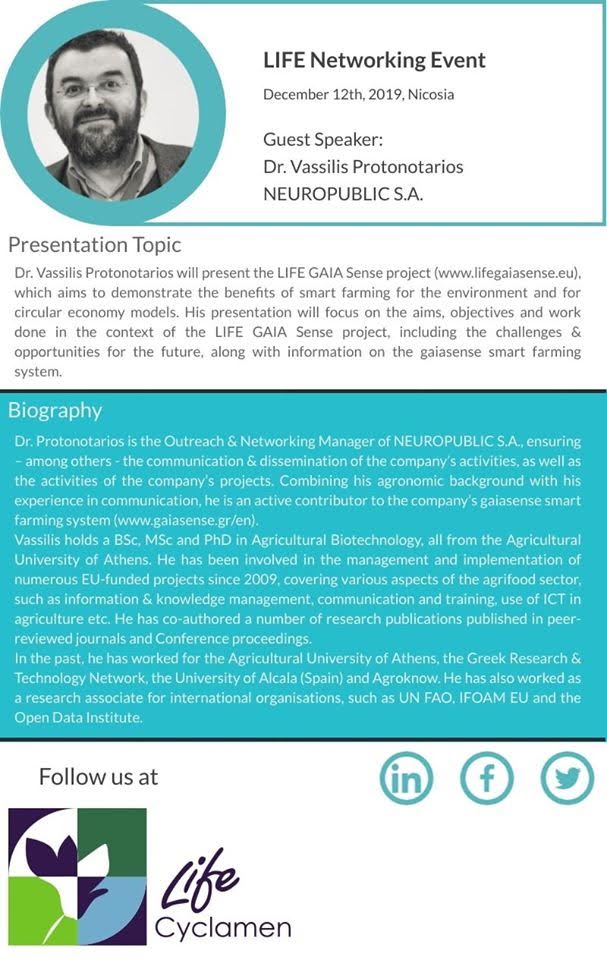
The LIFE Cyclamen project team was kind enough to invite me to their networking event that took place on December 12, 2019 at Nicosia, Cyprus. I would be one of the just three speakers and was asked to present the LIFE GAIA Sense project. It was like a follow-up from our recent contact during the Greek LIFE Task Force Networking Workshop, earlier in 2019.

There were no time slots, no agenda (at least not published), no strict starting time; just lots of dissemination and buzz around the event. The event would take place in the evening, starting at 18.00.

I was intrigued.

As I expected the audience to be diverse (and more focused on the environment) I prepared a new set of slides for the occasion, providing many definitions as simply as possible and avoiding the typical, full-text slides presenting the project.


The event took place at 1010 Hall, a carefully designed gallery-style hall which also included a large room suitable for presentations. We were welcomed by a cocktail-style reception, where we had the opportunity to go through a high number of project (and organizations') posters and discuss with the participants over a glass of wine (or two!). I personally had the opportunity to meet about a dozen people from various relevant (to my case) organizations - mostly research and academic institutions, with whom we exchanged experiences and ideas for future collaborations.

The number of people kept increasing and we finally were invited to the main hall of the place, where a projector was setup and people were seated at bar-style stools. We, the presenters, were presenting while standing - I love this, because it allows me to move from left to right and get close to the projection, highlighting on the screen parts of what I am presenting. I loved the setup!


The event concluded with a nice finger food buffet, with various local dishes and lots of drinks (both highly appreciated). This definitely helped in creating a relaxed atmosphere, where people had the opportunity to talk to the speakers and get more information on their presentations.

I was excited to have another half a dozen of participants approaching me one after the other and asking about various aspects of the LIFE GAIA Sense project and the gaiasense smart farming system, exploring opportunities for collaboration in the context of the same (or even another) LIFE project. I talked with people from the public sector, private companies, NGOs, LIFE project beneficiaries etc. exchanging information about our organizations, our work and potential collaboration.


I admit I didn't have the time to grab something to eat, as people kept coming one after the other. I am a foodie but trust me, I didn't mind at all! We talked about crops not yet covered by smart farming, production issues common between Cyprus and Greece, work of common interest in different projects, ideas for participation in common events etc.

What I especially liked was the fact that even though the attendance was not really high, participants were really into it and their vast majority got engaged in relevant discussions before and after the presentations. And in the end, this is what matters.

Not your typical networking event I guess!

Huge thanks to the LIFE Cyclamen team for the excellent communication, organization and dissemination of the event and for making this trip one of the best in my 10 years of traveling all over Europe - all my participation details were taken care of. And of course for inviting me to this special event :-)


Thursday, July 4, 2019

Networking workshop for Greek LIFE projects

In the context of the LIFE Project’s “Cyprus Capacity Building for LIFE – Cyclamen” delegation visit to Athens, the Greek LIFE Task Force organized a workshop on the networking of Greek LIFE projects. The event took place on Tuesday July 2 at the headquarters of the Green Fund at Villa Kazoulis.


I had the pleasure to participate in the Workshop on behalf of NEUROPUBLIC and present the LIFE GAIA Sense project, its objectives, the methodology it develops as well as the the progress it has made during its first year of operation.

LIFE GAIA Sense is a European project coordinated by NEUROPUBLIC, and co-funded by the LIFE Programme of the EC. The project is based on the gaiasense smart farming system and aims to present the way in which gaiasense contributes to the conservation of natural resources, to environmental protection and more generally, to circular economy models.


My presentation focused on gaiasense, with references to the system’s concept, its four dimensions, the role of technology, scientific results, data and human factor, as well as the benefits (environmental, financial etc.) resulting from its application.

After the end of the presentation I received a number of questions from the participants, who showed special interest in the approach followed by the project, as well as the gaiasense system. In addition, during the break, we discussed various opportunities for cooperation between LIFE GAIA Sense and other projects participating in the event, extending the system’s activity to new contexts and examining new potential applications.

I was impressed by the simplicity of the participants; it is something I also felt when meeting biodiversity researchers several years ago, when I participated in a BioVeL meeting. People seem to be more accessible and easy to approach compared to e.g. Horizon project partners - maybe I am mistaken.


This goes to the organizers of the meeting, who helped me feel comfortable among people I didn't know and a concept (the LIFE projects' ecosystem) that I was not familiar with.

I was also impressed by the venue; Villa Kazouli seems to have a long history and still looks fabulous.

Wednesday, June 26, 2019

Swedish Embassy’s workshop on sustainable agriculture

On Wednesday, June 19, the Embassy of Sweden in Athens, in collaboration with the University of Crete and the Consulate of Sweden in Heraklion, organized a Workshop on the sustainability of the agrifood sector, titled «Sustainable agriculture & food – our common future!» at the Chamber of Heraklion, Crete.

The aim of the Workshop was to highlight the challenges that the agrifood sector faces, including all stages from the field to the shelf, and the presentation of digital and technological solutions that contribute to addressing these challenges and to the sustainability of food production.

Credits: Embassy of Sweden/Orsia Fragkou
In this context, research and scientific outcomes were presented by institutions such as University of Crete and the Hellenic Agricultural Organization “Demeter”, on modern methods related to food safety through laboratory analyzes, plant protection, fisheries and aquaculture, and sustainable food production.

I had the pleasure to represent NEUROPUBLIC in the event, as one of the invited speakers, along with my colleague Dionysis Pantazatos, Project Manager. My participation, in the context of the second session of the Workshop, focused on the gaiasense smart farming system . My presentation highlighted the main features of the system and focused on how gaiasense contributes to the economic, environmental and social sustainability.

Credits: Embassy of Sweden/Theodore Karakassis
The event was attended, among others, by members of the academic community, researchers, representatives of agri-food businesses and related research projects, and was introduced by the Swedish Ambassador to Greece Charlotte Sammelin, and the Vice-Rector of Academic Affairs of the University of Crete Giannis Karakasis.

I also had the opportunity to join the Embassy's pop-up event, which preceded the Workshop. It was an informal event, during which I got to meet and talk to the Embassy's staff - including but not limited to Patrik Svensson, Counsellor and Deputy Head of Mission. Discussions took place over a cup of coffee and snacks and I learned a lot about the Embassy and its activities in Greece.

Special thanks to Sophia Keramida for the excellent communication and for organizing the event, as well as to all participants for contributing to the success of the event.

Thursday, March 28, 2019

When my online storage / syncing / backup system failed

To make a long story short: About two years ago, I purchased a Samsung smartphone and with it, I got an offer of 100GB of free OneDrive storage space. The catch: It would only be valid for 2 years. I activated it, thinking that I would never manage to make use of it, so it wouldn't hurt losing these 100GB after two years. I was wrong.

I have been using both Dropbox and OneDrive for storing and syncing my most important work files (so that I can access them anytime from any place) but still 100GB is an awful lot of space for me; if I recall well, I was using about 20 of my OneDrive's 30GB available back at that time. To me, having access to my files is crucial; no matter if I am at the office, at home or even on the road, I may have to access my files - both personal and work.


Since then, I made some important revisions in the way I used my free (maxed at 5.8GB) Dropbox account: I had to.move ALL my personal files from Dropbox to OneDrive (so that I maximized the space available for my work files) while using some OneDrive storage for my work, too. At the same time, I used my OneDrive storage space for syncing all photos and videos recorded through my Windows Phone.

Today, I needed to edit one of the files I keep on OneDrive, only to receive a message that I could not edit nor sync my files, as I have exceeded my free quota! What had happened is that not only had the 100GB Samsung offer expired, but I had managed to exceed my 30GB of free OneDrive storage (by about 4,5GB) in the meantime! The issue was apparently caused by me constantly shooting photos and videos with my Lumia smartphone, which led to an increased online backup / sync size while I kept adding work and personal files.

It took me more than a couple of hours to clean up the mess: I started by finding the biggest files, which were obviously the videos. I downloaded a batch of them, moved them to an external hard disk and kept an online backup on my YouTube channel. I also deleted some obsolete files (I even found some large map files and apps for my long-gone Windows 5.0 Mio P350 PDA / Pocket PC!) and duplicate ones, and downloaded my enormous collection of e-books.


In the end I managed to reduce my files to less than 30GB but still I needed to find a way to free more space for both my work and personal files that I keep online. This highlighted (for once more) the need for having (a) a reliable sync / online backup system and (b) a constant control over the files that need to be backed up and synced online (so that e.g. redundant and duplicate files will be removed ASAP).

I will surely have to rethink my sync / online backup approach (tools, workflows and files) so that I can exploit existing options and be as efficient as possible. I will probably have to include Google Drive in the picture, as it provides  enough storage and an easy to use desktop client for automating the process. I will only need time to do so - and time is scarce during this period... 

Saturday, February 9, 2019

Farewell to Google+

Google decided to shut down its Google+ platform on April 2nd, 2019, after yet another data breach (which may sound surprising for us taking into consideration the infrastructure of Google). It was a prominent but unfortunate platform, which allowed users to share content, interact, participate in online communities etc.; all backed up by a (almost) seamless operation with other Google products like YouTube, Photos, Blogger etc.
However, it seems that it never managed to live up to the expectations of their developers, being always in the shadow of Facebook in terms of data sharing.

But why am I bothered?

Google+ has been one of the tools I used for sharing updates, content etc. It was dead simple to do so, just pasting a link and you would come up with a preview and a box to share your thoughts on what you shared. Just like you do in Facebook, one would say. Yes, but it was WITHOUT using Facebook!

You see, in some corporate environments, Facebook is one of the websites that you don't have access to, because it is considered a major distraction (and in fact it is). So it was one of the few alternatives for content sharing.

On top of that, content sharing among selected contacts and groups of contacts was a breeze: There was the "Circles" concept, which you could use for grouping your contacts (e.g. family, friends, colleagues, professional connections, acquaintances etc.). By selecting the appropriate audience for each post, you could ensure that e.g. professional connections wouldn't see your family vacation photos and at the same time family wouldn't scratch their heads on the latest scientific research post you uploaded. I found much easier to use these Circles than Facebook's groups of connections.

Google+ was great for businesses, too, as it allows the creation of business profiles and pages, that could be easily linked to Google Maps and other Google tools.

In my case, I could also tag a specific Google user (and almost everyone has a Google account nowadays) in my blog posts by using a +Username and they would be notified of the post and mention - how cool is that? Everyone could then +1 (like) a post and comment using his Google+ profile. These features will be gone soon.

The next day; without Google+

I admit I haven't invested too much in my presence in Google+; I occasionally used it, mostly for sharing more professional content (while the personal one was mostly shared through Facebook). However, I was sorry to see it go, as it was always a good and reliable alternative.


My blog will surely be affected by this change, including comments left by others and comments left by me, +1 on posts etc. It is much time and effort going to waste.

I have tested other platforms for quick data sharing, such as Tumblr. It is nice, but it has its drawbacks, too. In the past I've used others, including Springpad and  

After seeing a tech giant like Google dropping its Google+ platform, it is hard to put your trust in any third party one. It only proves how "fragile" content sharing is and how much we rely on platforms that may cease to work at any time.

Farewell Google+. 

Tuesday, January 15, 2019

Overview of my 2018 - Top events

Another year is over; another fruitful year, full of experiences, a few trips and some interesting connections and opportunities for the future. I had the opportunity to try new things, to gain experience in new fields and even push myself to the limits.

My top 5 moments in 2018 - in terms of events, as I recall them now, are the following (in random order):

1. My presentation on smart farming at COPA COGECA: It was one of the most interesting experience ever; COPA COGECA is a huge organization with huge impact on the agrifood sector and it was an honor for me to have the opportunity to talk about smart farming in a pretty restricted and selected audience. The trip itself was also unique; it was a 1-day trip from Athens to Brussels through a total of 5 airports (Athens, Zurich, Geneva, Brussels, Zurich, Athens). An exhausting trip to remember.

2. My participation in the RDA Interest Group on Agricultural Data (IGAD) Pre-Plenary Meeting 11: Being among people that I have worked with throughout the last 8 years (and haven't seen for the last two) was really exciting. Research Data Alliance is a huge global network and being a part of it, is a privilege. I felt really comfortable among friends, old and new, and had the opportunity to present the role of FAIR Data in our H2020 DataBio project. The trip was challenging for once more, as I missed my connecting flight to Berlin from Frankfurt, had to stay for 3-4 hours at a hotel in the middle of nowhere (!!) and then my flight back was also cancelled so I found myself rushing to Berlin airport, in order to catch an earlier flight that I was rebooked.

3. The gaiasense workshop in Heraklion, Crete and GAIA Congress 2018: These were two side-by-side events, in which I had multiple roles. The gaiasense event was a big success and a great experience; we had to set up everything from scratch (from posters and dissemination materials to sound and video checking) and deliver our presentations. I had to cover a couple of topics along with a demo of selected gaiasense applications. I also managed our social media and

The next day, I participated in the 5th Panhellenic Congress on the Development of Greek Agriculture. I was responsible for covering parts of the Congress through social media, spending time in the gaiasense stand, drop by our DataBio booth and give a hand to my Italian colleague with her communication with Greek stakeholders, network with participants, disseminate our LIFE GAIA Sense project along with a couple of our Greek projects (SymbIoT and SmartPeach), give interviews for Greek media etc. The event concluded with a DataBio session with me being the only presenter :-)

Yet another exhausting but fruitful experience.

4. My participation in the Agrotica 2018 International Fair: Agrotica is one of the largest international agricultural Fairs in the Balkans. We had an impressive booth there, we had lots of visitors interested in what we were offering, we worked long hours but it was great. For me it was yet another opportunity to get to know more about the agricultural sector, being an agronomist with almost no agricultural experience :-)

5. Thessaloniki International Fair 2018: This is also one of the largest international Fairs in the Balkans, too, but not only focused on agriculture. We had a great booth for once more, we got to meet key people from the government, political parties and others, and we addressed everything in a professional way. As regards the trip, I had the opportunity to travel to Thessaloniki by train (I cannot recall when was the lest time I did a train trip) and I really enjoyed it!

Of course there were other highlights in 2018, too, not related to events but to personal and professional achievements. I will try to make a list for them, too, if time allows so that I can use it for future reference.

Sunday, November 4, 2018

Presenting DataBio at the 5th Panhellenic Congress on the Development of Greek Agriculture

One of the things I did during the recent 5th Panhellenic Congress on the Development of Greek Agriculture was to talk about the DataBio Horizon 2020 project and its smart farming pilots in Greece during an interactive session.

The session was organized by DataBio project partner GAIA Epicheirein and supported by NEUROPUBLIC. It aimed at Greek agrifood stakeholder interested in learning about smart farming and the benefits of digital agriculture. It took place on the 25th of October 2018, right after the GAIA Congress; in this way, we ensured that participants of the Congress would also attend the DataBio session, along with other selected participants who were invited.

Presenting the smart farming pilots in Greece during the session

I had the pleasure to be the sole speaker of the event: I started the DataBio session with a presentation of the project, focusing on its aims, objectives, expected outcomes and ongoing activities. After this introduction, I continued with a presentation of the smart farming pilots of the project in Greece, which allowed the participants to get practical information on the crops and locations in Greece where the pilots take place, as well as the expected benefits from each pilot – also mentioning the role of technology and data in each case.

The pilots on olive trees and grapes were of special interest to the participants, as both are among the main crops of Crete.

A big "Thank you" to the audience for their participation after a long and tiring Congress day

The last part of the session was a discussion between DataBio members and the audience, on various aspects of the project. The participants expressed their interest in smart farming and the benefits that they can reap through its adoption, with some of them even expressing their interest in participating in the pilots. Face to face discussions also took place at the DataBio booth with individual participants after the end of the session.

All in all, it was another interesting experience; it was great talking about smart farming to people who showed real interest in the transition from traditional agriculture to smart farming (and that's why they attended the session after a day-long Congress). I also enjoyed the collaboration with the GAIA Epicherein team organizing the session as well as with project partner Anna Bozza from CIAOTECH who spent the whole day at the DataBio booth, informing Congress participants about the project and focusing on the smart farming pilots, which were of special interest to the participants.