Wednesday, May 7, 2014

EdReNe 11th Conference

The 11th EdReNe Conference took place on 6/5/2014 at the premises of the Computer Technology Institute and Press "Diophantus" in Athens, Greece. It was co-organized by Agro-Know and CTI, while Angeliki has put a significant amount of time and effort in finalizing the agenda of the meeting, taking care of all the practicalities/logistics ensuring that everything will flow smoothly. It was my 3rd participation in a row in an EdReNe Conference and this time I had the honor to make the introduction and welcoming (short) speech!

Introduction to the 11th EdReNe Conference

Despite the fact that traditionally EdReNe takes place by the end of each year, this time we explored the opportunity to host it a little bit earlier; this would allow us to collocate it with other events and also to investigate funding opportunities in the context of the Horizon 2020 programme. Indeed, the EdReNe 11th Conference took place a day after the ARIADNE foundation General Assembly for 2014 and a day before the LRE Sub-committee meeting, a fact which allowed members of the two networks to attend the EdReNe Conference as well, actively contributing to the agenda of the event and bringing an alternative approach to it.

This time the EdReNe Conference consisted of the following sessions:

  1. Learning Resource Exchange panel 
  2. Social Data & Analytics: Social Data aggregation for learning recommenders and analytics
  3. Linked Data in Educational Repositories
  4. Exploiting Data for Educational Purposes
  5. Training Academy for Content Providers: An Open Discovery Space session aiming to provide the basic principles to people who wish to create and operate their own repository/metadata aggregator
  6. News from Members
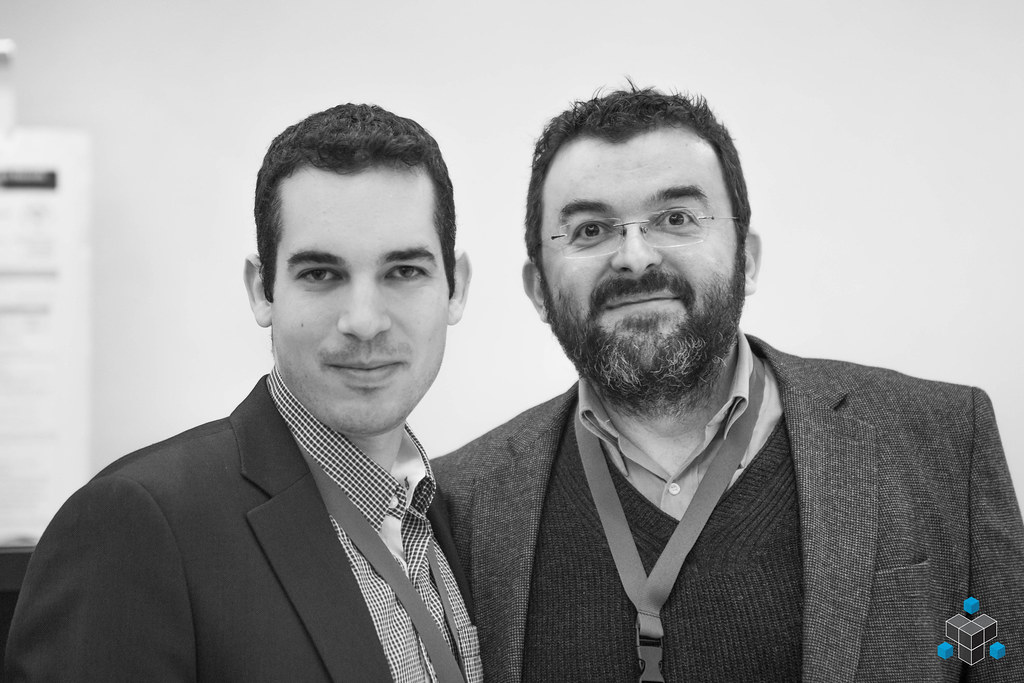
Partial view of the 11th EdReNe Conference participants

You may find more information about each session in the agenda of the Conference. What I liked in this Conference is that it included (as usually) a wide variety of topics related to learning resources and repositories within each session; 
  • ongoing EU projects, 
  • linked data for repository managers (e.g. ARIADNE linked data exposure) and applications of linked data (e.g. Europeana Judaica), 
  • social data, platforms and tools (e.g. the demo of the AgLR tool), 
  • presentations aiming at repository managers, 
  • presentations aiming at content providers, 
  • initiatives at national level (e.g. Photodentro) and at international level (e.g. Terena OER aggregator), 
  • presentations through Skype (Enayat Rajabi/UAH) and Webex (Karin Whooley), 
  • portals (Scoilnet & Green Learning Network / Organic.Edunet), 
  • visualization of metadata management workflows (elastic search / Kibana), 
  • discussions, panels etc. 

All these in just one day - from 09.00 to 19.30! It is obvious that the day was full and the agenda was packed with presentations, demonstrations and discussions; in order to stick to the program we needed to make several adaptations on the fly and in the end we managed to finish only 30 mins later than planned; however, the discussions were so interesting that noone complained. The day ended with a dinner at Scholarheio restaurant, only a few minutes from the meeting place.


I was really glad to see friends from the previous EdReNe meetings (Henk, Elena, David, Manon), meet new people (such as Elina Megalou, our hostess) as well as to be able to participate among friends and colleagues; it was this collaborative work that brought the nice results of the Conference. Big thanks also to Enayat and Karin for their remote participation! It is nice to see this dedication from the network members to EdReNe, especially taking into consideration that there is no funding for traveling and participation to the events. Overall, the meeting was a success, managing to bring together people from different networks, initiatives and projects, both old EdReNe members and new potential ones, blending the experiences with new ideas.

There was no discussion about the hosting of the next EdReNe Conference; however, there is an opportunity for Italy (which was not represented in this event) to host it - more information to be available soon.


Monday, May 5, 2014

ARIADNE General Assembly 2014

The ARIADNE Foundation General Assembly for 2014 took place on 5/5/2014 and was hosted by Agro-Know at the Agro-Know offices. The ARIADNE General Assembly is a private meeting restricted to the ARIADNE members and considers the new status of current projects, opportunities and general ideas so there is not much to say here. Some of the discussions included the role of networks such as EdReNe (Educational Repositories Network) and GLOBE (Global Learning Objects Brokered Exchange); in this context, I was invited to make a presentation regarding my participation in the previous two EdReNe Seminars (9th and 10th respectively), as well as to provide some information about the upcoming 11th EdReNe Conference which takes place in Athens, Greece on 6/5/2014, co-organized by Agro-Know and 
the Computer Technology Institute and Press "Diophantus".

Nikos Manouselis makes an introduction to the meeting

I was really glad to meet some of the ARIADNE members participating in the meeting, like the current president Frans van Assche (with whom we have met in the previous EdReNe Conference in Brussels), Manon Haartsen from Kennisnet (with whom we have met twice in the previous EdReNe Conferences) and Julien Broisin who has a long background of involvement with ARIADNE. He was also the one who pointed out that ARIADNE is in fact an acronym which stands for "Alliance of Remote Instructional Authoring and Distribution Networks for Europe" - as you know I love such trivia information! Apart from that, Kostas Vogias was representing GRNET, Miguel-Angel Sicilia represented UAH and Enayat Rajabi (UAH) participated through Skype.

During the short lunch break

Apart from that, ARIADNE has developed a software infrastructure, including the widely used ARIADNE harvester, which has been reused by several projects in several cases. If all go well, we should expect more advancements and developments from ARIADNE in the near future ;-)

Saturday, May 3, 2014

Organic.Lingua 3rd Review Meeting

Organic.Lingua
The Organic.Lingua project officially ended on 28/2/2014, after 36 months of effort towards re-engineering the Organic.Edunet Web portal and enhancing it with multilingual functionalities, among several other outcomes. A consortium bringing together language technology experts, domain and ontology experts, content providers, developers etc. worked towards the development and integration of automatic metadata translation functionalities in the Organic.Edunet Web portal and other tools, a multilingual metadata authoring tool, a revised ontology and metadata application profile and a well-defined sustainability and exploitation plan, just to name a few of the project's outcomes.

I personally have a special connection to the Organic.Lingua project; you see, the first project I got involved in when I started working with EU projects back in 2009 was Organic.Edunet. I spent numerous hours manually creating metadata records for the project (specific collections), providing Greek translations of metadata and then reviewing the quality of metadata records from other content providers of the consortium. In the context of the Organic.Edunet project I made my first project-related presentation (at the 5th Pan Hellenic Conference of Ecology, Patra) presenting the Organic.Edunet Web portal, and I also ran an autumn training school as a trainer by the end of the project, collocated with the Organic.Edunet Final Conference and Final Review Meeting in Budapest, Hungary in September 2010. Since then, I have spend several months on the Organic.Edunet Web portal and the collections, checking the integrity and quality of metadata and searching for new content providers. The end of the Organic.Lingua project does not mean that this effort will stop; instead, we plan to work intensively on the expansion of the portal and integrate additional revisions. However, it looks like a circle has closed and we will move forward with other projects.

Promoting Organic.Edunet, 22/10/2010

The project's 3rd (and final) review meeting took place between 28-30/4/2014 at Luxembourg. In fact, the first two days were dedicated to the preparation of the presentation to be delivered during the actual Review Meeting on the 30th of April, the preparation of the scripts for the demos of the Organic.Lingua tools etc. In this direction, the whole Organic.Lingua project consortium had the opportunity to meet for the last time and work collaboratively in order to ensure that all achievements of the project would be properly presented and attributed during the review meeting.

These have been three days of intensive work, working long-hours and spending more time together with the project partners. The UAH team, coordinating the project (and not only) during these three years, was populated by Salvador Sanchez, Giannis StoitsisDavid Martin MoncunillMeritxell Mallona Ponce and me while the Agro-Know team was proudly represented by Nikos Marianos.

Organic.Lingua review meeting
Coffee break during the review meeting

The review meeting took place at the EuroForum building of the European Commission. All consortium members were present (at least one representative from each project partner) along with Aleksandra Wesolowska, the project officer of the project and the two reviewers: Dr. Phillip Cimiano from the University of Bielefeld, Germany and Dr. Piek Vossen from Vrije University, the Netherlands. As usual, the presentation included an overview of the outcomes per Work Package according to the project's DoW and based on the feedback received during the previous review meeting as well as a demo during which project partners used the outcomes of the tool (e.g. the MoKi tool for the management of the ontology, the Organic.Edunet Web portal and its multilinguality features as well as the AgLR tool and the agriMoodle platform for the multilingual management of educational resources and courses respectively. During the meeting there were long discussions focusing on specific aspects of the project, such as the exploitation of the outcomes, the sustainability and of course the application of the approaches selected by the project in other contexts.


Even though it is way too early to extract precise outcomes from the meeting, the first impressions were positive; it was obvious that the consortium has taken into consideration all the feedback received during the previous review meeting, additional deliverables were provided when necessary and effort was focused on the aspects of the project which needed revisions etc. The reviewers had a deep knowledge in the technologies used by the project, which led to fruitful discussions during the meeting, and at the same time it was obvious that the exploitation of the outcomes and their sustainability through business models etc. were of special interest. However, the consolidated report which is expected within the next months , should provide more detailed and accurate feedback, as well as the final mark of the project.

Apart from that, it was nice for the consortium to have the opportunity to meet for the last time and have some time together; apart from the intensive work during these three days, we had the opportunity to see a little bit of the city of Luxembourg, try the local dishes and enjoy the Champions' League matches of Spanish teams (Real and Atletico Madrid respectively, both of which did a great job btw!) while enjoying a glass of beer and snacks. After these three years of excellent collaboration between the consortium members, this was something that came out naturally. I really hope that we will have the opportunity to join our efforts in the near future, too!

Salvador leading the social event
Apart from that, it was a nice trip to Luxembourg, among good friends and colleagues and we certainly had some fun as well during these three days. Luxembourg is an expensive city but having a good company and a good mood can make up for that!

Friday, May 2, 2014

Some thoughts on the joint CIARD/GODAN consultation meeting

The 1st joint CIARD/GODAN Consultation meeting took place between 22-24/4/2014 at the FAO Headquarters at Rome, Italy. This was an invitation-only meeting, aiming to bring together people from the CIARD initiative as well as the GODAN (Global Open Data for Agriculture and Nutrition) representatives in order to investigate the opportunities for close collaboration. In this context, having three members of the Agro-Know team participating (Nikos Manouselis, Effie Tsiflidou and me) was a significant privilege and we tried to make the most out of it.
In my opinion, one of the biggest success of the meeting was the fact that it managed to bring together so many policy and decision makers, initiative and community leaders etc., who sat at the same table and tried to explore  ways of collaboration between these two large-scale initiatives. The list of participants included people from (among others):

as well as our good friends from FAO (Johannes Keizer, Imma Subirats, Caterina Caracciolo and Thembani Malapela), INRA (Odile Hologne and Esther Dzale), WUR (Hugo Besemer and Sander Janssen) etc. - I hope that I have not forgotten anyone but it seems impossible to fit everyone in a short blog post. There were participants from Europe, USA & Latin America, Asia and Africa, covering almost all regions.
Johannes Keizer (FAO) during a session of the meeting

The main objective of this joint meeting was for the participants to identify the ways which would enable the seamless collaboration between these two initiatives, minimizing the effort and time needed for common work and eliminating the duplication of effort. The sessions showed that there is common ground for that and that the collaboration of CIARD with its large user base, technical expertise and connection with numerous user groups (from farmers to ICT experts in agriculture) and GODAN with its highly political-level profile and involvement of policy and decision makers would significantly lead things forward towards opening up agriculture and nutrition data and making them available to all stakeholders. Apart from that, there were sessions showing advances in the area of open agricultural data; for example, I really enjoyed the joint presentation of Johannes Keizer (FAO), Simon Liu (NAL USDA) and Martin Parr (CABI) about the Global Agricultural Concept System (GACS), an effort for aligning the three major vocabularies used in the agricultural sector, namely AGROVOC (FAO), NAL Thesaurus and CABI Thesaurus.
During one of the Plenary Sessions of the meeting
The agenda included presentations, lectures, workshops, plenary sessions & parallel ones, remote participation of speakers, discussions and exchange of information, interactive sessions etc.; the latter e.g. provided the opportunity to the participants to indicate what they could bring to the community in terms of contributions (e.g. tools, policies, collaborations, standards etc.) while at the same time stating what they are currently missing and would appreciate receiving from other partners.
Agro-Know had its part in the meeting;

    CIARD-GODAN Joint Consultation Meeting

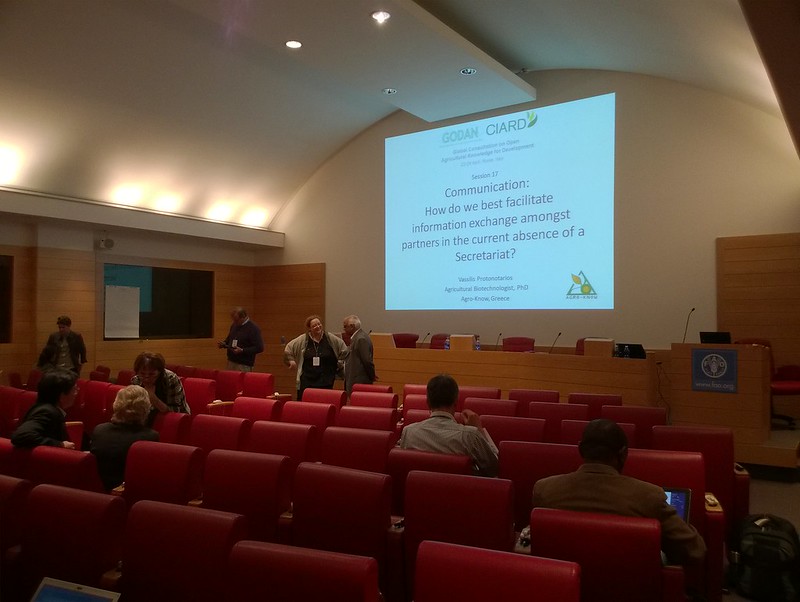
  • I led a session titled "Communication: how do we best facilitate information exchange amongst partners in the current absence of a Secretariat?", during which I proposed some ideas which would facilitate the communication among CIARD and GODAN participants, as well as the exposure and dissemination of the outcomes of these joint activities.
  • I was one of the social media facilitators for several sessions, mostly tweeting about the discussions in each session.
Effie presenting the GFSP initiative
In addition, we had the opportunity to get to meet and have extremely interesting conversations with several people, like Kevin Gamble from the Michigan State University, Laura Meggiolaro from Land Portal, Kim Mallalieu from the Caribbean Open Institute and Federico Sancho from the Inter-American Institute for Cooperation on Agriculture (IICA). Of course the list is much longer but it is hard to mention everyone here...
The meeting achieved its goals; however, more solid outcomes should be expected in the next months, and presented in the next joint consultation meeting of CIARD & GODAN, which is expected to take place by the end of this year with the exact date and location not yet defined. By then, it is expected that issues such as the definition and operation of a common Secretariat for the two initiatives (coordinating the joint activities), the formulation of the processes through which the joint activities will take place as well as the definition of the role of each initiative in this common framework, will be defined and described in details, allowing the full potential of these initiatives to be unleashed. Agro-Know will surely be there, supporting both the organization of the event, as well as actively contributing to the discussions.
You can find photos from the event at the Agro-Know Flickr photostream.

Thursday, April 10, 2014

Agro-Know in SEMIC 2014

The SEMIC 2014 Conference (Semantic Interoperability Community), titled "Metadata Governance & Management" was held on 9/4/2014 in Athens, Greece at the premises of the National Center of Public Administration and Local Governance, as another one of the related events in the context of the Greek Presidency of the Council of the European Union in collaboration with the Greek Ministry of Administrative Reform and e-Governance. It engaged about 199 participants from almost all EU member states (there were about 220 registrations) plus the 24 speakers (also from USA and Japan, among others), and aimed to explore how Public Administrations can use semantic technologies to make information exchange efficient and effective, allowing them to operate at lower costs and provide better services.

In this direction, the Conferfence consisted of 2 large sessions, each one of which consisted of smaller sessions:

  1. Introduction / Keynote speeches: Included, among others, a presentation from Vassilios Peristeras from the European Commission (and one of the people behind the Rural Inclusion ICT-PSP project that we were working on under the GRNET umbrella) ho highlighted the fact that there are already enough vocabularies and approaches developed so there is no need to develop new ones; instead, the existing ones should be reused. The outcomes are publicly available through the JOINUP web site
  2. Session 1: Metadata Governance and Management
  3. Session 2: Semantic Interoperability
The full program of the Conference can be found here, while the presentations will also be available shortly from the same link.

Skipping the details from each presentation (most of which I found really interesting), it was obvious that everyone highlighted the need of using existing standards and reusing existing work instead of duplicating effort and working from scratch. Most of the solutions presented were based on existing standards and identified the need for linking publicly available e-Gov data. Good practices and recommendations were presented in several cases, such as the use of persistent and unique identifiers (URIs), documenting all developments such as standards, providing both a human- and a machine-readable format of the data/metadata.


Muriel Foulonneau, one the reviewers of the now over VOA3R project was also there, presenting the really interesting approach of re-using existing "building blocks" = components from other projects instead of developing additional standards, in the context of the e-SENS project. I am really fond of reusing existing material instead of developing new ones, so I vote for the approach presented in Muriel's presentation. Her presentation was followed by the one by Ralph Hodgson, CTO of TopQuadrant, a person and a company heavily involved in semantic interoperability and standards, not limited to the public sector and e-government. I also enjoyed the presentations of John Sheridan titled "Linking Legal Data" and the one by Martin Le Vrang which presented a really practical application of semantic interoperability in the context of online job search in EU - really close to what we are working in AK in the context of projects like CerOrganic & AGRICOM.

Of course I also enjoyed the last presentation of the Conference, provided by Johannes Keizer about AGROVOC, VocBench and AGRIS, as case studies of the semantic interoperability between different systems in the agricultural sector. This was by far the most closely related presentation to my interests.

The main outcomes of the Conference were the following:

  • Using unique, persistent URIs; 
  • Avoid using machine non-readable formats (PDF) when publishing data; instead use formats such as HTML (human-readable) and XML/RDF (machine readable);
  • Reusing existing standards instead of developing new ones, such as the ones already available through the JoinUP portal, the eGov Core Vocabularies, the DCAT AP for describing datasets etc.; 
  • Define and develop sustainability plans for each new project and workflow; 
  • Share all developments, standards etc. and keep them open;


During the Conference I had the pleasure to get involved in discussions with long-time friend and colleague in projects +Johannes Keizer (also here), Muriel Foulonneau (about both the VOA3R and agINFRA projects), Nikos Loutas (ex- Rural Inclusion project member) and Vassilis Peristeras (also about the background of the Rural Inclusion project), as well as Maria Kardami, Information Systems Developer at Publications Office of the EC. I also had the chance to meet again Charalampos Koutouris from NCSR Demokritos, which was one of the participants of the Big Data School which we organized some months ago - he provided some really interesting feedback and his experience.

Overall the Conference was a really useful experience, keeping us updated on the use of the semantic standards in the public sector as well as providing opportunities for networking and dissemination.

SEMIC 2015 will probably take place in Latvia, so keep tuned!

Saturday, April 5, 2014

Meeting Christopher Brewster

As mentioned in my previous post, I had the pleasure to meet Dr. Christopher Brewster at the European Data Forum 2014, which was held in Athens, Greece between 19-20/3/2014. Dr. Brewster is a lecturer at Aston Business School, UK and among the variety of his research interests, there are two that we share; Knowledge Representation , Semantic Web and Agriculture and Food Supply Chains (well, it seems that they are at least three!). Among others, he was actively involved in the Smart Agri-Food project  and is currently involved in the FI Space project.

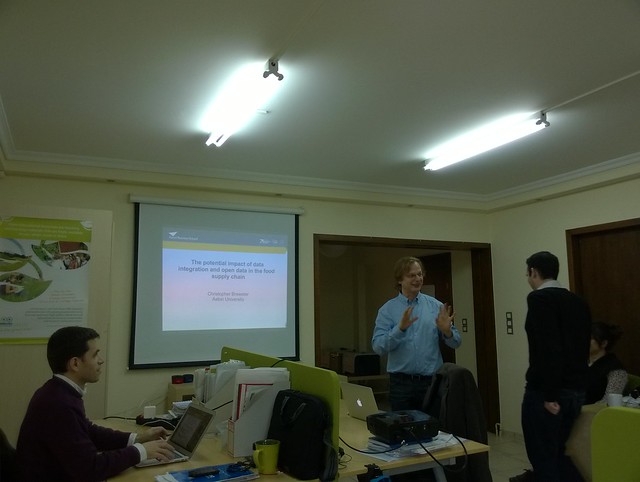
Dr. Brewster during the presentation

Dr. Brewster was kind enough to accept our invitation and visit the AK offices on Friday 21/3/2014, where he made a really interesting presentation, titled "The potential impact of data integration and open data in the food supply chain". The presentation discusses the issue of food supply chain data, taking into consideration aspects such as open food data, mentioning data platforms, initiatives and standards, legislation, the status in various EU countries etc. After the presentation we had the opportunity to spend some time talking about the issues highlighted in his presentation and present our feedback on these and I hope that we will have the opportunity to collaborate in the near future.

Dr. Brewster, Nikos and Andreas exploring possibilities for collaboration

Friday, April 4, 2014

Agro-Know in the EDF 2014

The European Data Forum (EDF) 2014 took place between 19-20 of March 2014 and it was only one of the data-related events that would take place during the 6-month Greek presidency of the EU Council. According to the website of the event, "The European Data Forum (EDF) is an annual meeting place for industry, research, policy makers, and community initiatives to discuss the challenges and opportunities of data in Europe, especially in the light of recent developments such as Open Data, Linked Data and Big Data". This is at the heart of what we are currently working on in AK; we are getting deeper and deeper in the open, linked and big data, always in the agricultural context. This means that there was no way that the AK team would not be represented at the event.

The event was collocated with the Europeana Cloud Plenary, which was attended by my colleagues +Theodore Mathioudakis+Effie Tsiflidou and +Andreas Drakos who are contributing to this effort. Andreas also helped with the Agro-Know booth that was setup at the EDF2014 and which was full of brochures of Organic.Lingua, as the sponsoring project of this activity, agINFRA and of course Agro-Know ones.

Andreas & Vassilis @ EDF2014
(source: https://www.flickr.com/photos/lod2/13433089254/in/set-72157642967653084/)
Even though I did not have the time to actually attend the speeches of the first day of the forum (unfortunately I could not attend the second day - the full programme is available here), I had a great time being there and meeting people who were interested in the AK products; at the same time, I had the time to take a look around and see what the other booths were about, finding interesting people, projects and products. I had the pleasure to meet Karel Charvat again (after the EFITA 2011 Conference), one of the most active persons that I know, actively involved in several initiatives. Among  the other participants, I got engaged in a discussion with Natalia Manola from Athina Research Center, a person actively involved in several data-related projects like DRIVER, OpenAIRE and OpenAIREPlus. Our first meeting was during the RDA 2nd Plenary Meeting in Washington D.C., last September. Last but not least, I had the pleasure to meet Dr. Christopher Brewster from the Aston Business School of the Aston University, UK - we had the opportunity to meet again during the next day at the AK office.


Created with flickr slideshow.


I also got to see +Sarven Capadisli, one of the people I admire for their work in linked data; this was the same case with Deirde Lee from DERI, Ireland, an old time acquaintance from a joint project with GRNET back in 2010. Both of them were engaged in conversations almost during the whole day so I did not find the appropriate time to get to know them better.

Overall it was a really interesting experience which provided us with the opportunity to expose our work to a related and wide audience (yes, the AK booth got busy at some points!) and to get to know interesting people working in similar topics and with whom we could establish collaborations in the near future. Andreas and Elena were there during the 2nd day of the event which was as useful as the first one.

Post-processing EDF2014 (info from the official web site)

Thursday, April 3, 2014

Food for thought: Agricultural Knowledge and Innovation Systems Towards 2020

(blog post initially posted at the Agro-Know blog)

We recently came across a really interesting publication by the European Commission’s Standing Committee on Agricultural Research (SCAR), titled "Agricultural Knowledge and Innovation Systems Towards 2020". The publication is available through the EU Bookshop, which is always a valuable source of  policy documents and reports.
SCAR was established back in 1974 and is responsible for the coordination of agricultural research efforts across the European Research Area, including questions of advisory services, education, training and innovation. SCAR set up a Strategic Working Group (SWG) of civil servants from the European Commission and the EU Member States to reflect on the Agricultural Knowledge and Innovation Systems (AKIS) - you can find a really interesting publication on AKIS, titled "Agricultural Knowledge and Innovation Systems in transition Findings of the SCAR Collaborative Working Group on AKIS" in the OECD iLibrary. SCAR consists of more than twenty (20) Collaborative Working Groups (CWGs) and Strategic Working Groups (SWGs) formed by Member & Associated State representatives. The role and the structure of the WGs are described in the report that we are referring to.

Cover of the "Agricultural knowledge and innovation systems towards 2020" report
The report itself is based on the need for revisions to be implemented in the current approach followed by AKIS, in order to ensure that it will meet the requirements for actually feeding an increased number of people in the following years making the best use of the available resources. In this direction, the repost reflects on "how innovation could be organised in the European research and innovation policy, using the framework of the European Innovation Partnership for Agricultural Productivity and Sustainability, and how this could be connected to agricultural policy and the Horizon 2020 research framework programme". The role of ICT in this context is really important and highlighted through the document, along with the role of the innovation which is a necessary component of the whole process. The report is providing interesting aspects on topics such as agricultural research policies and innovation in agricultural research, proposes approaches for engaging the agricultural researchers in targeted research & innovation, discusses alternative approaches and revisions to the existing ones, proposes approaches for stimulating the entrepneurship; all these filtered through the experiences of the 37 member countries represented in SCAR. However, the most relevant part for what we are working on in Agro-Know is presented in Chapter 6 of the document.
Chapter 6 is developed by the International Centre for Research in Organic Food Systems (ICROFS), co-authored by Ilse Rasmussen, an Agro-Know long-time friend and colleague in projects. The chapter focuses on the role that ICT in general and more specifically the social media may have in the transformation of AKIS and the innovation approaches proposed throughout the document. In fact, this chapter provides a useful overview of the hardware (e.g. mobile devices such as smartphones and tablets), software (such as software tools and platforms) and other aspects, which are described and analysed in some cases.  I am always interested to see commonly used platforms like Facebook, Flickr, Slideshare and Twitter used for serving agricultural knowledge sharing purposes - in some cases in a unique way, such as AgChat. In Agro-Know, we massively use such tools for the dissemination of the projects that we participate in and apart from that, for the dissemination of the AK-related news and events - and it seems that even these free (but widely used) tools are doing a great work. Additional ICT tools, such as the Flash Meeting platform, Google Hangouts and other platforms are also frequently used for virtual project meetings, online Workshops and delivering presentations; the Webinars @ AIMS series is a fine example of using an online platform for such purposes. Apart from that, there are platforms serving online course management and delivery for various levels of education, such as the agriMoodle platform, which is also developed by Agro-Know - in fact this refers to a number of Moodle components developed by AK for meeting the requirements of the agricultural learning communities.
The VOA3R platform for networking agricultural researchers, students and practitioners, providing virtual space for creating user communities, sharing resources and networking and on top of that access to million of agricultural research publications is another example mentioned in the report. We feel proud as AK to have been involved in each development, adaptation (under the GRNET umbrella) and also have plans to adapt it to meet specific requirements of existing communities and reuse it in this way.
agINFRA_logo_newThe low adoption of the ICT tools in agriculture, which is highlighted in the report, was something that we have also faced in the projects that we have been involved. For example, in at least two cases, there were agricultural training curricula developed, organized and made available through online course management platforms; however, access to the courses by the end users was usually limited due to various reasons including the lack of appropriate equipment, the lack of a stable internet connection and last but not least the lack of basic knowledge of using a computer and/or the software used for the delivery of the courses. Other issues such as the language barriers which did not allow users to access resources in other languages than their own were solved by solid solutions proposed by projects like the Organic.Lingua, which transformed the Organic.Edunet Web portal into a fully-multilingual portal which serves a relatively high number of languages through automatic translation features and cross-language information retrieval through a fully multilingual user interface. Other issues, such as the agricultural information scattered in several different databases, repositories and websites is currently being investigated (and solved) by the aggregation and linked agricultural open data approach and the integrated cloud/grid based services proposed by the agINFRA project. This is being taken one step further by the SemaGrow project, that aims to enhance the real-time performance of the global agricultural data infrastructures, by proposing a linked data-based approach. Agro-Know is actively involved in these projects and the last two have been discussed during the G8 conference on open data for agriculture about one year ago, as two of the most promising ones funded by the European Commission.
Agro-Know is also involved in initiatives such as the Global Open Data for Agriculture and Nutrition (GODAN), the Coherence in Information for Agricultural Research for Development (CIARD) and the Global Food Safety Partnership (GFSP), while it also closely follows other related networks and initiatives, such as the Research Data Alliance (RDA) and more specifically the Agriculture Data Interoperability Interest Group and the Wheat Data Interoperability Working Group. All these initiatives have more or less a common goal; to identify the requirements of the agricultural community related to access to agricultural data and to allow and/or to enhance access to open and linked data, making use of infrastructures that can support the management of large volumes of information and knowledge and disseminate related open access policies and information between stakeholders. CIARD aims to "to develop common standards, share knowledge and contribute to coherent, effective and open institutional approaches to agricultural knowledge" and could be the link between the individual agricultural data providers, individual researchers, policy makers and other stakeholders, and the data infrastructures that are available for facilitating access to agricultural resources. In this direction , the CIARD R.I.N.G. (Routemap to Information Nodes and Gateways) acts as a global directory of web-based information services and datasets for agricultural research for development and could provide this link that could also be a key component of the processes proposed by the report. More information about the RING can be found in the CIARD RING handbook (PDF).

These are only some examples of existing tools, services and initiatives which can be used in this large-scale effort towards the reformation of the AKIS mentioned in the report. It is really important that all these initiatives previously mentioned are taking into consideration the previous work done in this context so that existing material can be adapted, adopted and reused in order to meet the requirements of the constantly growing sector of the agricultural information and data management. The upcoming "Global Consultation on Open Agricultural Knowledge for Development", a  joint CIARD/GODAN meeting in Rome (22-24/4/2014), will provide an opportunity for the members of these two large initiatives to meet, exchange ideas and find some common ground for joining forces and working toward opening up access to agricultural knowledge and information.