Tuesday, November 3, 2015

ODI Summit 2015 & Agro-Know

The ODI Summit themed "Celebrating Generation Open" takes place today, 3/11/2015 at London, UK - obviously organized by the Open Data Institute. If you ask me (and many more), it is the biggest Open Data event of the year. Globally. It provides the opportunity to a wide variety of stakeholders to gather and shares their views, updates and ongoing work on open data.


Agro-Know is there, represented by our CEO Nikos Manouselis, who was really excited after attending the Summit last year. Since then, we had the opportunity to get to know the work of ODI better and even got the chance to work with their lovely team on the GODAN Discussion Paper (see also here). On top of that, our COO Giannis Stoitsis successfully completed ODI's Train the Trainer course, becoming a certified Open Data Trainer and since then he has delivered a number of courses on the topic. Last but not least, we have been working on joint project proposals with ODI during the last months and we are really looking forward to see them accepted and start working on their implementation. :-)

I am sure that Nikos will make the most of of this event, and he will come back to the office full of ideas and new connections, among others - any memorabilia from the event will also be more than welcome!

P.S. Did I mention that Agro-Know has recently become an ODI member? :-)


Saturday, October 31, 2015

Big Data apps for food safety; where are they?

We frequently refer to the highly important role of big data in the agri-food context, food & food safety but which are the big data-powered applications that already exist and serve real needs in this context? Agro-Know recently received a related question through a tweet:

The response is surprisingly not easy and a recent blog post by Nikos Manouselis (Agro-Know CEO) also poses the same question: Is there really a substantial purpose for using big data in this context or is this work taking place in the context of academic exercises?

I have described one of the really promising efforts in this context (the collaboration between IBM and Mars Inc.) but if we are looking for something even more publically available, then we should look for alternatives.


If you happen to be aware of any big data-powered apps for food safety, please leave a comment below! :-)

Saturday, October 17, 2015

On the concept of staleholders

The other day I had a pretty urgent task to complete: Two of our EU projects needed feedback from potential end users of their approaches and outcomes in order to help us understand if we have produced something meaningful and useful to them; one of them is looking at the existing gaps between education and actual professional needs while the other is focusing on the competences required in the same context (both of them activated in the agriculture and green contexts in general). In this context, both projects had online surveys prepared and ready to be completed by potential recipients of an email invitation.

Such projects usually aim to provide solutions to real problems of a predefined target group. In this context, they usually get the initial information and current status from desktop research, they validate these issues through initial workshops that aim at the elicitation of actual user requirements, they start building solutions based on them, they validate these solutions through trials and then, as soon as the solution seems mature enough, this goes public in the form of a public consultation.


What I had to do was to compile two lists of recipients of the corresponding email invitations (one for each case) and prepare a short invitation text for the email, customized for each case. Since I am a big enemy of spam (I receive an awful lot of them on a daily basis), the recipients of my lists were carefully selected, so that only people that might be interested in each survey were included. The invitations were sent to about 15 and 35 recipients respectively (some of them were common). I did not require a response in my email and I have not checked the responses yet. In addition, none of my emails bounced back, so they were all sent to valid email addresses. In the first couple of days, I only received one (kind) response to my email, mentioning that they will complete the survey and that they would also forward the invitation to potential stakeholders.

Have you ever contacted friends, colleagues and other contacts asking for their feedback on something that may be of interest to them but never hearing of them?

My experience from similar efforts in the past shows that the response rate is really-really low; we only get a low number of responses to similar questionnaires from people that ideally should be interested in the specific topic. Why this happens, I don't know: it might be due to lack of time for completing the survey, lack of interest in the specific topic, ignorance in general - maybe it is the way the are presented to them (dull/boring) or the fact that they already receive a lot of similar requests so they have stopped responding to them.


This is when a typo I made in a report I was preparing gave me the idea of the concept; were are referring to staleholders, meaning potential stakeholders that have stop being interested or responsive about a topic that should be of interest to them. I guess that such people should have been interested at first, but for any reason (like the aforementioned ones) they are not interested in it anymore. Stale may refer to both the status of the user as well as to the information that he/she receives. Sounds funny but true at the same time!


The point is that since such projects are working on providing solutions for these users, and they spend time and effort for this purpose, then we need to find ways to actually raise their interest and engage them. Of course this is not possible to take place at 100% but the response rate needs to be improved and since face to face meetings have obvious restrictions (number of seats, time and place limitations), an alternative approach should be identified.

According to the Merriam Webster Dictionary, stale is defined as "not interesting or new; boring or unoriginal"

If you have any ideas about that, please let me know (through a comment) and I will be eternally grateful to you!

Monday, September 28, 2015

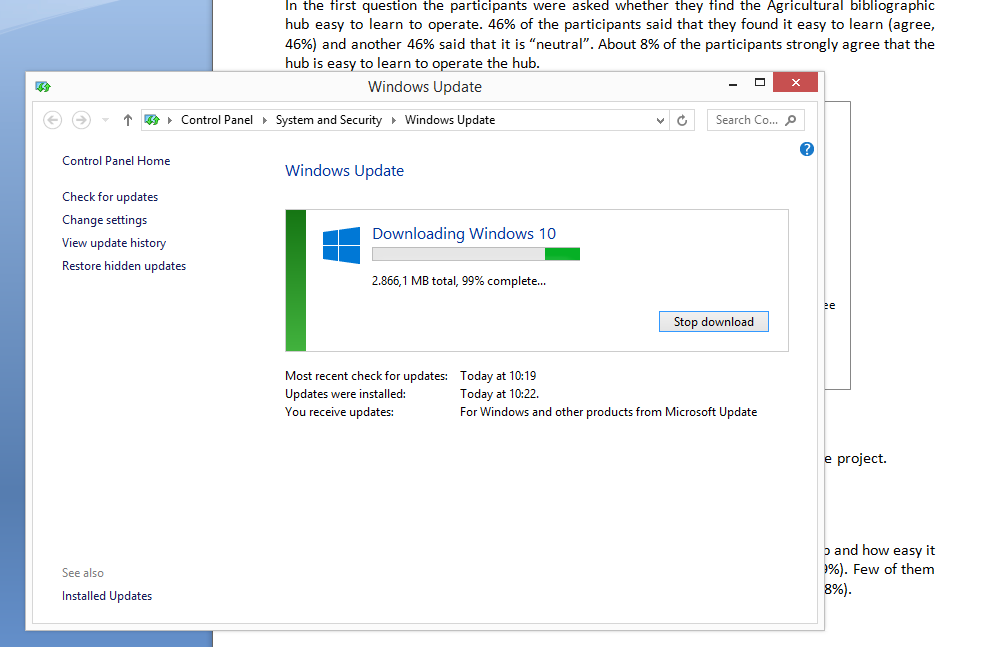
Upgrading my work laptop to Windows 10...

...while actually working on deliverables and other stuff. How smart is that? :-P


I tried to postpone it but I get this weird urge whenever an update is available - no matter what so I decided to move on at this very moment! For the time being I am working and upgrading at the same time... fingers crossed!

Saturday, September 5, 2015

Our paper for the EDEN Open Classroom 2015 got accepted :-)

Some weeks ago, we prepared and submitted a paper titled "Environmental Education Through Enquiry and Technology: The Case of the GreeNET Poject" for the EDEN Open Classroom 2015 Conference, that will take place in Athens, Greece between 18-21/9/2015. According to the organizers, "the Conference incorporates the final event of the Digiskills project, a European project demonstrating ways to involve school communities in innovative teaching and learning practices, and empower teachers and trainers to use, share and exploit unique resource, as well as the GreeNET project that aims to address the increasing necessity to develop an integrative approach in environmental education. The timing will also make several of the conference activities the first steps in the sustainability of the Open Discovery Space projectone of the ever-largest EU co-funded educational networking initiative."

GreeNET Final Conference @ EDEN Open Classroom Conference 2015


On Friday we received a notification from the Program Committee that our paper has been accepted for presentation at the conference and inclusion in the ISBN-identified Conference Proceedings (to be published in both printed and electronic versions). :-)

The paper describes the tools developed and used by the GreeNET project, namely the GreeNET Inventory, the GreeNET Best Practice Authoring Tool and the GreeNET Moodle. I wish I could share some more details on these, but I will have to go prepare my slides for the presentation now; the presentation will take place on Sunday, September 20th Saturday, September 19th 2015 and you are invited to attend :-)


Wednesday, September 2, 2015

Change of role - change of signature

I took some time today to revise my email signature, in order for it to reflect my new role in the team - Senior Project Manager! It feels strange to see this revision in the signature, even though I adapted in my new role pretty quickly; after all, I am no stranger to project management! I spent several years in the past supporting the management (and mostly the implementation) of several of our projects and have flown thousands of miles traveling all over Europe in order to represent Agro-Know (and not only) in project meetings, Conferences and Workshops

I also did the corresponding revisions in my Agro-Know wiki profile; I still have to revise the text on the corresponding website Team page. Small but still significant revisions.

Tuesday, September 1, 2015

PubAg: Providing Open Access to agricultural research

PubAg is the National Agricultural Library's (NAL) search system for agricultural information. It provides access to quality agricultural research publications both from USDA-affiliated researchers as well as from external ones. authored and other highly relevant agricultural research. When it was launched, it started with a number of 40,000 full-text journal articles provided by USDA staff  and including about 450,000 citations to both internal and external publications. The aim of the National Agricultural Library is the enrichment of the available content on a monthly basis, by adding about 20,000 citations each month.

PubAg provides access to full-text articles relevant to the agricultural sciences, along with citations to peer-reviewed journal articles. Each resource is described with metadata, including

  • Title
  • Abstract
  • NAL terms: They are clickable, so by clicking one of them, you get a list of results tagged with the specific term.
  • Names of Authors: They are clickable, so by clicking one of them, you get a list of results from the specific author.
  • Citation
  • Link to the publisher's record (through DOI): The link can be used to access the metadata record of the publisher and hopefully the full-text article, if it is openly shared (i.e. it is not available behind a paywall).
In addition, each metadata record can be exported as CSV or printed; in the latter case, the user receives a printer-friendly version of the metadata record.

A metadata record in PubAg


On the other hand, when a user want to perform a query with specific terms, he can use a free-text search box. Words entered into the search box are automatically translated into subject terms from the NAL Thesaurus (NALT) and the corresponding documents tagged with these NALT terms are retrieved and presented to the user.

List of results after a query

As of today, PubAg provides access to about 972,000 metadata records and 42,000 full-text articles. 200,000 records reflect on research published after 2012, which makes the content really up to date.

 I was also surprised to find a few of my publications on the PubAg portal!

Who would have thought...(some of) my publications available through PubAg!
Thanks to the ongoing work related to GACS (Global Agricultural Concept Scheme), this large database of quality agricultural research outcomes will be easily interconnected with others, such as the FAO AGRIS (that Agro-Know is maintaining and expanding, boasting almost 8M records) and the CAB Abstracts (about 2M records). This is expected to greatly facilitate the work of agrifood researchers, information and knowledge managers, among others.

Thursday, August 20, 2015

Agro-Know and social media: The progress in one year

One of the nice things in Agro-Know is the fact that you have the opportunity to get involved in various interesting tasks and change the focus of your work (which is good in some cases). In this context, I had the opportunity to focus on Agro-Know's marketing activities, tools and strategy; something that I have really enjoyed (at this point, I spend more time in the Project Management Department of Agro-Know, supporting its Director Nikos Marianos in various tasks).

As a Marketing & Networks Manager of Agro-Know I had the opportunity to combine my domain-specific expertise that allowed me to identify of at least the basic concepts, the main stakeholders and the identification of topics of interest, with a basic (at least) knowledge of the use of social media and marketing tools. Skills like communication, writing and copywriting/copyediting, desktop research and analysis of data, even photography and networking are also the ones that are needed for such a position and I tried to work on them; in fact, I still do as I am really interested in this kind of work - I even got invited to an interview by Agora MedSpring about the use of social media on the dissemination of information and knowledge.

What I did during this year was to focus on something that I really enjoyed; social media. Starting with our (almost inactive) Twitter account and also the fresh Facebook page of Agro-Know, I worked not only on trying to share quality content that would bring value to the company but also to identify the audience that would be interested in this content and build a community of engaged users. My aim was to create a buzz around the Agro-Know brand and share news related to the activities and outcomes of Agro-Know as well as quality content on agrifood information and knowledge management, covering topics such as open access and open data, linked open data, research outcomes, EU-funded research projects and proposals, interviews with people that work on these topics etc. At the same time, I tried to provide an insight on Agro-Know as a team, providing information on its members, activities in the office, internal culture and a more informal side of Agro-Know - just to show its human aspect.

Number of Twitter followers


At the same time, I experimented with Agro-Know's Google+ page (which is updated more or less like the Facebook one), I tried to keep the Flickr and Slideshare accounts updated and introduced a new tool, Instagram (which started as an informal experiment and now it's another tool in our social media arsenal). On top of that, I dedicated time and effort in transforming Agro-Know's LinkedIn page, which currently features 155 followers.

Number of Facebook likes
Number of followers on LinkedIn


However, the main source of content was published through the Wordpress-based Agro-Know blogwhich allows us to share news, updates, events and even personal opinions on topics of interest. Even though it is not as teamwork as I would like it to be, I believe that it has great potential as long as it is frequently updated with quality content. It can and should be used by everyone in the team (we also invite guest bloggers to contribute!) to share their work, concerns and ideas on what we are working on.


AK blog page views for the last year


The analytics of all the aforementioned tools used show that indeed the numbers are growing; likes and followers are increased, the same goes for retweets and shares, blog subscriptions are constantly growing etc. In addition, taking advantage of major events and using their special hashtags, participation in related online conversations can boost engagement and reach. But how does this affect Agro-Know (in a positive way)?

I am afraid that I do not have the answer to this question; it seems that it is really hard to identify the impact that all this time and effort put in our social media have in the progress of the company. I know that our social media presence is appreciated by several people that I /we admire and appreciate their own work but we cannot go further than that.

What I have noticed during this year is the fact that while sharing and liking seems to go pretty well (after all, it is only a matter of pressing a button in all cases), we receive no feedback on our content; only a few responses/comments have been received to our (currently) 200 blog posts (most of them within the team), our tweets very rarely get responses (not referring to retweets but to replies) and no comments appear below our Facebook posts. Some of the possible factors include

  • the lack of time for commenting and replying; in contrast to liking/retweeting and sharing, responding takes time for putting thoughts in order and expressing them in a logical way, 
  • the abundance of information constantly shared through social media and blogs, 
  • the high number of content sources that potential stakeholders need to access;
  • the lack of interest in general and 
  • (hopefully not!) the low quality of the content.

Information and knowledge sharing, especially in the agrifood sector, is a hot topic nowadays and I can see several vacancies related to this context (something that highlights the need for staff with specific skills). My experience so far shows that there is a wealth of information and knowledge to be shared and at the same time a long way to go for ensuring the optimal sharing of this content. At the same time, there are multiple platforms that share similar content and this renders the identification of quality content harder, as a content consumer needs to access multiple content sources. Aggregators like Agrifeeds partially solve the problem, by aggregating feeds from multiple sources (mostly blogs and websites) and offering user-defined RSS feeds, but still content shared through social media is not available through Agrifeeds. 

Ideally, a platform allowing users to select the feeds they want from a predefined list or to add their own sources; something like Agrifeeds or the most widely known Feedly do but with more options and a better, more user-friendly interface. Even though this solution would (partially) solve the problem of multiple content sources and lack of time, still there's not much that can be done in terms of lack of interest as well as the low quality of the content. 

In the end, the same question remains unanswered: Does it worth the effort and cost for working on the dissemination of agrifood research outcomes and other news? Does this actually pay back in any way?

P.S. What I didn't do during this year? I did not put enough time on updating the printed marketing material of Agro-Know (after all the changes in the team and focus of our work were constant and significant so it would have been obsolete in a short time), neither on our corporate website (which surely needs a nice facelift in terms of content). As regards printed material, I believe that it shouldn't be the main marketing tool; as for the website...revisions are on their way!

Thursday, August 13, 2015

Agro-Know team lineup: August 2015

After some changes in the Agro-Know team which took place during the previous months, this is our current team lineup:


As a result to these changes, there have been some changes in the internal organization and structure so I found myself supporting Nikos Marianos in the Project Management Dept. of Agro-Know; my work consists mostly on working on various deliverables for various projects that Agro-Know participates in. At the same time, I still devote some time on a daily basis for updating the social media of Agro-Know and other marketing and networking activities.

I miss my ex-colleagues, as I have been working with some of them for several years and they have been part of the family; at the same time, most of them had the chance to explore new business opportunities. It's not always easy to work with a smaller team, but it seems that is is more flexible in this way. Still I wish all the guys (and girls) the best for finding a brand new working environment, hopefully even better than the one of Agro-Know!

Saturday, July 11, 2015

Working on user requirements extraction for the OpenMinTeD project

My colleague Nikos is currently presenting the work that we have done regarding the TAPipedia conceptual design (a report of more than 130 pages so far) and aims to collect feedback that will allow us to work on the final revisions of the document. This is a task that both of us have dedicated a lot of time, effort and creative thinking on, so I am really anxious to receiving the feedback collected during the TAP Experts Group meeting that he is attending these days in Rome, Italy.

In the meantime, I got involved in the preparation of the guidelines for the organization and implementation of events that aim to collect user requirements for the text- and data-mining applications for the OpenMinTeD H2020 project. The project aims to "enable the creation of an infrastructure that fosters and facilitates the use of text and data mining technologies in the scientific publications world and beyond, by both application domain users and text-mining experts". Through a dedicated set of events and using a specific methodology, the project aims to collect requirements from specific types of stakeholders that will allow it to better meet their needs through the development of tools and infrastructure. It includes a generic methodology to be adapted for each individual case (event), a number of templates (e.g. agenda, PPTs, evaluation form etc.) and tips on the successful implementation of such an event. I have some previous experience on the development of such guidelines and methodology, I have support from the rest of the team (whenever and wherever needed) and I really like working on such things, so I am working on that full speed!

The project uses a Redmine installation for various purposes, including management of tasks and documentation of activities like the aforementioned one. According to Wikipedia, "Redmine is a free and open source, web-based project management and issue tracking tool. It allows users to manage multiple projects and associated subprojects. It features per project wikis".

So far, I have been working directly on the wiki-like interface of Redmine for publishing the guidelines. It has a set of wiki features that allow the organization of text in sections and sub-sections, making it easy to create a complex document. I have to admit that I miss some of the typical wiki functionalities (like the automatically created ToC at the beginning of the page) but still I found Redmine really easy to use. Unfortunately I am only using a specific set of functionalities of the tool, which seems to be diverse and efficient in what it aims to allow users to achieve.

The guidelines are expected to be ready by the end of this month and I hope that they will be publicly available so that I can share a link to them! :-)