Tuesday, February 21, 2012

Open Education Week - Only 10 days to go!

I am reposting a press release for an event that is really important for the open access / open education community, regarding the Open Education Week, organized by the The OpenCourseWare Consortium:


OPENCOURSEWARE CONSORTIUM DECLARES FIRST ANNUAL OPEN EDUCATION WEEK FOR MARCH 5-10, 2012
Efforts to Expand Access to Education and Knowledge to be Featured in Global Events

CAMBRIDGE, Mass., – (February 21, 2012) –The OpenCourseWare Consortium announces today the first annual Open Education Week from March 5-10, 2012.  Open Education Week is a global event that seeks to raise awareness about the benefits of free and open sharing in education, especially Open Educational Resources (OER). OER are high-quality, free and open educational materials that offer opportunities for people anywhere in the world to share, use and reuse. 
“The vision of the open education movement is to create a world in which the desire to learn is fully met by the opportunity to do so, where everyone, everywhere, is able to access affordable, educationally and culturally appropriate opportunities to gain whatever knowledge or training they desire. The movement encompasses producing, sharing, using and modifying content, as well as innovative models of educational delivery,” said Mary Lou Forward, executive director of the OpenCourseWare Consortium. “Open Education Week will showcase projects, resources, people and ideas so that people around the world can see the breadth of what has been accomplished already, and participate in discussions about the future of the movement.”
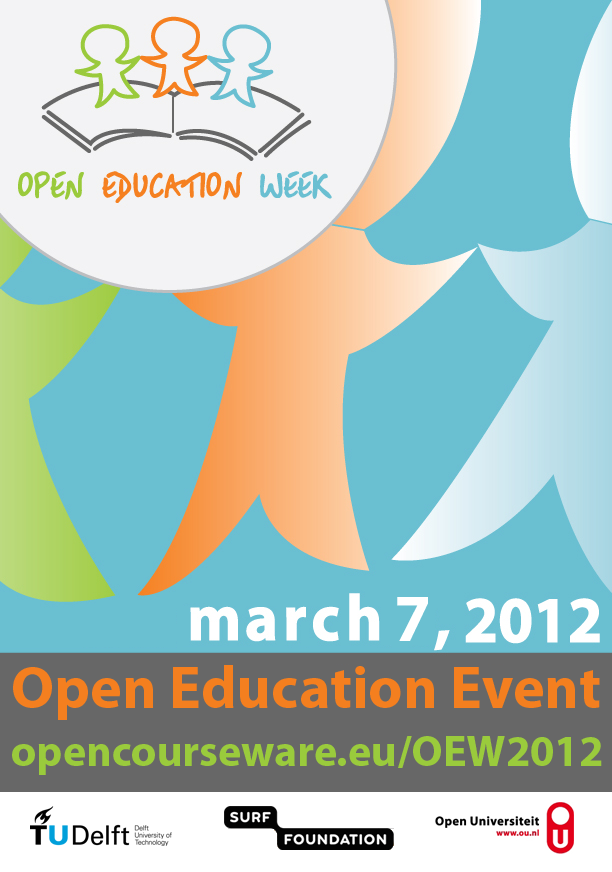
Open Education Week is being coordinated by the OpenCourseWare Consortium.  The event will take place online and in different locations around the world, with opportunities to participate in webinars, discussions and live events. Projects and events will be featured from institutions and organizations from around the world, including: University of Cape Town, University of Michigan, Universidad PolitĂ©cnica de Madrid, University of California, Irvine, Delft University of Technology, and Creative Commons. Participation is free and open to all. Visit www.openeducationweek.org and follow @openeducationwk for more information.
About The OpencCourseWare Consortium: The OpenCourseWare Consortium (OCWC) is a community of more than 250 universities and associated organizations worldwide. The mission of the OCWC and its member institutions is to advance formal and informal learning for educators and self-learners around the world through the sharing and use of free, open, high-quality education materials packaged as courses readily accessible on a digital platform.  The Consortium showcases its members to a global audience and provides information and training through webinars, newsletters, and free and open materials. For more information, visit http://www.ocwconsortium.org.

Thursday, February 9, 2012

Puzzled by Policy

I just took a break and participated in the Puzzled by Policy survey, just to see what it is about. I found the questions to be clear and focused and the whole process was real fun! It has been really well set-up, both the content and the user interface while at the same time collecting feedback about a specific issue (immigration policy) and bringing you close to the real situation in your country.

I will not reveal the end, but it will really surprise you!

This platform is a product of the Puzzled by Policy, an ICT Policy Support Programme (ICT-PSP), part of the Competitiveness and Innovation Framework Programme (CIP)  project.

Thursday, January 19, 2012

Applying analytics for a learning portal: the Organic.Edunet case study

I was only recently informed of another publication, to which I partially participated. It is titled "Applying analytics for a learning portal: the Organic.Edunet case study" and it was a paper initially submitted, accepted and presented by my colleague Nikos Palavitsinins at the 1st International Conference on Learning Analytics and Knowledge 2011 (LAK '11) in Banff, Alberta, Canada. Nikos had a really hard time there, due to the severe cold and the last-minute revisions that he had to make to his presentation!


So far, only the presentation made by Nikos at the Conference was available through SlideShare; however, the paper is now available in the Proceedings of the 1st International Conference on Learning Analytics and Knowledge by ACM (Association for Computing Machinery). Unfortunately, this publication is not open access (in fact access to this article costs $15), but the publication of all accepted papers in the Proceedings of the Conference was a selection of the organizers (and surely not up to us). Still it was really nice to see another publication, especially in this accredited series of Proceedings by ACM.

Wednesday, December 21, 2011

Blogs and wikis - Free tools for publishing information

I really like both blogs wikis. Both of them have a main purpose, but they are easily configurable and can serve additional purposes as well. Here's how I see things and use both of them in different ways:

Blogs: They allow everyone to have a free personal page, which can be easily modified thanks to the wealth of free templates. No need to know about HTML, no need to think about the layout; just experiment with various templates and start entering your own information. For me, a blog provides a virtual space not only to describe some of the most important days of work and achievements, but it also allows me to create my virtual web site, collecting all related information such as my profiles in various professional networking websites, such as Research Gate & Mendeley, my presentations at SlideShare, my latest tweets etc. All my professional information in just one place! I used to keep a diary when I was younger, so it came rather naturally to me.

Another use of blogs is for creating "websites" or reference sites for various events, where creating a new website is not an option. For example, when a project organizes a Workshop or a Conference, all information (such as concept, venue, directions, photo gallery and even submissions in case there is a call for papers or presentations) can be easily hosted in a blog. I have created myself a blog for the controlled experiment of VOA3R project, which includes a wealth of information about the event, including the submitted papers.

Wikis: I am not really familiar with wikis, as I only recently was introduced to a wiki. As I see it, it can partially substitute a website, in the way that it consists of a set of sub-pages, organized and interlinked, providing the information we need in a simple but effective way. A wiki needs some previous knowledge and experience, even when using Mediawiki, which provides a more user-friendly interface. However, it is not as simple as working with a blog, where everything is almost automatically done.

In our case, a wiki temporarily substitutes the website of the company (which is currently under construction). It consists of a number of clearly defined sections such as information about the company, the people, the projects and events. In addition, new wiki pages can be dedicated to specific events, providing information about the events, access to related files etc. See for example the Wiki page for the CerOrganic European Conference.

What I see as a main difference between a wiki and a blog for an event, is the fact that in case a wiki is used for this purpose, it still remains a part of the company's activities so it can be an additional part of an existing set of activities. A wiki should be installed on a server, so this may cause some additional work/expenses. On the other hand, a blog is more individual and autonomous and looks more appealing. In addition, it is usually already installed on a central server, so only a registration is required.

Image taken from keywordy.net
Both tools provide a low cost/free way to present information, avoiding a number of issues such as hosting/servers/reservation of domain names/cost etc. They are easy to use, flexible and remain available without time limitations. Just think of how many times you have tried to reach a website of a project/conference a few years after its end and you ended up with a 404 - Not found error message, because the funding was over...so, when sustainability is an issue, choosing a free option may be the best in some cases, as long as you are willing to make some compromises mostly in terms of appearance ;-)

Tuesday, December 13, 2011

My brand-new publication on Biotechnology

Even though I have been working for EU projects on Organic Agriculture (mainly), vocational training and management of collections/digital content during the last years, my academic background is focused on agricultural biotechnology. In fact, I was lucky enough to have a long and fruitful collaboration (since 1998) with Prof. D.L. Bouranis and Dr. S. Chorianopoulou, who guided me from my first steps in my under-graduate years, through my MSc and PhD research, experiments and theses. With their support and help, and after spending countless hours in the Lab, I have managed to have a number of scientific publications in the area of agricultural biotechnology.

Since I have presented my PhD thesis back in 2008, I have not been active in this area. So it came as a surprise to me to be informed by Dr. Bouranis that we have another publication based on the results of my PhD and the related experiments! The publication is called "Comparative spatiotemporal analysis of root aerenchyma formation processes in maize due to sulphate, nitrate or phosphate deprivation" and is available online through the Protoplasma International Journal (by Springer). It seems that the work done back then still has some things to show and that makes me proud! To this direction, we plan to work on some additional publications in the near future, hoping that they will also be well-accepted like this one.

My list of publications exhibits a high degree of diversity, since a number of them are related to my agricultural part, while the rest are related to my current context, being more related to learning/training content/curriculum, digital repositories and metadata. Even though updating my list of publications is not my main concern (in fact, it has never been!), it is always nice to see a new publication especially as a reward for the tasks completed now and in the past.


Friday, December 9, 2011

CerOrganic European Conference

The CerOrganic European Conference titled "Organic Agriculture & Education: Challenges in Training Advisors of organic farmers", took place on Tuesday, December 6th 2011 at the premises of the Institute of Agricultural Sciences (IGE – www.ige.gr). The Conference was organized under the auspices of the CerOrganic LdV EU project (www.cerorganic.eu) and aimed to provide an opportunity for meeting and discussion between scientists and experts from all over Europe, who are involved in the education and training in the field of organic agriculture.

The poster of the CerOrganic European Conference

The Conference included a number of presentations from project partners, who had the opportunity to present the outcomes of the work done during the project. In addition, presentations on related topics were delivered by external, invited speakers including:

  • Costas Dritsas (Greek Representative of IFOAM EU Members), presenting the International Federation of Organic Agriculture Movements (IFOAM)
  • Prof. (KR) Christian Stracke from University of Duisburg-Essen (Germany), presenting "The Needs for Quality Management, Competence Modelling and Certification in Vocational Education and Training"
  • Prof. Stergios Tzortzios from the University of Thessaly (Greece) presenting his previous experience from related LdV projects "EcoJob-AP" and "Eco-Qualify III”
  • Prof. Alex Koutsouris, from the Agricultural University of Athens (Greece) presenting "Co-learning facilitation: new roles for OA extension"
  • Bas Timmers from the International Foundation for Sustainable Agriculture Training (The Netherlands) presenting "The advisor: the man in the middle"
The Conference consisted of four well-defined and focus sessions on 
  1. "Competence-based curriculum in Organic Agriculture training", 
  2. "Blended learning Approach in professional training for the Organic Agriculture", 
  3. "Quality of vocational training on Organic Agriculture" and 
  4. "ICT tools for the vocational training on Organic Agriculture".
I had the opportunity to present (during the last session) the Course Management Platform (MOLE) as it was used by the CerOrganic project during the various training events (both the CerOrganic Training of Trainers Summer School and the Validation Seminars that took place in each user country). The statistics of the usage of this platform were really encouraging after all!

More information about the Conference, including the agenda, poster and brochure can be found in the Conference's wiki page.

Thursday, November 24, 2011

Organic.Balkanet European Workshop

The Organic.Balkanet EU project organized a European Workshop titled "Training Challenges for the Agricultural Professionals: The Organic.Balkanet Experience", that took place in the eula of the University of Agronomic Sciences and Veterinary Medicine Bucharest  on November 17th, 2011. The Workshop was attended by more than 70 people, including researchers, academia, students of agronomic sciences, professionals in the field of organic agriculture as well as representatives of the Romanian Ministry of Agriculture.

The Workshop started with a keynote speech from Dr. Helga Willer from FiBL, providing a short overview of the status of Organic Agriculture in Europe and a presentation of the Organic Eprints archive and was followed by a presentation of previous similar to Organic.Balkanet initiatives (such as Bio@gro and Organic.Edunet), as well as the the presentation of the Organic.Balkanet project. A presentation of the e-learning methods was also delivered in the same session. The 2nd session was dedicated to presentations of the training events of the Organic.Balkanet project in the user countries (Bulgaria, Romania and Slovenia).

A hands-on session included the use of the Organic.Balkanet MOLE portal, a course management platform for creating and delivering online courses as a part of a training curriculum. The 2nd part of the hands-on session included the VOA3R portal, which focuses on providing access to a siginificant number of open access scholarly content, as well as for interconnecting researchers of sciences related to agriculture, aquaculture and related areas. Both sessions were handled by Ass. Prof. Salvador Sanchez from University of Alcala and me, as a member of the GRNET team.

The last sessions of the workshop were dedicated to the Sustainability plan of the project and some additional presentations from Romanian organizations related to organic agriculture.

You can find more photos from the Workshop in the project's Flickr photostream.

Tuesday, November 22, 2011

Organic.Balkanet 5th project meeting

Prof. G.V. Roman discussing during the
project meeting
The 5th (and last) project meeting of the Organic.Balkanet EU project took place at the premises of the University of Agronomic Sciences and Veterinary Medicine Bucharest between November 16-18, 2011. All project partners were available and discussed the pending issues of the project, a few weeks before the end of the project. I had the opportunity to meet the project partners for the last time after a couple of years. I have to admit that I was especially connected to this EU project, since it was the first one that I was so actively involved (and the second one in my short career so far, after my involvement in the Organic.Edunet project).
Some photos from the project meeting can be found in the project's Flickr set.

The project meeting was collocated by the Organic.Balkanet European Workshop that took place at the Eula of the University on November 17th, 2011.

Sunday, November 13, 2011

I.S.L.E. Professionalization Fair / 4th project meeting

Two different but closely related events of I.S.L.E. network , that took place in the premises of Instituto Superior de Agronomia of the Technical University of Lisbon, Portugal between November 7-11, 2011

1. Professionalization Fair: It took place between 8-9/11. Almost all project partners, along with some additional stakeholders/companies, were allocated a space, which included a chair, a desk, power supply and internet connection, as well as enough space for 4 posters, in order to promote their work and meet potential stakeholders. Everything was really nicely organized and the Agro-Know team was happy to introduce the first ISLE project poster, as well as revised brochures of the project. Unfortunately, due to various reasons (including the bad weather), the participation from people outside the project was limited. However, it was still a nice opportunity for project partners to get to know each other even better and more specifically have a clearer image of what each project partner is working on.
The 2nd day of the Fair included a number of interesting presentations from organizations that are involved in the area of sustainable development as well as a substantial (but rather short) round table discussion, including various experts in the area of SD.

2. I.S.L.E. 4th project meeting: It took place between 10-11/11. The first day was dedicated to the current status of the ongoing tasks of the project, so each WP leader provided a brief overview about the status of the corresponding WP. In addition, Dr. Jad Najjar from the Katholieke Universiteit Leuven, was introduced as the new Belgian partner. Additional sessions in the evening were arranged, in order to discuss the next actions for each WP and set the corresponding deadlines.The second day included a technical visit to the Companhia das LezĂ­rias, the largest agriculture, cattle and forest farmstead in Portugal, covering the marshlands of Vila Franca de Xira, Charneca do Infantado and Pauis (Belmonte, Lavouras and Magos), totalling about 18,000 hectares.

For once more we spent so much time together that it felt like a family reunion! From breakfast time in the morning to the dinner time in the evening, we were working in teams, discussing various things, exchanging opinions and having fun! Had to leave really early (about 07.00), but I was lucky enough to have a bus stop of a convenient bus right outside my hotel so I just had to wait for a few minutes before I entered the bus.

Looking forward to the next project meeting that will take place at the premises of Harper Adams University College in Newport, UK.

Saturday, November 5, 2011

Preparing for the 4th project meeting of I.S.L.E.

On Monday I am flying to Lisbon, Portugal in order to participate to the I.S.L.E. 4th project meeting as well to the Professionalization fair, which will be collocated and organized by the School of Agronomy of the Technical University of Lisbon, as an ISLE partner.

Clipped from: voa3r.cc.uah.es (share this clip)
This time we have a lot of things to present to the project meeting, and not limited to the dissemination activities that we are responsible for: New project brochure and poster, almost ready-to-send newsletters, a new platform for providing the ISLE project partners a place to meet, share and discuss, revised course management platform and handbooks etc. It is a good thing that almost all these activities were supported by my colleague Andreas, who devoted a significant amount of time for them.

The Professionalization fair will provide us (as Agro-Know) with the opportunity to present our work in various projects related to the area covered by I.S.L.E. I have already packed my suitcase with posters, brochures and leaflets from these projects, while I have a number of slides presenting these projects, that will be played back and forth in my netbook during the Fair. It sounds like a really big event and I am really anxious to see what it's going to be like.

An I.S.L.E project meeting is different than any other project meeting as it always looks like a big family reunion: It is so nice to see people from all over Europe, younger and older, really friendly and full of ideas and share all these days with them not only working but also enjoying the limited free time. Just imagine a consortium consisting of about 39 institutions coming from about 30 different countries - the gathering is just amazing! It is always a pleasure working with this big family and provide as much as possible to the consortium.