Friday, November 8, 2013

Accidental meeting with the BioVeL team - Linked Data in real life

We were on the train from Brussels to the airport, me and my colleague Nikos Manolis, after the end of the EdReNe 10th Conference. He was holding a brochure about Brussels, mentioning the word "Vibrant" and I accidentally though about the Vibrant FP7 project, with which I am quite familiar (due to my involvement with the agINFRA project) and which is closely related to the BioVeL FP7 project, both working in the biodiversity research area. Nikos corrected my and in fact found my mistake funny.

As soon as we reached the airport, still in the train station area, I accidentally met +Matthias Obst, one of the WP leaders of the BioVeL project and the kind host of the 2nd BioVeL workshop that I attended last May. He was travelling with Norman Morisson (also an acquaintance from the same workshop, one of the most active project partners as far as I understood!) and I was really glad to see them. It seems that the team was returning from Spain where the project's review meeting has just taken place. I wished them good luck with the results but I am sure that they will do fine as I am aware of the high quality of the project and its outcomes.


It was not the first time that I got into familiar faces from projects while travelling and this comes to an agreement with my statement that we tend to travel a lot all over Europe (which is not always bad of course!). In addition, it seems that my involvement with linked data has found an application in real life, outside the data and metadata context!

Tuesday, November 5, 2013

Agro-Know on the move - Keep on travelling!

Ok, it is in the nature of our work to travel quite often (project meetings, dissemination events, participation in Conferences etc.), but sometimes this is getting too much (or too funny!); for example, due to our frequent trips, many of us in AK tend to be away from office at the same time and this week is one of these cases:
  • Andreas is currently in Australia, participating in the 3rd EU-Australia Research Infrastructures Workshop, which takes place between 4-8 November 2013, at Canberra, Melbourne, Australia.
  • Laura and Nikos are currently in Vilnius, Lithuania, in order to attend the ICT 2013 - Create, Connect, Grow, in Vilnius on 6-8 November 2013, focusing on Horizon 2020 - the EU's Framework Programme for Research and Innovation for 2014-2020.
  • Another Nikos and me are travelling to Brussels, Belgium in order to attend the 10th EdReNe Conference, which takes place between 7-8/11/2013 at the EUN premises.
I guess days like these are much quieter for those staying back at the office; I surely appreciate such days when I am at the office while others are travelling.

Lovely logo for the ICT 2013 Conference

This also reminded me of the summer of 2011, where I spent three weeks in a row out of office, travelling for the Organic.Balkanet project meeting in Maribor, Slovenia (28-30/6/2011), the ISLE summer school in Malta (4-8/7/2011) and the EFITA 2011 Conference in Prague, Czech Republic (11-14/7/2013). I only had the weekends in between in order to get back home, get some clean clothes and get back on the road again! 

I really love travelling so I do not mind; sometimes I find it amazing how automated this process has turned into so I can pack and get everything ready for a long trip in a couple of hours. My packing skills have also advanced over the years, allowing me to take only the necessary stuff with me (even though I am usually tempted to fill any space available in the suitcase with additional stuff, just in case). I know which airplane seat to choose and why, how to take advantage of the time during short and long flights (reading/taking notes/preparing my presentations and using my netbook respectively), what to do in between flights, how to select a nice hotel within the available budget, how to adapt to new environments, small hotel rooms, find the best way to travel from an airport to my hotel and vice-versa. Of course this takes some time in planning before the trip, explore available options, take notes and print maps but it worth every minute of it as it makes travelling much easier.

Working in the woods! Leuven, Belgium
Sometimes (unfortunately not frequently) I get to find some free time during the trips to go for long walks, sightseeing and taking photos; I usually find myself in such a tight schedule that I hardly find enough time to sleep. In any case, each trip is different and it's always an interesting experience to visit new places - challenging might also be an appropriate word for that! I have found myself working in benches in the woods (during the VOA3R preparations for the 2nd review meeting in Leuven), trying to connect to wifi in hotel lobbies after midnight, squeezing myself next to a snack dispenser in the Sofia airport in order to plug my netbook to the only power source available, working while relaxing in Star Alliance lounges, missing my only mean of transportation and looking for alternatives on the fly, trying to understand why I do not have a hotel room while I have the voucher in my hand and so on. These memories are not to be forgotten in any case ;-)


Friday, October 18, 2013

ISLE: Compendium of Good Practices

One of the first EU projects that I got involved in (including their management on the Agro-Know side) was ISLE. ISLE (Innovation in the teaching of Sustainable development in Life sciences in Europe) was a project funded under the Erasmus programme of the European Commission and gave me the opportunity to join a large network of university teachers in Life Science Universities around Europe (mostly agricultural ones) and work towards developing the expected outcomes of the project. AK was the Dissemination Work Package leader, and I had a really great time disseminating the project in various occasions and using a wide variety of dissemination materials and tools. The project ended on September 30th, 2013 (a couple of weeks ago) and it currently continues in the form of an Association.

It was a really nice surprise today to receive a small package from +Corinne Stewart, the coordinator of the project (and head of the AgroSup Dijon team) and find a printed copy of the Good Practices Compendium, developed by the project.


The compendium is already available in a digital form from the ISLE web site - you can download it here. You can also find additional interesting material, in the form of project deliverable in the Outcomes section.

More things are expected in the future from ISLE, including a proposal for the continuation of the network and expansion of its outcomes which is planned and the liaison with related associations and networks. As I am currently one of the Board Members of the ISLE Association, I have the opportunity to be actively involved in the decision making of the next steps of the association and really anxious to see where this will lead during the next months.

That's me, signing for the creation of the ISLE Association!

Data management policies - which ones are most important to you?


The Research Data Alliance (RDA, https://rd-alliance.org/) Practical Policy Working Group solicits your input on the policies used to manage data collections by your project / institution. Please vote for the policies that you believe are most important or add more policies to the list.

The form is very short and will take only less than 5 min. You input will be used to identify best practices and promote automated policy-based management systems. Thank you!


Thursday, October 10, 2013

Organic.Lingua 6th project meeting

The 6th project meeting of Organic.Lingua took place between 8-10/10/2013 at the AMEDIA hotel in Graz, Austria, hosted by the Know-Center partner of the project. The conference room was an excellent choice, providing advanced facilities for the meeting, which made things easier for the consortium partners. I participated to the meeting as a member of the UAH team, along with Salvador and David Martin.

The presentation panel of the meeting room
It was the first project meeting after the 2nd review meeting which took place in April 2013, so we needed to ensure that all comments received by the reviewers were already addressed or at least that there were ongoing activities towards this direction. All aspects of the project, both content and technical-related, were discussed and the next steps of the project were defined. Special attention was given to the status of the multilingual (and not only) components that are expected to make the difference for the project. Since the project officially ends by the end of February 2014, there are only some months left, during which we need to make sure that everything will be ready as promised.

The project's user partners working during the parallel session

What I found really interesting was the collaboration between the technical partners (I really enjoyed the joint presentation) as well as the hands-on sessions for the user partners, which included the use of the MoKi tool and work towards the use of new components recently integrated (which helped us identify some issues) as well as work related to the ontology evolution. Nikos Marianos from AK also held an interesting session during which we had the opportunity to use the different automatic translation options available through the Organic.Edunet Web portal and compare the translations provided in each case.

K-C proved to be excellent hosts (thank you for the great social event!) and Graz was a lovely, well-preserved city, full of interesting buildings; modern and traditional at the same time. The hotel suggested by the local hosts was also high-quality, providing (among others) constant and fast internet connection (which is always appreciated). In fact, I think that this was one of the most comfortable rooms that I have ever stayed in during my recent trips all over Europe.

The next and last project meeting of Organic.Lingua is expected to take place in Birmingham, UK, hosted by BCU before the end of January 2014. This will allow partners to meet again, ensure that everything is going according to the schedule and leave enough time before the end of the project and of course before the 3rd and final review meeting, during which the progress and final outcomes of the project will be evaluated.

UAH team: David Martin and me celebrating the progress of the project during the social event
The trip back to Athens proved to be challenging, including delayed flights, almost missing connection ones, damaged luggages, missing buses and grumbling taxi-drivers; sometimes I think that such trips are the spice of life!

You can find more photos from the meeting here. Salvador has also posted an interesting (as usual) blog post at the IEUAH blog ;-) 

Thursday, September 26, 2013

Trip to Washington D.C - Behind the scenes

Some quick notes taken during and after my trip to Washington D.C. for the RDA 2nd Plenary Meeting. In general I had a great time in the states, but sometimes things tend to go wrong:

  • I exchanged 200 euros for USD260 at an exchange bureau in the center of Athens; I would have gotten much less at the Athens airport.
  • I flew from Athens to Washington D.C. through Philadelphia
  • Various snacks and beverages were offered during the flight but I still felt hungry; I tend to get more hungry when I am tired. All experienced passengers had snacks in their carry-on luggage!
  • It was really cold during the flight; it reminded me of Greek ships to the Greek islands, where the temperature in the salon is usually really low. I suppose they want to keep us fresh and young during the long trips in both cases. At least US Airways was kind enough to provide warm blankets to everyone during the flight.
  • Due to extremely long queues at the passport check points in Philadelphia, I missed my connection flight to Washington… had to wait for three hours at the airport, which to my surprise provided free access to the internet. It was the first time I missed a flight in more than 30 trips!
  • My luggage travelled to Washington without me, as I was told this happens with national flights. I was really worried that the last time I saw it would have been at the Athens airport; however, it was on the correct lane, waiting for me to arrive in Washington.
  • I wish I have chosen a direct flight to Dulles or Baltimore airports; I would have saved a lot of time from the security screening and might have shortened my trip – both of them were more far away from the city center though (so I would have to take a bus and a metro later), and this is why I chose to fly to Ronald Reagan Airport. I promise that I will never do that again – Only direct flights to my U.S. destination if possible.
  • While waiting at the Philadelphia airport, I grabbed a snack and sat to eat it; I didn’t notice a small (but oily) piece of food left on the chair. This left me with one pair of trousers less during my stay in Washington.
  • I left home at 07.30 and reach hotel at 05.30 (Greek time), so my trip took almost one day!
  • Metro at the Ronald Reagan Airport was not operational on Sunday evening due to works; I had to get a bus for a couple of metro stations, carrying around my heavy luggage.
  • I reached hotel only to realize that there was a problem with both my debit cards (both Visa and Mastercard); the Mastercard was rejected, while the limit for the Visa was 500 euros. I only had USD250 in cash with me.
  • The hotel policy for Debit card owners was to charge a fee of $60 per night for the use of the card – I was not aware of that rule and would have paid in cash if I only knew about that. They said that it would be automatically refunded after 10 days – I never trust this kind of transactions, as businesses tend to “forget” that they have to give you back your money.
  • Each evening I returned to the hotel room after the meeting, only to realize that the magnetic key was not working; I was told during my last night at the hotel that this was due to the fact that the room was not paid yet. However, this also applied to my first night at the hotel.
  • Fees for withdrawing money from ATMs in the States were rather high - I should have converted more Euros in Athens.
  • I was never sure the amount charged to my card by the hotel (twice), as the transactions took place behind the counter and in a nicely-hidden spot. And we are not talking about crooks here; it was a $250/night hotel at the center of Washington D.C.
  • Finding out the exact price for an item in U.S.A. is hard, as the prices shown never include taxes – and taxes are different in different cases. You can only find out about that after you pay.
  • On top of that, you need to tip in almost any occasion. You need to tip the doorman, the bellman, the waiter, the lady cleaning the hotel room, the taxi driver etc. Sometimes you are kindly requested to do so, sometimes you really need to. This is not common in Europe and of course it adds up to the (already high) prices.
  • I could not find a fast food in Washington, at least the ones shown in movies, with large burgers, large fries, large milk shakes. I only got to each some “big” (but still normal in size) sandwiches and less-than-normal sized milk shakes.
  • Walking around Washington was a pleasure; big pedestrian walks, enormous parks, lots of sights. I walked so much that my feet hurt.
  • You feel safe in Washington. There is police around the city, especially near the public buildings (which are really numerous).
  • I spent about an hour walking to the Capitol, thinking that the river would be exactly behind it; I was totally disoriented as usually, as the river was on the exactly opposite side.
  • There were a lot of buildings that looked like ancient Greek ones; it was really appreciated. On top of that, Americans seem to be really proud of their history and respect monuments and figures; this is not the case in Greece.
  • Jogging is very popular in Washington – you need to take better care of the joggers than the cyclists.
  • Jet lag is a fact – I felt exhausted every day after the lunch for the first days. Then I travelled back home, where things were even worse (see below).
  • There are no croissants in grocery stores (I think they call them Pharmacies here) – The only options for breakfast at the hotel room were biscuits and cereals, along with milk. I lived with that during my last morning in Washington.
  • I did not find any stores to buy gadgets/clothes etc. I wouldn’t have minded to get my hands on a refurbished Microsoft Surface tablet, a Nokia Lumia Windows Phonw or maybe a Mac Pro, but it seems that there was nothing around my hotel (and my long walks).
  • I was nervous about the use of power adapters in US with a Schuko plug (for my laptop) so I grabbed a cheap one from Athens, which costed my 14,5 euros. A similar but more well-built-looking adapter in the Athens airport was sold for 35 euros and the same one (as mine) at Philadelphia airport for about $30. I have seen a similar one selling for $50 in a magazine available in the airplane! I have to admit that I loved my adapter, which allowed me to charge all my gadgets using both the plug and the included USB port at the same time. It is highly recommended as a cheap alternative to the more expensive and elegant ones (such as SKROSS).

  • I had problems checking out of my hotel, as my cards could not be used for paying the remaining amount ($600 while my account balance was much higher in both cases). I had to visit an ATM and use both cards (Visa & Mastercard) for withdrawing money as there was a $400 limit per card by the ATM and I needed $600 (transaction which incurred fees both by the ATM and by my banks). In the end, there was a pre-charging made in both cards and one of them will have to be released (it may take up to 10 working days as I was told by the hotel). I just hope that I will not be overcharged. Cards are a mess-cash is good…
  • On my was back to Ronald Reagan airport I managed to get the wrong metro line and I started moving outside the city – thanks to a friendly passenger, I was told how to get the right line again.
  • Before flying from Washington to Philadelphia but as soon as we were seated in the airplane, we were told that there was an weight imbalance and one (volunteer) passenger from rows 1-4 should be moved to the last row; I am currently 115 Kg and was sitting at row 4, next to a guy who seemed to be twice as big as me. To everyones relief, I offered to move to the last row.
  • This time there were no big queues so I had to wait quite a lot at the airports. However, there was a 50 min delay from Philadelphia to Athens. This trip seemed endless. And there were no duty-free shops with gadgets around.
  • As I flew from evening (U.S.) to morning (Greece) I had trouble getting some sleep during the flight. I spent two days trying to recover from the trip.
  • I was expecting my wife to pick me up with the car from the airport but (of course) something happened and I had to take the suburban railway. This meant a delay of about 20 mins and me, sleepless, carrying my 20Kg suitcase and 15 kg backpack over a quite a big number of stairs at the destination station, as both the elevator and the escalators were out of order.
  • Tourist photos from my trip to Washington are available here.

Thursday, September 19, 2013

RDA 2nd Plenary Meeting: Day 3

The third and last day of the meeting was also split between the National Academy of Sciences (morning sessions) and Washington Marriott (afternoon sessions). More specifically, the morning session started with a nice breakfast and a presentation of the outcomes of the break out sessions of the previous day. Johannes presented the outcomes of the Agricultural Data Interoperability Interest Group. I have to admit that I had not realized by then how many IGs and WGs exist in RDA!

The presentation of the WGs outcomes

After that, it was Mark Parsons, the Managing Director/Secretariat of RDA and responsible for the organization of the 2nd Plenary Meeting, who took the floor and presented an overview of the meeting and provided some statistics. He then introduced Andrew Treloar, Director of Technology of the Australian National Data Service who announced the venue of the 3rd Plenary Meeting (Dublin, Ireland), with the help of the DRI (Digital Repository of Ireland) team and a really nice video presentation of Dublin.

No lunch was provided this time but this gave me the opportunity to discuss some pending issues with Johannes while walking back to the Washington Marriott hotel for the afternoon sessions. This time, I attended the Libraries and Research Data session, which was fully packed and to my surprise was also attended by Mark Hahnel, the founder of Figshare. The discussion was rather generic and an overview of things already discussed in other sessions; however, the chairing of Wolfram Horstmann made things more interesting. In any case, it was obvious that everyone was exhausted after three days of intense meetings and participation.

My overall impression of the meeting was really nice; not only I got to follow the advances taking place in various interesting areas, but also gave me the opportunity for some networking and meeting new people (such as Keith Jeffery, a man actively involved in CERIF, a standard developed by EuroCRIS). In addition, it provided me with the opportunity to be more actively involved with both the Agricultural Data IG and the Wheat Data InteroperabilityWG.


The end of the meeting gave me the opportunity to get something to eat (at last - it was 18.00 and did not have lunch yet!) as well as get some things for the road/office/home. I also managed to go for a short walk at the Lincoln Memorial and Potomac river bridge. Last but not least - pack my staff and be ready for departure tomorrow morning!

My photos from the 3rd day of the meeting are available here.

RDA 2nd Plenary Meeting: Day 2

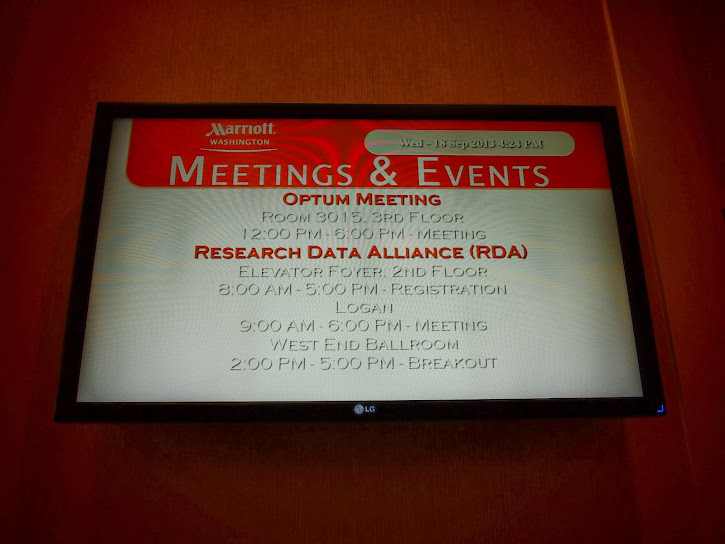
The second day of the RDA Plenary took place at the Washington Marriott hotel. It consisted of break out sessions dedicated to each Interest Group of RDA. I participated in the session of the Agricultural Data Interoperability WG. Each session was located at a different meeting room, which allowed the participants to focus on the topic and contribute to the progress of the Group - however, at the same time one could not attend two sessions of interest, if they were scheduled in the same time slot.

The Agricultural session consisted of about 25 people, including Johannes Keizer (Chair), Devika Madalli (co-Chair), Esther Dzale Yeumo Kabore (INRA) and me. There were people from various organizations, but the ones that come to my mind right now are Luz Marina Alvare from IFPRI and Martin Carr from CABI. Unfortunately I could not see all participants of the meeting, as I was standing at the end of the (long) table. The discussion was based on the proposed agenda and brought up some really interesting issues, including the suggestion for creation of a new Germplasm working group among others.  The outcomes of the meeting are available here; however, there are no photos from the meeting, as I was focused on both participating and keeping notes...

After the lunch break, it was time for a new round of break out sessions; this time (and since our session was over) I decided to attend the session dedicated to metadata. There were some interesting discussions there as well, including some really interesting for the Agri IG. The main idea was about a registry of metadata standards and schemas based on the Digital Curation Center (DDC), as well as the option to have a machine-readable export of the existing information. Unfortunately, the internet connection was not consistent, leading to constant disconnections and issues with the presentations which included links and live demos - let alone twitting!

The last session I attended was dedicated to Data Citation; unfortunately that was a continuation of a previous session (which I did not manage to attend) so it was rather hard to follow but still I found some interesting stuff there. In addition, I got to meet Fotis Karagiannis and Yiannis Ioannidis (University of Athens & ATHENA Research Center), who work with Natalia Manola in the OpenAIRE project and the Athena Research and Innovation Center.


The day ended with a Conference Dinner on the Odyssey Dinner Cruise; however, I was so tired (not fully recovered from the jet lag) that I decided to go for a walk around Washington and then get some rest. I managed to walk until the Capitol passing through the White House and took some really nice photos, which are available here.

In addition, there are photos from the RDA Plenary meeting at the RDA website.

RDA 2nd Plenary Meeting: Day 1

The first day of the 2nd Plenary Meeting of RDA is over. It was dedicated to interesting key-note speeches, presentations on the status and progress made during the previous months, affiliation/liaisons with other organizations / initiatives. More specifically, the meeting started with a nice buffet breakfast, which also provided the opportunity to the participants to get to know each other and start matching faces to names. I was surprised to see and get to talk to Phil Archer from W3C, as I have been using the W3C documentation on Linked Data as a prototype for the work done towards the publication of the agINFRA data as Linked Data. We had a really nice discussion about the fact that publishing data as Linked Data is not as easy as it should be; we both expect that things will change for the better in the next period.

The National Academy of Sciences

The meeting was hosted at the National Academy of Sciences and started with Plenary I, which consisted of keynote speeches from various people activated in the context of the Research Data Alliance. After the first coffee break, Herman Stehouwer chaired a session (Plenary II) dedicated to the progress of RDA during the last months, such as the progress of the various Working and Interest Groups of RDA. The networking lunch provided another opportunity for chatting and networking, as well as tasting the tasty dishes.

Plenary III included discussions related to affiliation between RDA and various related organizations and initiatives. It started by an interesting discussion led by a panel which included, among others, a really important Greek person; Kostas Glinos, the Head of the e-Infrastructure division of the European Commission. During the coffee break we had a short discussion, only to realize that we both come from the same Greek island (Naxos)! What a coincidence, especially if one takes into consideration that the introduction was made by Natalia Manola from the OpenAIRE project who also comes from Naxos! We are not talking about the Greek lobby, but a more specific one ;-)

The discussion was followed by discussion of representatives from affiliated organizations and initiatives, such as W3C, CODATA, DataCite and ESIP. The first part of the meeting ended with Plenary IV, which included the Technical Advisory Board (TAB) in a discussion about WGs and IGs, as well as a nice presentation of the candidates who are interested to become members of TAB.

Nice animation automatically created by Google, by merging a number of my photos

After a short 1 1/2 hour break, we moved to Washington Marriott for the poster session. There we were provided with space for putting up our posters and brochures and had the opportunity to check what each one of the RDA meeting participants was actually involved in. The agINFRA team was represented by +Johannes Keizer (FAO), Devika Madalli (ISI) and me. The poster session was collocated with a well-thought reception. The drinks and light atmosphere allowed the participants to enjoy themselves and get engaged to discussions not limited to the RDA meeting. The reception was sponsored by Microsoft and in fact there was a short speech by Tony Hey, Vice President of Microsoft Research Connections. I was really hoping that there will be a pack of Microsoft Surface Tablets in the room as well, to be distributed to the participants (at least the ones who use Windows Phones!) but of course this did not happen... :-S

That was the end of the day - and there were still things to be done for the next day! I have uploaded some photos from the 1st day of the meeting here. You can also check out the heavy tweeting that took place during the Plenary using the hashtag #rdaplenary and of course by following RDA at Twitter: @resdatall

The full program of the RDA 2nd Plenary Meeting is available here.

Monday, September 16, 2013

RDA 2nd Plenary Meeting Part 1: Background and getting to Washington D.C.

The 2nd Plenary Meeting of RDA is taking place in Washington D.C. (U.S.)  between 16-19/9/2013. This time I was invited to participate as an agINFRA project member of the UAH team and in this direction, I applied for the grant which was available for this purpose; I feel lucky to have been selected for that. In addition, the trip was approved by the agINFRA project officer, so everything was confirmed and ready to be planned. There were the practicalities to be arranged (e.g. flight tickets, accommodation, registration etc.) during the last week of August; however, that was a rather inactive period so everything was arranged during the first days of September. much faster than I initially expected.

Despite the long trip (more than 12 hours pure flight time) and delays (due to heavy traffic at the Philadelphia airport security check-points) I managed to miss my connecting flight to Washington and had to wait for an additional 3,5 hours at the airport, I hope that I will finally manage to reach my hotel (I am still at the Philadelphia Airport, waiting for my flight to WAS).

Even though the whole concept of the Research Data Alliance is really interesting, I am mainly focused on the sessions dedicated to Agricultural Data (supported by the Agricultural Data Interoperability Interest Group of RDA), including the discussions of the Wheat Data Interoperability Working Group, where our efforts are currently focused on. Apart from the agINFRA partners involved in these groups (Johannes Keizer from FAO and Devika Madali from the Indian Statistical Institute), colleagues from other partner like INRA will also be present. Linked Data seems to be a really hot topic of the Conference and this comes at a time where a similar effort is taking place in the agINFRA project, where we expect to publish all metadata schemas, Knowledge Organization Systems used by the agINFRA data providers as well as metadata as linked data, following standards already established in the context of the Semantic Web. Additional sessions on metadata and data sharing in general seem really interesting and could provide ideas to be adapted for our purpose.

I have to admit that I am excited to participate in such a big event where so many key persons will be attending and will be available (?) for interesting discussions. I expect that fresh ideas discussed in the RDA meeting will be adapted by agINFRA while at the same time, the agINFRA methdologies and workflows could be adapted and reused in the effort done by the Wheat Data Interoperability group. agINFRA has already developed a methodology for the metadata management, the data integration and is working towards the publication of data and metadata as linked data.