Are you a researcher, a student, a teacher or a practitioner in the agricultural domain? Are you interested in language technologies and translation innovations? Have you visited the re-designed Organic.Edunet Web portal with its new multilingual services? Check it out now and help us improve by providing your feedback!
Organic.Edunet is an international portal that has been serving the Organic and Sustainable Agriculture community since 2009, bridging together a network of learning repositories and providing its users (such as pupils & students, teachers, etc.) with a significant volume of relevant educational resources on Organic Agriculture (OA) and Agroecology (AE).
Under the scope of the Organic.LinguaProject, the portal was enhanced with new multilingual capabilities, offering automatic translations in 17 languages and more! As we are reaching the end of the project, we are proud to announce that the brand-new version of the portal is now LIVE and you are all invited to test it!
To help us improve, fill in a short evaluation questionnaire, which can be accessed here.
Your contribution is highly appreciated, as we are constantly trying to develop the services offered to our users, in order to accommodate the needs and requirements of people involved in learning and teaching Organic Agriculture and relevant topics such as ecology, environment, aquaculture, water resources management, sustainability and other green topics.
One of the nice Greek traditions is the celebration which takes after the New Year's day (in the next weeks/months in fact), where a family gathers and celebrates the New Year by sharing equally cut pieces of a special cake. This cake is called "New Year's cake" internationally and "Vasilopita" in Greece. In this direction, AK as a big family who respects traditions, had this nice little celebration in the office last Tuesday, where everyone participated and partied.
AK New Year's cake
The nice thing is that each vasilopita contains a coin; this coin not only brings a year of good luck to the one who will find it in his piece of the cake, but is usually accompanied by a nice present! This year Dimitra found the lucky coin in her piece (she was also the one who brought the cake to the office; strange coincidence, huh?) and apart from the luck she got a nice present from our good friends at Orbita travel agency.
The lucky coin!
There was a small party at the office, including long-time-missed informal discussions and we got to see almost all the team again (apart from Mada, who was greatly missed...); even Babis made an appearance after a couple of weeks on leave due to health issues! This provided the opportunity for another family photo, as you can imagine...
P.S. The "To kopi ti pita" part of the title (Kopi tis pitas in proper Greek) is an extremely common expression in Greece, while it is not a Greek phrase; instead, it was a bad moment of a foreigner jewellery seller who wanted to refer in the celebration during his Greek TV show but he failed to do so in proper Greek (of course we understand; it sounded Greek to him!). After that, he managed to make this expression the standard one when referring to the celebration.
Just about a month before the end of the Organic.Lingua project, the Final Workshop of the project will be held. More specifically, the Workshop will be titled "Using multilingual technologies in web portals - Challenges & Promises" and will take place on Thursday, February 6th, 2014 between 15.30-18.30 (CET)at the premises ofCittà dell'Altra Economia (CAE)in Rome, Italy. It will be co-organised by Agro-Know Technologies and University of Alcalá (UAH), both project partners of the Organic.Lingua project.
The aim of this Workshop will be to present the produced multilingual technologies & framework applied to transform the Organic.Edunet to a truly multilingual service, and their potential to be used in other online services. In this direction, the workshop aims to bring together people from different organizations and initiatives that are active in the Agricultural domain, as well as potential adopters of the multilingual framework, to discuss on how they could take advantage of these multilingual technologies within their institutions/organizations. During the workshop a set of best practices for transforming an online service to a truly multilingual service will be presented and discussed.
The Organic.Edunet Web portal
The draft agenda of the Workshop includes the following topics:
The language barrier in the Agricultural Domain;
Applying language technologies in agricultural online services: The case of Organic.Edunet;
Managing multilingual vocabularies and ontologies;
A multilingual framework for transforming online services to truly multilingual;
Round Table: Discussion on best practices and networking session
The workshop will also include a networking session, that will give the participants the chance to discuss on potential opportunities arising from Horizon 2020 and Connecting Europe Facility.
You can find updated information on the Workshop in the Organic.Lingua wiki page, and you can register to the Workshop by contacting Mrs. Angeliki Papageorgiou at:
I had the pleasure to visit Birmingham some days ago for the 7th Organic.Lingua project meeting, between Tuesday 14th and Friday 17th of January 2014. Being an avid Black Sabbath fan since my high school days, a trip to Birmingham, where Black Sabbath started playing was always a dream - now to come true. I still remember a discussion I had with Susie, a member of the BCU team, back in the Organic.Lingua kick-off meeting, asking her about the possibility for BCU to host one of the project meetings in Birmingham. I had to wait almost three years and for the last project meeting in order to get my feet there!
Ozzy's star at the Birmingham Hall of Stars
Ok, I have to admit that I tried hard to have all my presentations ready before I got to Birmingham, which would allow me to have more free time and spend more time around the city; I managed to do so. I also admit that I had a hard time finding free time during the fully-packed project meeting but feeling the vibes of Birmingham I did not feel tired at all at any time. The time difference between Athens and Birmingham also helped, as I usually went to bed early (based on Greek time) and woke up really early (again due to the Greek time). This allowed me to spend a couple of hours on early Wednesday morning, right after breakfast, walking around the city and taking lots of photos. I have to admit that I was expecting an ugly industrial city; instead, I was amazed by what I actually saw: a lovely canal crossing the center of the city, nice shops, bridges, lovely brick buildings and interesting pubs. On top of that, I loved the classical buildings (reminding me of ancient Greece) and the numerous statues all over the city. All of them well-preserved; no sign of a graffiti or vandalism, a sight commonly seen in Greek monuments (even the most important and historical ones...)
The first day included a visit to Shakespeare's Memorial, at the top floor of the Birmingham library, where the meeting was hosted; this provided an excellent view of the city, as well as information on Shakespeare himself. After the meeting, we had a nice dinner at the Bank. But the best was yet to come...
On Thursday evening, an extremely interesting person was kindly asked (and he agreed!) to guide us around Birmingham and let us know of the cultural history (focusing on the music part) of the city. His name was +Jez Collins and he seems to be a Jack of all trades: Research project Manager at the BCU, the founder of the Birmingham Popular Music Archive, Executive Co-Producer for the award winning documentary "Made in Birmingham: Reggae Punk Bhangra" and a contributor to http://popmatters.com, among others.
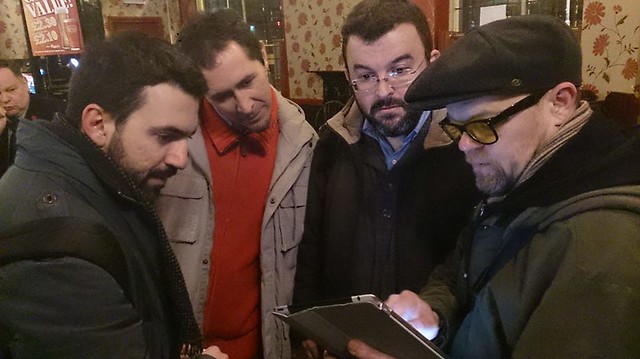
UAH team, Jez and his iPad in the Crown pub
So what Jez did was to pick us up from the Birmingham Library right after the 2nd day of the meeting and guide us through some places where really interesting things have taken place, including concerts of Sex Pistols and Black Sabbath, while sharing the most amazing stories behind that! On top of that, he had a huge collection of related photos and videos in his iPad, through which we had the opportunity to see ourselves what he was describing. The first stop was at the Crown pub, where Black Sabbath gave one of their first concerts; as expected, I got shivers down my spine while entering the pub and exploring every corner. Unfortunately there must have been almost nothing reminding of that period, as the pub seemed to be in idle mode, with pop music coming from the radio and no sign of its history at all available...however, it was still an cozy place to sit and have a beer (and this is what we actually did).
The Crown pub
Unfortunately we had to leave rather early for catching up with other friends in Birmingham so we had to say goodbye rather early. The group went for another round of beers and local food in another pub, while we ended up at a ridiculously expensive (but still high quality and offering meat in large quantities) Brazilian restaurant, where the UAH team along with Greek friends had a nice dinner. That was the end of my 2nd day at Birmingham. Despite the fact that we had a nice time (and a rather lovely dinner), I think that I should have gone for something more traditional and original, following the rest of the team in another pub, tasting local dishes and another round of local beers...these are lessons taken!
After a lovely dinner
That was all about my stay in Birmingham; I would like to have some more time, visiting Aston (where Black Sabbath actually resided) but according to Jez, we would need a ride to get there, as well as more time and we lacked both. However, I hope that I will manage to visit Birmingham in the near future again and see what I have missed this time, also tasting a more traditional part of the city (instead of exotic ones!).
Big thanks to +Jez Collins for the amazing guided tour, sharing his time and passion with the rest of us, and of course to our local hosts (mainly Ben and Katharine from the BCU team) who arranged everything so perfectly!
Edit 27/01/2014: Ben Wells (BCU) shared this interesting and well-designed video by BCU featuring Jez Collins and his research; you should definitely take a look at that!
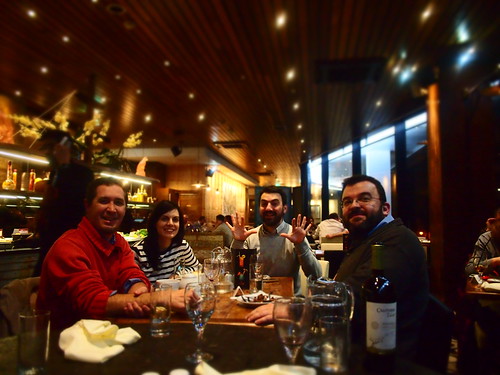
The 7th (and final) project meeting of Organic.Lingua took place between 15-17 of January 2014 at the lovely premises of the newly built Library of Birmingham, hosted by BCU. Just one month before the end of the project, the consortium had an opportunity to meet for the last time and coordinate on the final details before the end of the project and the upcoming final review meeting (to be held in Luxembourg by the end of April 2014). The K-C team could not physically attend the meeting; however, Christoph and Dominik participated through Skype video calls when needed (focusing on the sessions on the UGC widget and recommendation service) and thanks to the facilities of the meeting room their participation was smooth. As a member of the UAH team, this time I presented the re-engineered Organic.Edunet Web portal, the revised AgLR tool and the developments in agriMoodle (the latter is also available at the GitHub).
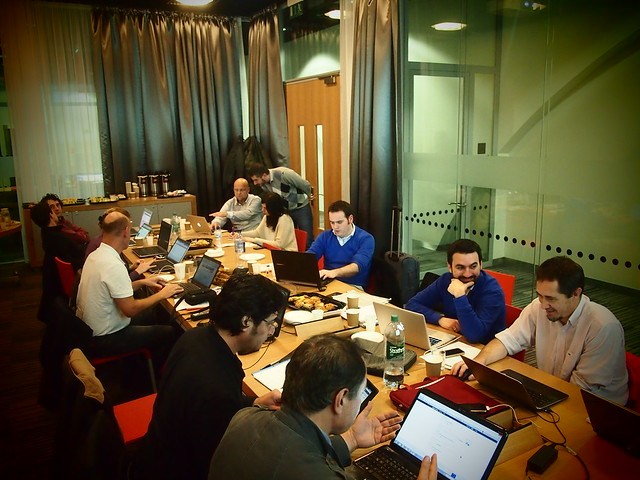
Short break during the meeting
All aspects of the project were discussed per Work Package, pending issues were highlighted and solutions were proposed. All activities are planned for the next month and everything is expected to be completed by the end of the project. There were also several news in this meeting; Raluca Ionescu from the BCU team made her first appearance in an Organic.Lingua project meeting after a long-time involvement in the project, replacing Ben Cave, the usual representative of the BCU team (who was attending the agINFRA project meeting in Budapest at this time). At the same time, it was Katharine's last involvement in the project, as she has a new placement and Ben Wells from BCU will be replacing her until the end of the project.
The meeting was full of nicely organized events as well; kudos to the local organizers for that! The first day included a short visit to the Shakespeare Memorial Room at the top of the Library, which provided an insight to the Shakespeare's work and also a magnificent view of the city (which was heavily photographed by the project partners!). It also included a well-thought dinner at a restaurant next to the canal.
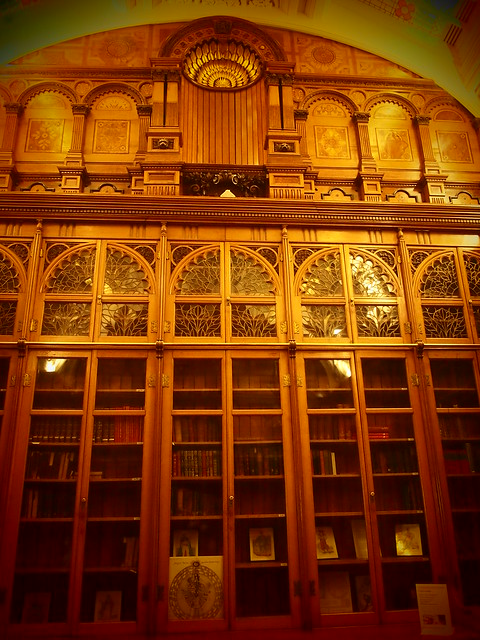
Inside the Shakespeare memorial
The 2nd day included an amazing tour in Birmingham, focusing on the music history of the city, which proved to be really rich (and much richer that we initially though!). Our guide was Jez Collins from BCU, a person heavily involved in the cultural activities of Birmingham and really keen on promoting the city's cultural history (also the founder of the Birmingham Popular Music Archive). Jez used his knowledge, experience and combined with photos and videos from his iPod in order to introduce us to hidden spots of high interest in the city. The bonus of this short tour was a stop at the Crown pub, which is supposed to have hosted the first Black Sabbath gig ever; however, there was nothing to prove the history of this place now...
Jez Collins and the UAH team
Overall it was an amazing experience, combining three days of intensive collaborative work and social activities. Many thanks to the BCU team (mostly Katharine Fuller) for organizing everything so nicely and arranging the accompanying social activities; it was one of the best project meetings ever!
You can find additional information about the meeting in the interesting blog post by Salvador Sanchez (the coordinator of the project) in the IEUAH blog, as well as in the Agro-Know blog.
Well, today was one of these days, when a large part of the AK team is travelling on the same date. Nikos Manolis, Andreas and me found ourselves on the same flight without even knowing; my colleagues travelling to Budapest for the agINFRA project meeting while I was travelling to Birmingham for the Organic.Lingua 7th project meeting - both flights through Munich (the common part of our trips). Nikos Marianos had taken an earlier flight to the UK for the Organic.Lingua meeting, Giannis would join us on the following day while Babis had to cancel the trip he was sharing with Andreas and Nikos Manolis due to health issues. Needless to say that during the 14th-17th of January, the AK office was half-empty (or half-full, from an optimists point of view!).
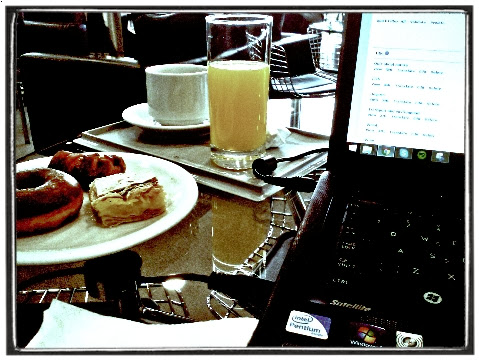
I arrived earlier and managed to get in the lovely Aegean lounge at El. Venizelos airport, which provided a quiet environment, fast wireless internet and coffee/snacks; an ideal place to work before getting on board and much more convenient than the gate seats...
We all flew together to Munich and then separated; I had to rush in order to catch my flight to Birmingham while Andreas and Nikos had some time to spend at the airport before boarding to their flight to Budapest. We all arrived to our destinations safe and well in the end, having some time for last minute preparations for our meetings.
As I have mentioned in the past, I am an avid user of social media tools and sites, both for personal and for professional purposes. When I find something interesting, I like to share it through Twitter, Facebook, Google+ etc., so that it can also be discovered by friends, colleagues and followers, and this is a process I really enjoy. The objective is always the same; the mean depends on the kind and amount of information to be shared - shorted for Twitter, elaborated on Facebook, blog etc..
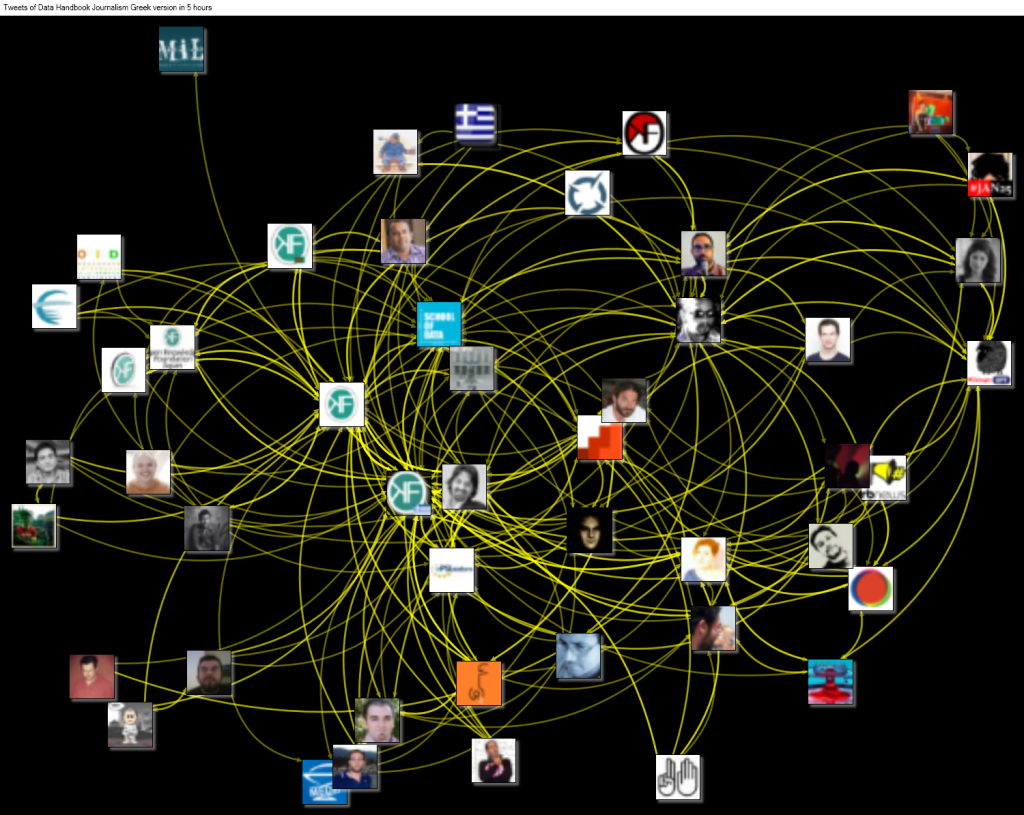
I found the idea really interesting and the Greek version well-implemented, so I re-tweeted the original tweet. After a couple of weeks, I came across a really interesting analysis of the dissemination of the Greek version of the Handbook through Twitter. It seems that I was one of the first 238 users who re-tweeted the news, as shown in the following image.
You can see my avatar at the bottom left side of the graph
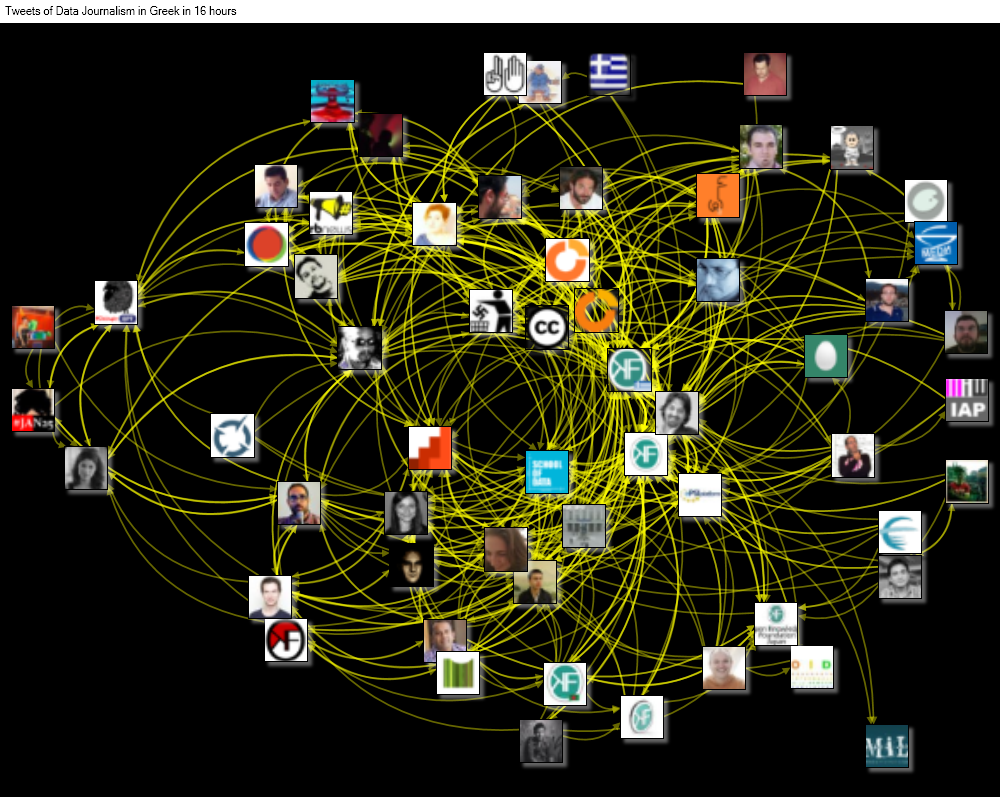
16 hours after the initial tweet, there had been 471 retweets through a core of 60 accounts involved, which are considered relatively high numbers.
My avatar is moved to the right center of the graph in this one; many more accounts are involved in this case
It is cases like these where I feel that every slight individual contribution can make a difference. I share something that I find interesting and this might provide a unique opportunity for a friend/colleague of mine to get to hear about this news item/event etc. and then he can also share it with his circles. Share after share, good and interesting news can reach really remote recipients in a really short time; all these powered by the World Wide Web and mostly Web 2.0 tools.
Both graphs were taken from the OKFN Greece web site, which provided this interesting analysis. You can follow OKFN Greece at Twitter, Facebook and of course their website.
Just a couple of days before I get back to the office after the Christmas break, I started planning (don't expect too much, just a rough scheduling) my first steps in 2014. An indicative list of things that I will be working on in the next couple of months is the following:
Preparation for the 7th (and last) Organic.Lingua project meeting. The meeting will take place in Birmingham, UK between 15-17/1/2014 and will be the last opportunity of the project partners to meet and discuss the next steps in the project, before its end and the upcoming review meeting (which will take place later in 2014).
Final revisions in the Organic.Edunet IEEE LOM AP and the Organic.Edunet OA-AE ontology (also to be presented at the Organic.Lingua PM)
Finalize all pending issues related to the Organic.Lingua multilingual content population before the end of the project (28/2/2014), such as the fine-tuning of the workflow for the User Generated Content.
Contribution to (at least) two deliverables of the agINFRA project, both of them related to data integration.
Work on the integration of a CRM tool in the metadata integration workflow, which will allow us to better organize not only the contact database of the data providers but also allow various team members involved (e.g. data and technical team members) to indicate the status of the metadata integration of each collection. It also provides a number of advantages which will be mentioned later, as soon as the integration is completed.
Update my slides of my Big Data in Agriculture presentations, which were prepared in late 2013.
Keep the Agro-Know dissemination tools, like the newly introduced blog, the Facebook page and the Twitter account updated (a task I really enjoy!)
I expect other urgent tasks to appear in the meantime, some of them unexpected but I will keep some slots in my schedule flexible enough to make sure that there is time for everything to be delivered on time. There should also be time for the upcoming trips and for some publications as well!
Then I thought that it is not only funny but also presents an interesting aspect; is really Facebook taking too much of our (precious) time? Is it worth spending quality time on Facebook (and other social media sites)?
Even for our daily routine, Facebook is a useful tool for disseminating our projects and their outcomes, present the updates of our work, share interesting links with people who usually belong to a common group or follow a page. It is a common practice to create a Facebook page or group for each one of our projects and use it to attract people who also use Facebook for professional reasons. I can recall the Facebook pages for agINFRA, Organic.Edunet, VOA3R, Organic.Balkanet and of course ISLE (one of the most dynamic project pages), while we also maintain the Green Ideas Project page and the one for the Green Hackathon. Of course Agro-Know has its own Facebook page, which was rather recently launched and is now frequently updated.
On the other hand, Facebook started as a social media site which everyone used for sharing mostly their personal updates, personal photos etc. I notice that sometimes when I log in to Facebook to share a project update in the corresponding page, I see some notifications that I want to check, messages that I would like to respond etc. Generally, I believe that one could spend hours and more hours on Facebook for browsing news, updates and even chat. As a result, I tend to avoid using Facebook even for professional purposes, at least during the most productive hours of the day.
After all, Nikos and Giannis, both AK CEOs and people that I personally consider successful, do not have Facebook accounts (ok, Giannis has one, but it seems to be in hibernation). Is it just a coincidence or a fact, according to the aforementioned tweet? Have they consciously chosen to refrain from spending even the slightest amount of time in this social network and instead focus on their professional goals or are they just too busy to notice the Facebook avalanche?
It seems like yesterday that I wrote the corresponding blog post for 2012... 2013 has also been a long and rather successful year, full of trips, meetings, tasks and tight deadlines. I took some time to go through the major events that I participated in during 2013 and here is a short list:
Organic.Lingua 5th Project meeting(20-22/2/2013, Alcala de Henares, Spain): The meeting was hosted by UAH, the coordinator of the project and it was my 2nd time in Alcala de Henares (a town that I really love). This time I was a member of the UAH team (typically) but my responsibilities were more or less the same. I was travelling with my colleague Nikos Marianos and had the opportunity to see again my friend Pascal from the VOA3R project as well as meet Esther for the first time (both members of the INRA team; I would meet Esther at a later time in the RDA 2nd plenary meeting some months ago).
VOA3R 7th project meeting (14-15/5/2013, Rome, Italy): A few days before its end (31/5/2013), the VOA3R project organized its 7th and final project meeting, which was hosted at the FAO Headquarters, in Rome. For me as an agronomist, FAO was always the top of the tops; just imagine how I felt walking in this huge building thniking about how many important decisions related to agriculture were made in the meeting rooms... it kept sending shivers down my spine! It was my first time in Rome and I really liked it; maybe it was due to the really warm room I had. The meeting provided the VOA3R consortium the opportunity to organize all pending tasks and ensure that all deliverables will be submitted on time. The meeting also included a common session with related EU project SemaGrow, during which lunked data and semantics were discussed. Speaking of SemaGrow, I also had the opportunity to participate in the 1st day of its project meeting, which took place on 13/5/2013 at the Tor Vergata University, outside Rome and included a session on data sources (in which I was partially involved as well).
Herbal.Mednet 2nd project meeting (30-31/5/2013, Athens, Greece): The meting was hosted at the premises of Institute of Agricultural Sciences, inside a big park/forest, just outside Athens. It was the 2nd time I participated to the meeting, this time along with my colleague +Andreas Drakos who had made almost all the preparations. It was nice to see old friends again, like Prof. Roman and Dr. Toader from USAMVB (Romania) and see new faces as well. The project meeting was well-organized and the next steps were defined; apart from that, APIVITA had prepared a special buffet with surprises, like honey directly from its own hives, along with traditional Greek delicacies (which were well-received by the participants)!
ISLE 7th project meeting (11-14/6/2013, Varna, Bulgaria): I was not supposed to participate in the final meeting of ISLE but thanks to the persistence of my good friend Corinne Stewart (the coordinator of this large Erasmus Network) I was invited and replaced my colleague +Andreas Drakos who was managing the project from the AK side. The meting was mainly hosted at a lovely hotel outside Varna and I had a great time; I loved the ISLE project as it was one of my first ones and I really liked the dissemination role that AK had in the project. It was an opportunity to see some good friends for the last (probably) time, as we found later that our ISLE 2 proposal was not accepted. The trip itself was adventurous, including delayed flights and a road trip through forests and thick fog; however, the amenities of the hotel helped us in relaxing a bit during the project meeting.
VOA3R 2nd Review meeting (16-18/7/2013, Brussels, Belgium): We spent two days at the lovely premises of the Innovation and Incubation Center of Leuven University (almost inside a small forest) preparing our review meeting presentations. The mood was strange, as the place was not familiar and we had the anxiety about the upcoming review meeting. The meeting itself took place at the premises of EC in Brussels, and mainly thanks to the long experience of +Miguel Angel Sicilia (UAH, the coordinator of the project) and +Christian Stracke (UDE) everything went well; +David Martín Moncunill was also the man behind most of the preparations, coordinating everything until the last minute and ensuring that everything was delivered on time and as promised.
RDA 2nd plenary meeting (16-19/9/2013, Washington D.C., USA): I never expected that this trip would happen; +Nikos Manouselis suggested that I should attend the meeting early enough on behalf of the agINFRA project, but since it was during summer holidays, organizing such trip was not easy; I only issued my passport some days before the meeting and all bookings (flights and hotel room) were made a few days before my flight. This trip had everything: Missed flight (for the first time after three years of intense travelling), non-working debit cards, broken luggage etc. but at the same time it was an amazing experience, meeting all these key persons involved in the Research Data Alliance. Funny fact: It was the first time I met +Johannes Keizer (and it had to be on US grounds!). +Esther Dzale was there, along with +Devika Madalli from ISI, an agINFRA partner. The trip included dissemination of the agINFRA project, as well as actual participation in the Agricultural Data Interoperability Interest Group (let alone the reporting on the actual event in the form of tweets, photos and texts). It also allowed building bonds between RDA and the agINFRA project. It was my longest trip ever (the 1st outside the EU boundaries). Funny fact #2: I spent my b-day away from home for the 2nd time in a row...
Organic.Lingua 6th project meeting (8-10/10/2013, Graz, Austria): This meeting was hosted by Know Center, one of the Organic.Lingua partners. The K-C team did a great job in organizing the meeting, so we actually stayed at the same hotel where the meeting took place. Apart from the typical meeting stuff, we appreciated the traditional cuisine and vast selection of beers, as well as a social dinner which was on the house (rarely to see that in project meetings nowadays). For once more I was travelling with Nikos Marianos and we almost missed our connecting flight from Frankfurt to Athens (we made it, but our luggage didn't!). My suitcase was brought home damaged and I had to go through some process in order to get reimbursed.
EdReNe 10th Conference (6-7/11/2013, Brussels, Belgium): It was the 2nd year in a row for me participating in an EdReNe Conference. This time I participated on behalf of the UAH team of Organic.Lingua and presented the multilinguality features of the Organic.Lingua outcomes. My AK colleagues +Nikos Manolis and +Madalina Ungur were also attending the meeting, and I had the opportunity to meet +Elena Shulman and +David Massart again after a long time, along with EdReNe members with whom we had a nice time during the previous meeting. The trip was really short and tiring; the hotel room was rather bad, there was no internet and I had an awful headache during the 2nd day of the meeting which got worse and worse...
agINFRA 2nd Review meeting (13/12/2013, Athens, Greece): I participated in the first part of the preparations (the technical meting) which took place at the AK office and attended the actual review meeting. I was really glad to see how the project is progressing, as my role is limited to the data integration and I do not have the opportunity to get to know about the technical achievements of the project. It seems that all went well and only minor comments will be received.
I also participated in some really interesting events during 2013:
agINFRA users' meeting (26-27/3/2013, Athens, Greece): It was hosted by AgroKnow in the office and provided the opportunity to agINFRA data providers to have a dedicated session together, discuss about metadata, share the data management workflows followed by their institutions and discuss the linked data approach to be followed by the project. It was the first time I saw most of the agINFRA partners and was delighted to meet +Valeria Pesce and +Ivana Spasojevic for the first time, meet +Imma Subirats again and also meet other partners like David Morse, Devika Mandalli and ARD Prasad among others.
OliveClima Networking Meeting (28/5/2013, Athens, Greece): I was kindly invited to the specific meeting to talk about data silos, data sharing and interoperability of data sources, using the use cases of VOA3R and agINFRA projects as useful tools for the projects also invited in the meeting. Everyone realized that their projects produce high amounts of data, which are usually not organized and cannot be accessed by external stakeholders. The VOA3R platform for researchers and the agINFRA infrastructure for data sharing were presented by me as solutions to the networking of researchers and data sharing respectively.
1st International e-Conference on Germplasm Data Interoperability (6-20/12/2013): Well, that was also something large... started as a joint idea between Bioversity International and AK, in the context of the agINFRA project and the Germplasm Working Group which was organized by the project. It evolved into a series of four online sessions (one of them asynchronous), involving key persons from various organizations and initiatives working with germplasm data and biodiversity, such as Genesys,EURISCO, GBIF, CGIAR, EGFAR etc. I felt honoured to make the introduction in two of the sessions and make three presentations for the e-Conference, while at the same time actively participated in the organization and hosting of the event. Despite the issues that we had with the platform (Google Hangouts were used for presenting the slides live), a lot of interesting discussions evolved, which seem to lead towards the achievement of interoperability between the various germplasm data sources and the application of a linked data framework supporting this. What I really appreciated was the opportunity I had to collaborate with important people and to spend time organizing the event with the precious help from +Eliza Arnaud and +Luca Matteis (both from Bioversity International).
In the meantime, I managed to find some time for some publications, based on the outcomes of the things that I am actually working on:
Protonotarios, V., Stoitsis, G., Kastrantas, K., and Sanchez-Alonso, S. (2013) Using Multilingual Analytics to Explore the Usage of a Learning Portal in Developing Countries. Journal of Asynchronous Learning Networks (JALN) Vol. 17, Issue 2 (July 2013). Available online here
Protonotarios, V., Stoitsis, G., Sanchez-Alonso, S., Kastrantas, K. and Martin-Moncunill, D. (2013) Using Agricultural Learning Portals in Developing Countries: The Case of Organic.Edunet. EFITA 2013 Conference, Turin, Italy, June 24-26, 2013. Available online here.
Palavitsinis, N., Papageorgiou, A., Gavrilut, L. and Protonotarios, V. (2013) Green Ideas: A Social Generator of Green Solutions, Deconstructed. EFITA, WCCA and CIGR VII 2013 Conference, Turin, Italy, June 24-26, 2013. Available online here.
L’Abate., G., Costantini, E., Pesce, V., Protonotarios, V., Geser, G. and Caracciolo, C. (2013) Preliminary Work Towards Publishing Vocabularies for Soil Data as Linked Data. Submitted in Information Processing in Agriculture (Springer)
So, what I really worked on during 2013?
Organic.Lingua: Supported the multilingual content population of the project, actively contributed to the ontology evolution in MoKi, supported the administrative stuff.
agINFRA: I have been actively involved in some big deliverables of the project related to the data integration, the (meta)data management workflows, the linked data framework etc.
VOA3R: Ensuring that all content population-related tasks were completed on time, worked towards the effort estimation of the metadata enrichment, contributed to a publication titled "Opening Up Access to Scientific Information", which was an additional outcome/deliverable of the project. In addition, I finalized a number of small ontologies for the needs of the project, using for once more the MoKi tool.
ISLE: I was not really active as my colleague Andreas took over the ISLE management. However, I was involved in the ISLE Association from the beginning and have participated in discussions related to the future of the Association and the next steps.
AK blog: After a discussion we had with +Nikos Manouselis, we considered that the idea of an Agro-Know blog would be nice to implement; in this direction, I put some time in setting up a Wordpress installation, customizing it and making sure that there is a critical mass of posts, which will hopefully encourage colleagues to share their ideas and news through it.
I had smaller contributions to other projects, like SemaGrow, GreeNET and supported other projects through sub-contracting as well, mostly by preparing deliverables related to metadata integration and content population processes. I took some time to check the available CRM solutions and how they can fit in a data source management system and of course I must have done other things as well, which I cannot recall right now...
Well, 2013 looks like a productive year; this was (at least partially) due to the change of my role in the AK team. I feel much better now and more comfortable with what I am actually working on. Keeping fingers crossed for an equally productive 2014!


 The 7th (and final) project meeting of Organic.Lingua took place between 15-17 of January 2014 at the lovely premises of the newly built