Tuesday, February 25, 2014

About the Agro-Know blog: First three months

It was about three months ago (end of November 2013) when we had a discussion with +Nikos Manouselis about various AK-related stuff and I was delighted to hear that he was in fond of starting our corporate blog - not only that, but he would leave everything to me to design and implement. It seems that Nikos has been following my blog (the one that you are reading now) for the last months, he liked it and he would like to see something similar for AK.

In about 10 days we had everything up and running, with the precious technical help of my colleague Stauros Gkinis: the latest version of Wordpress was installed in one of the AK-owned servers and an FTP was setup for installing themes and plugins. Since we opted for a self-hosted blog, we had to skip my favorite Blogspot or even the promising and easier to use Tumblr. It took me some days to set up and customize the Wordpress installation by selecting a green theme (related to the scope of the blog), install plugins for sharing posts through social media, set up an analytics account for the blog etc. On November 27th, 2013 the blog was online and public! Of course a number of revisions were performed until now, based on the actual use of the blog, and more are expected to take place eventually. I like to experiment with new interfaces and plugins and as an admin of the blog, I have the opportunity to do so every now and then.


The content of the blog consists of posts about AK-related events, reports from project meetings and trips, interviews with friends of AK as well as interviews with the AK team members (who are asked to expose themselves in the "Know Agro-Know" series!). I should not leave out the really interesting posts with personal views, usually on topics that the AK team is working on, like open and linked data, green topics etc.

I was recently informed that the blog had to be placed in a more powerful server due to increased traffic which caused issues to the proper functionality of the other services hosted in the same server; that was good news! Indeed, in less than three months from its launch, the blog has 48 blog posts from 9 different authors and 37 comments. It has received almost 1,500 visits and more than 3,200 pageviews from about 500 unique visitors coming from 34 different countries. The best part: More than 66% of the visitors are returning ones, meaning that they like what they see and they come back to check!


I am proud of what the blog has achieved so far and I am sure that it will get better and better day by day with the precious help of all collaborators; the more it will be used, the better it will be. You can check out the Agro-Know blog here.


Saturday, February 22, 2014

Webinar@AIMS:Organic.Edunet ontology evolution and management

A couple of weeks ago I received an invitation from the FAO AIMS team to make a presentation on the management of Knowledge Organization Systems (KOSs), as a part of a series of Webinars. Many people know how I feel when it comes to FAO: as a student of agricultural sciences I used to consider FAO as the centre of agricultural decision making and I still remember my recent visit to the FAO HQ in Rome (during the VOA3R 7th Project Meeting) which sent shivers down my spine each time I walked up and down the building.. I felt honoured to receive the invitation and could not refuse of course; I still have a crush on FAO!

Despite the fact that I do not have a background in knowledge management or ontology engineering, I have found myself involved with ontologies and KOSs rather often mainly as a domain expert; my first attempt was with the Organic.Edunet ontology back in the years of the Organic.Edunet project, then I got the opportunity to be involved in the development of a number of small, domain-specific ontologies for the VOA3R project (aquaculture, viticulture, organic agriculture and ICT in agriculture) and recently contributed to the corresponding agINFRA deliverable describing the publication of KOSs as linked data, along with an analysis of the KOS used by the agINFRA data providers. At the same time, I was heavily involved in the Organic.Edunet ontology evolution which took place in the context of the Organic.Lingua project and included a significant update/revision of the ontology in several aspects, like multilinguality (translation of concepts in additional languages), deprecation of existing concepts and refinement of existing ones (depending on their usage) etc.


In any case, I thought that the best approach for this case would be to make it a presentation on the Organic.Edunet ontology management/evolution, a case that I know pretty well and I could present in details. Indeed, the Webinar on the Organic.Edunet ontology management and evolution, titled “Knowledge Organization Systems (KOS): Management of Classification Systems in the case of Organic.Edunet” took place on 21/2/2014 using the Adobe Connect platform of FAO AIMS. Despite the connection issues I faced throughout the Webinar (I think I got disconnected 2-3 times, a fact which disorganized me...), everything went pretty well and you can see the recording of the webinar below (as well as through the FAO AIMS page of the webinar).


The presentation included a short introduction to KOS and some of the open source tools used for the management of KOS before focusing on the Organic.Edunet ontology evolution and the MoKi tool used for this purpose.

The next steps in the ontology evolution, as described in the slides as well include additional translations, minor revision of concepts and their publication as linked data; we still have to define a valid namespace and fine tune some details. At the same time, we are working on a similar approach in the agINFRA project but with different "raw" material.

Overall, the webinar was a really nice experience and provided an opportunity for us to expose a part of the work that took place in the context of the Organic.Lingua project. Additional webinars in collaboration with FAO AIMS are in the plans for the next months, equally interesting and related to the agricultural metadata and KOS standards so... stay tuned!

Thursday, February 13, 2014

Report from the last Organic.Lingua Greek user trial

Another user trial of the Organic.Lingua project took place a few days before the end of the project, on the 12th of February 2014, at the premises of the Agricultural University of Athens (AUA), kindly hosted by the Laboratory of Viticulture and organized by Agro-Know.

The audience consisted of approximately 15 people, mostly post-graduate students of AUA as well as faculty of the laboratory; participation was not easy for anyone wishing to participate, as the exam period was ongoing during these days. The approach followed was according to the guidelines developed by the Organic.Lingua project, consisting of a couple of introductory presentations and a hands-on session. More specifically, the trial started with a presentation titled "Green Open Educational Resources (OER) concept", which provided an introduction to the OER concept and examples on web portals and other sources of green OER. The presentation was followed by another one, titled "Agricultural education collections & repositories", which provided information on the concept of metadata and their importance, how they are created and used in the portals for retrieving educational resources etc.

Presenting the OER concept

After a short coffee break, the re-engineered Organic.Edunet Web portal was presented to the participants; starting with a brief flash-back on how it all started, its evolution and the current status through the improvements made in the context of the Organic.Lingua project. The demonstration focused on the multilinguality features of the project such as the multilingual user interface and the metadata automatic translation features. The users were invited to register and follow a pre-defined scenario for browsing through the portal and perform specific activities which tested the portal's feature. The next step was the participation in the online questionnaire which was used by the participants to provide their feedback.

Partial view of the participants

The last session of the workshop included a hands-on session on the use of the AgLR tool and the new visualization interfaces of the Organic.Edunet ontology, which is going to replace the previously available semantic browsing option of the Organic.Edunet Web portal. Due to the fact that not all participants had their laptops available during the workshop, the specific part had to take place in groups rendering the process more challenging. However, this allowed a more informal discussion to take place by the end of the workshop, which focused mainly on various aspects of the Organic.Edunet Web portal and the OER concept in general.

Overall it was a nice experience; a validation and dissemination event for the Organic.Lingua project and an opportunity for the participants to get to know about OER, web sources of OER and of course the Organic.Edunet Web portal. You can find additional photos from the event here.

Saturday, February 8, 2014

Report from the Organic.Lingua Final Workshop

The Final Workshop of the Organic.Lingua project, titled Using multilingual technologies in web portals – Challenges & Promises”, took place on Thursday, February 6th, 2014 between 15.30-18.30 (CET) at the premises of  CittĂ  dell’Altra Economia (CAE) in Rome, Italy. It was co-organised by Agro-Know Technologies and University of Alcalá (UAH), both project partners of the Organic.Lingua project. The Agro-Know team was represented at the Workshop by Nikos MarianosGiannis was there on behalf of the UAH team while Andreas Drakos was also there, as the Workshop was collocated with the Herbal.Mednet 3rd project meeting, which Andreas attended. I did not manage to attend and I have to admit that I missed that but the trip would be too time consuming during a really busy period.
Photo taken by David Martin Moncunill
The Workshop was focused in the multilingual outcomes of the project and included the following presentations:
  1. Multilingual information services in the area of agricultural data : the use case of AGRIS (Keynote Speech): Fabrizio Celli (FAO)
  2. Applying language technologies in agricultural online services: The case of Organic.Edunet: Salvador Sanchez-Alonso  (UAH)
  3. Managing multilingual vocabularies and ontologies: Mauro Dragoni (FBK)
  4. A multilingual framework for transforming online services to truly multilingual: Giannis Stoitsis (UAH)
The workshop also included a networking session in the form of a round-table discussion, which provided the opportunity to the participants to discuss on potential opportunities arising from Horizon 2020 and Connecting Europe Facility.
Photo taken by David Martin Moncunill
The Workshop provided a nice opportunity to expose the outcomes of the Organic.Lingua project to a wider audience and also to explore the opportunities for making a step further in this direction, probably in the form of another proposal/project. The next milestone for the project is of course its end (28/2/2014) and the upcoming 3rd Review Meeting (30/4/2014). I am optimistic that all will go well and that we will manage to get another green card for this project ;-)

You can find more photos from the event here.


Created with flickr slideshow.

Friday, January 31, 2014

Open invitation: Help us make the Organic.Edunet Web portal even better!

Do you speak Organic?

Are you a researcher, a student, a teacher or a practitioner in the agricultural domain? Are you interested in language technologies and translation innovations? Have you visited the re-designed Organic.Edunet Web portal with its new multilingual services? Check it out now and help us improve by providing your feedback!
Organic.Edunet is an international portal that has been serving the Organic and Sustainable Agriculture community since 2009, bridging together a network of learning repositories and providing its users (such as pupils & students, teachers, etc.) with a significant volume of relevant educational resources on Organic Agriculture (OA) and Agroecology (AE).
Under the scope of the Organic.Lingua Project, the portal was enhanced with new multilingual capabilities, offering automatic translations in 17 languages and more! As we are reaching the end of the project, we are proud to announce that the brand-new version of the portal is now LIVE and you are all invited to test it!
The Public Pilot Trial will take place between Saturday, the 1st of February and Monday, the 10th of February, 2014. A script on how to use the portal is available at http://wiki.organic-lingua.eu/Public_Open_Trial_Scenario
To help us improve, fill in a short evaluation questionnaire, which can be accessed here.
 Your contribution is highly appreciated, as we are constantly trying to develop the services offered to our users, in order to accommodate the needs and requirements of people involved in learning and teaching Organic Agriculture and relevant topics such as ecology, environment, aquaculture, water resources management, sustainability and other green topics.

Thank you for your participation!
Organic.Edunet_1

Thursday, January 30, 2014

AK celebrates with the New Year's cake: To kopi ti pita!

One of the nice Greek traditions is the celebration which takes after the New Year's day (in the next weeks/months in fact), where a family gathers and celebrates the New Year by sharing equally cut pieces of a special cake. This cake is called "New Year's cake" internationally and "Vasilopita" in Greece. In this direction, AK as a big family who respects traditions, had this nice little celebration in the office last Tuesday, where everyone participated and partied.
AK New Year's cake
The nice thing is that each vasilopita contains a coin; this coin not only brings a year of good luck to the one who will find it in his piece of the cake, but is usually accompanied by a nice present! This year Dimitra found the lucky coin in her piece (she was also the one who brought the cake to the office; strange coincidence, huh?) and apart from the luck she got a nice present from our good friends at Orbita travel agency.
The lucky coin!
There was a small party at the office, including long-time-missed informal discussions and we got to see almost all the team again (apart from Mada, who was greatly missed...); even Babis made an appearance after a couple of weeks on leave due to health issues! This provided the opportunity for another family photo, as you can imagine...
AK family photo - January 2014
Additional photos from the event (small selection; sorry for that!)
P.S. The "To kopi ti pita" part of the title (Kopi tis pitas in proper Greek) is an extremely common expression in Greece, while it is not a Greek phrase; instead, it was a bad moment of a foreigner jewellery seller who wanted to refer in the celebration during his Greek TV show but he failed to do so in proper Greek (of course we understand; it sounded Greek to him!). After that, he managed to make this expression the standard one when referring to the celebration.

Wednesday, January 29, 2014

Organic.Lingua Final Workshop

Organic.LinguaJust about a month before the end of the Organic.Lingua project, the Final Workshop of the project will be held. More specifically, the Workshop will be titled "Using multilingual technologies in web portals - Challenges & Promises" and will take place on Thursday, February 6th, 2014 between 15.30-18.30 (CET) at the premises of  CittĂ  dell'Altra Economia (CAE) in Rome, Italy. It will be co-organised by Agro-Know Technologies and University of Alcalá (UAH), both project partners of the Organic.Lingua project.
The aim of this Workshop will be to present the produced multilingual technologies & framework applied to transform the Organic.Edunet to a truly multilingual service, and their potential to be used in other online services. In this direction, the workshop aims to bring together people from different organizations and initiatives that are active in the Agricultural domain, as well as potential adopters of the multilingual framework, to discuss on how they could take advantage of these multilingual technologies within their institutions/organizations.  During the workshop a set of best practices for transforming an online service to a truly multilingual service will be presented and discussed.

The Organic.Edunet Web portal

The draft agenda of the Workshop includes the following topics:
  • The language barrier in the Agricultural Domain;
  • Applying language technologies in agricultural online services: The case of Organic.Edunet;
  • Managing multilingual vocabularies and ontologies;
  • A multilingual framework for transforming online services to truly multilingual;
  • Round Table: Discussion on best practices and networking session

The workshop will also include a networking session, that will give the participants the chance to discuss on potential opportunities arising from Horizon 2020 and Connecting Europe Facility.
You can find updated information on the Workshop in the Organic.Lingua wiki page, and you can register to the Workshop by contacting Mrs. Angeliki Papageorgiou at:
Angeliki Papageorgiou
Agro-Know Technologies
tel. 0030 2106897905
email: angeliki@agroknow.gr
You can also follow the Organic.Lingua project through Twitter & Facebook!

Thursday, January 23, 2014

My three days at Birmingham

I had the pleasure to visit Birmingham some days ago for the 7th Organic.Lingua project meeting, between Tuesday 14th and Friday 17th of January 2014. Being an avid Black Sabbath fan since my high school days, a trip to Birmingham, where Black Sabbath started playing was always a dream - now to come true. I still remember a discussion I had with Susie, a member of the BCU team, back in the Organic.Lingua kick-off meeting, asking her about the possibility for BCU to host one of the project meetings in Birmingham. I had to wait almost three years and for the last project meeting in order to get my feet there!

Ozzy's star at the Birmingham Hall of Stars
Ok, I have to admit that I tried hard to have all my presentations ready before I got to Birmingham, which would allow me to have more free time and spend more time around the city; I managed to do so. I also admit that I had a hard time finding free time during the fully-packed project meeting but feeling the vibes of Birmingham I did not feel tired at all at any time. The time difference between Athens and Birmingham also helped, as I usually went to bed early (based on Greek time) and woke up really early (again due to the Greek time). This allowed me to spend a couple of hours on early Wednesday morning, right after breakfast, walking around the city and taking lots of photos. I have to admit that I was expecting an ugly industrial city; instead, I was amazed by what I actually saw: a lovely canal crossing the center of the city, nice shops, bridges, lovely brick buildings and interesting pubs. On top of that, I loved the classical buildings (reminding me of ancient Greece) and the numerous statues all over the city. All of them well-preserved; no sign of a graffiti or vandalism, a sight commonly seen in Greek monuments (even the most important and historical ones...)


The first day included a visit to Shakespeare's Memorial, at the top floor of the Birmingham library, where the meeting was hosted; this provided an excellent view of the city, as well as information on Shakespeare himself. After the meeting, we had a nice dinner at the Bank. But the best was yet to come...

On Thursday evening, an extremely interesting person was kindly asked (and he agreed!) to guide us around Birmingham and let us know of the cultural history (focusing on the music part) of the city. His name was +Jez Collins and he seems to be a Jack of all trades: Research project Manager at the BCU, the founder of the Birmingham Popular Music Archive, Executive Co-Producer for the award winning documentary "Made in Birmingham: Reggae Punk Bhangra" and a contributor to http://popmatters.com, among others.


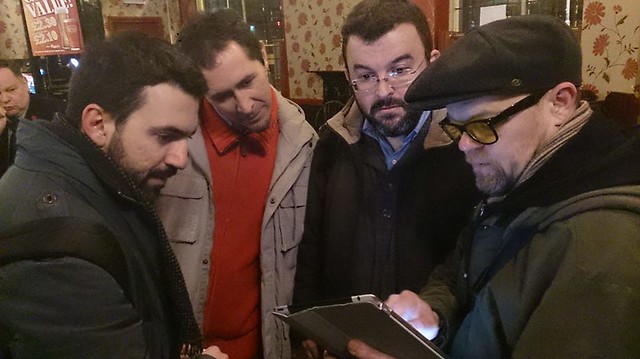
UAH team, Jez and his iPad in the Crown pub
So what Jez did was to pick us up from the Birmingham Library right after the 2nd day of the meeting and guide us through some places where really interesting things have taken place, including concerts of Sex Pistols and Black Sabbath, while sharing the most amazing stories behind that! On top of that, he had a huge collection of related photos and videos in his iPad, through which we had the opportunity to see ourselves what he was describing. The first stop was at the Crown pub, where Black Sabbath gave one of their first concerts; as expected, I got shivers down my spine while entering the pub and exploring every corner. Unfortunately there must have been almost nothing reminding of that period, as the pub seemed to be in idle mode, with pop music coming from the radio and no sign of its history at all available...however, it was still an cozy place to sit and have a beer (and this is what we actually did).

The Crown pub
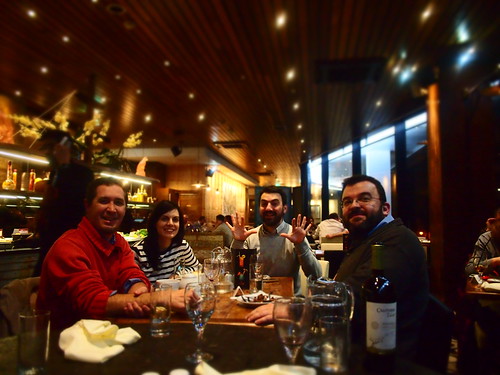
Unfortunately we had to leave rather early for catching up with other friends in Birmingham so we had to say goodbye rather early. The group went for another round of beers and local food in another pub, while we ended up at a ridiculously expensive (but still high quality and offering meat in large quantities) Brazilian restaurant, where the UAH team along with Greek friends had a nice dinner. That was the end of my 2nd day at Birmingham. Despite the fact that we had a nice time (and a rather lovely dinner), I think that I should have gone for something more traditional and original, following the rest of the team in another pub, tasting local dishes and another round of local beers...these are lessons taken!

After a lovely dinner
That was all about my stay in Birmingham; I would like to have some more time, visiting Aston (where Black Sabbath actually resided) but according to Jez, we would need a ride to get there, as well as more time and we lacked both. However, I hope that I will manage to visit Birmingham in the near future again and see what I have missed this time, also tasting a more traditional part of the city (instead of exotic ones!).

Big thanks to +Jez Collins for the amazing guided tour, sharing his time and passion with the rest of us, and of course to our local hosts (mainly Ben and Katharine from the BCU team) who arranged everything so perfectly!

Edit 27/01/2014: Ben Wells (BCU) shared this interesting and well-designed video by BCU featuring Jez Collins and his research; you should definitely take a look at that!


Saturday, January 18, 2014

Organic.Lingua 7th project meeting

The 7th (and final) project meeting of Organic.Lingua took place between 15-17 of January 2014 at the lovely premises of the newly built Library of Birmingham, hosted by BCU. Just one month before the end of the project, the consortium had an opportunity to meet for the last time and coordinate on the final details before the end of the project and the upcoming final review meeting (to be held in Luxembourg by the end of April 2014). The K-C team could not physically attend the meeting; however, Christoph and Dominik participated through Skype video calls when needed (focusing on the sessions on the UGC widget and recommendation service) and thanks to the facilities of the meeting room their participation was smooth. As a member of the UAH team, this time I presented the re-engineered Organic.Edunet Web portal, the revised AgLR tool and the developments in agriMoodle (the latter is also available at the GitHub).
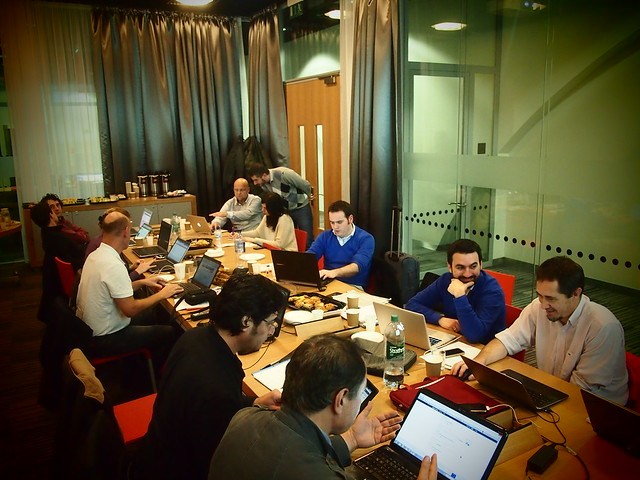
Short break during the meeting
All aspects of the project were discussed per Work Package, pending issues were highlighted and solutions were proposed. All activities are planned for the next month and everything is expected to be completed by the end of the project. There were also several news in this meeting; Raluca Ionescu from the BCU team made her first appearance in an Organic.Lingua project meeting after a long-time involvement in the project, replacing Ben Cave, the usual representative of the BCU team (who was attending the agINFRA project meeting in Budapest at this time). At the same time, it was Katharine's last involvement in the project, as she has a new placement and Ben Wells from BCU will be replacing her until the end of the project.


Created with flickr slideshow.

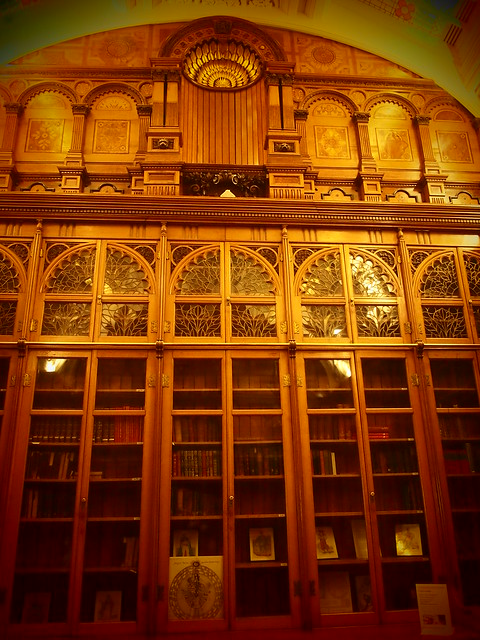
The meeting was full of nicely organized events as well; kudos to the local organizers for that!  The first day included a short visit to the Shakespeare Memorial Room at the top of the Library, which provided an insight to the Shakespeare's work and also a magnificent view of the city (which was heavily photographed by the project partners!). It also included a well-thought dinner at a restaurant next to the canal.

Inside the Shakespeare memorial
The 2nd day included an amazing tour in Birmingham, focusing on the music history of the city, which proved to be really rich (and much richer that we initially though!). Our guide was Jez Collins from BCU, a person heavily involved in the cultural activities of Birmingham and really keen on promoting the city's cultural history (also the founder of the Birmingham Popular Music Archive).  Jez used his knowledge, experience and combined with photos and videos from his iPod in order to introduce us to hidden spots of high interest in the city. The bonus of this short tour was a stop at the Crown pub, which is supposed to have hosted the first Black Sabbath gig ever; however, there was nothing to prove the history of this place now...

Jez Collins and the UAH team
Overall it was an amazing experience, combining three days of intensive collaborative work and social activities. Many thanks to the BCU team (mostly Katharine Fuller) for organizing everything so nicely and arranging the accompanying social activities; it was one of the best project meetings ever!
You can find additional information about the meeting in the interesting blog post by Salvador Sanchez (the coordinator of the project) in the IEUAH blog, as well as in the Agro-Know blog.

Tuesday, January 14, 2014

Agro-Know on the move (Part II)

Well, today was one of these days, when a large part of the AK team is travelling on the same date. Nikos Manolis, Andreas and me found ourselves on the same flight without even knowing; my colleagues travelling to Budapest for the agINFRA project meeting while I was travelling to Birmingham for the Organic.Lingua 7th project meeting - both flights through Munich (the common part of our trips). Nikos Marianos had taken an earlier flight to the UK for the Organic.Lingua meeting, Giannis would join us on the following day while Babis had to cancel the trip he was sharing with Andreas and Nikos Manolis due to health issues. Needless to say that during the 14th-17th of January, the AK office was half-empty (or half-full, from an optimists point of view!).

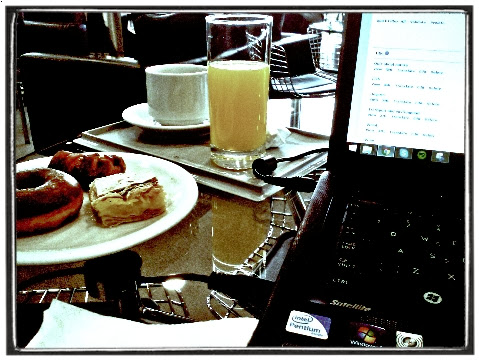
I arrived earlier and managed to get in the lovely Aegean lounge at El. Venizelos airport, which provided a quiet environment, fast wireless internet and coffee/snacks; an ideal place to work before getting on board and much more convenient than the gate seats...

Working in the Aegean lounge

While waiting for boarding, we also met Dr. Vangelis Karkaletsis from NCSR Demokritos, a good friend and partner in the Semagrow FP7 project, who was travelling to Luxemburg for the "Info Day for Big Data and Language Technologies", a part of the Information and networking days - H2020 Work Programme 2014-2015, Connecting Europe Facility. These topics are in at the heart of what all three projects (agINFRA, Organic.Lingua and Semagrow) are working on.

We all flew together to Munich and then separated; I had to rush in order to catch my flight to Birmingham while Andreas and Nikos had some time to spend at the airport before boarding to their flight to Budapest. We all arrived to our destinations safe and well in the end, having some time for last minute preparations for our meetings.