Thursday, August 20, 2015

Agro-Know and social media: The progress in one year

One of the nice things in Agro-Know is the fact that you have the opportunity to get involved in various interesting tasks and change the focus of your work (which is good in some cases). In this context, I had the opportunity to focus on Agro-Know's marketing activities, tools and strategy; something that I have really enjoyed (at this point, I spend more time in the Project Management Department of Agro-Know, supporting its Director Nikos Marianos in various tasks).

As a Marketing & Networks Manager of Agro-Know I had the opportunity to combine my domain-specific expertise that allowed me to identify of at least the basic concepts, the main stakeholders and the identification of topics of interest, with a basic (at least) knowledge of the use of social media and marketing tools. Skills like communication, writing and copywriting/copyediting, desktop research and analysis of data, even photography and networking are also the ones that are needed for such a position and I tried to work on them; in fact, I still do as I am really interested in this kind of work - I even got invited to an interview by Agora MedSpring about the use of social media on the dissemination of information and knowledge.

What I did during this year was to focus on something that I really enjoyed; social media. Starting with our (almost inactive) Twitter account and also the fresh Facebook page of Agro-Know, I worked not only on trying to share quality content that would bring value to the company but also to identify the audience that would be interested in this content and build a community of engaged users. My aim was to create a buzz around the Agro-Know brand and share news related to the activities and outcomes of Agro-Know as well as quality content on agrifood information and knowledge management, covering topics such as open access and open data, linked open data, research outcomes, EU-funded research projects and proposals, interviews with people that work on these topics etc. At the same time, I tried to provide an insight on Agro-Know as a team, providing information on its members, activities in the office, internal culture and a more informal side of Agro-Know - just to show its human aspect.

Number of Twitter followers


At the same time, I experimented with Agro-Know's Google+ page (which is updated more or less like the Facebook one), I tried to keep the Flickr and Slideshare accounts updated and introduced a new tool, Instagram (which started as an informal experiment and now it's another tool in our social media arsenal). On top of that, I dedicated time and effort in transforming Agro-Know's LinkedIn page, which currently features 155 followers.

Number of Facebook likes
Number of followers on LinkedIn


However, the main source of content was published through the Wordpress-based Agro-Know blog, which allows us to share news, updates, events and even personal opinions on topics of interest. Even though it is not as teamwork as I would like it to be, I believe that it has great potential as long as it is frequently updated with quality content. It can and should be used by everyone in the team (we also invite guest bloggers to contribute!) to share their work, concerns and ideas on what we are working on.


AK blog page views for the last year


The analytics of all the aforementioned tools used show that indeed the numbers are growing; likes and followers are increased, the same goes for retweets and shares, blog subscriptions are constantly growing etc. In addition, taking advantage of major events and using their special hashtags, participation in related online conversations can boost engagement and reach. But how does this affect Agro-Know (in a positive way)?

I am afraid that I do not have the answer to this question; it seems that it is really hard to identify the impact that all this time and effort put in our social media have in the progress of the company. I know that our social media presence is appreciated by several people that I /we admire and appreciate their own work but we cannot go further than that.

What I have noticed during this year is the fact that while sharing and liking seems to go pretty well (after all, it is only a matter of pressing a button in all cases), we receive no feedback on our content; only a few responses/comments have been received to our (currently) 200 blog posts (most of them within the team), our tweets very rarely get responses (not referring to retweets but to replies) and no comments appear below our Facebook posts. Some of the possible factors include

  • the lack of time for commenting and replying; in contrast to liking/retweeting and sharing, responding takes time for putting thoughts in order and expressing them in a logical way, 
  • the abundance of information constantly shared through social media and blogs, 
  • the high number of content sources that potential stakeholders need to access;
  • the lack of interest in general and 
  • (hopefully not!) the low quality of the content.

Information and knowledge sharing, especially in the agrifood sector, is a hot topic nowadays and I can see several vacancies related to this context (something that highlights the need for staff with specific skills). My experience so far shows that there is a wealth of information and knowledge to be shared and at the same time a long way to go for ensuring the optimal sharing of this content. At the same time, there are multiple platforms that share similar content and this renders the identification of quality content harder, as a content consumer needs to access multiple content sources. Aggregators like Agrifeeds partially solve the problem, by aggregating feeds from multiple sources (mostly blogs and websites) and offering user-defined RSS feeds, but still content shared through social media is not available through Agrifeeds. 

Ideally, a platform allowing users to select the feeds they want from a predefined list or to add their own sources; something like Agrifeeds or the most widely known Feedly do but with more options and a better, more user-friendly interface. Even though this solution would (partially) solve the problem of multiple content sources and lack of time, still there's not much that can be done in terms of lack of interest as well as the low quality of the content. 

In the end, the same question remains unanswered: Does it worth the effort and cost for working on the dissemination of agrifood research outcomes and other news? Does this actually pay back in any way?

P.S. What I didn't do during this year? I did not put enough time on updating the printed marketing material of Agro-Know (after all the changes in the team and focus of our work were constant and significant so it would have been obsolete in a short time), neither on our corporate website (which surely needs a nice facelift in terms of content). As regards printed material, I believe that it shouldn't be the main marketing tool; as for the website...revisions are on their way!

Thursday, August 13, 2015

Agro-Know team lineup: August 2015

After some changes in the Agro-Know team which took place during the previous months, this is our current team lineup:


As a result to these changes, there have been some changes in the internal organization and structure so I found myself supporting Nikos Marianos in the Project Management Dept. of Agro-Know; my work consists mostly on working on various deliverables for various projects that Agro-Know participates in. At the same time, I still devote some time on a daily basis for updating the social media of Agro-Know and other marketing and networking activities.

I miss my ex-colleagues, as I have been working with some of them for several years and they have been part of the family; at the same time, most of them had the chance to explore new business opportunities. It's not always easy to work with a smaller team, but it seems that is is more flexible in this way. Still I wish all the guys (and girls) the best for finding a brand new working environment, hopefully even better than the one of Agro-Know!

Saturday, July 11, 2015

Working on user requirements extraction for the OpenMinTeD project

My colleague Nikos is currently presenting the work that we have done regarding the TAPipedia conceptual design (a report of more than 130 pages so far) and aims to collect feedback that will allow us to work on the final revisions of the document. This is a task that both of us have dedicated a lot of time, effort and creative thinking on, so I am really anxious to receiving the feedback collected during the TAP Experts Group meeting that he is attending these days in Rome, Italy.

In the meantime, I got involved in the preparation of the guidelines for the organization and implementation of events that aim to collect user requirements for the text- and data-mining applications for the OpenMinTeD H2020 project. The project aims to "enable the creation of an infrastructure that fosters and facilitates the use of text and data mining technologies in the scientific publications world and beyond, by both application domain users and text-mining experts". Through a dedicated set of events and using a specific methodology, the project aims to collect requirements from specific types of stakeholders that will allow it to better meet their needs through the development of tools and infrastructure. It includes a generic methodology to be adapted for each individual case (event), a number of templates (e.g. agenda, PPTs, evaluation form etc.) and tips on the successful implementation of such an event. I have some previous experience on the development of such guidelines and methodology, I have support from the rest of the team (whenever and wherever needed) and I really like working on such things, so I am working on that full speed!

The project uses a Redmine installation for various purposes, including management of tasks and documentation of activities like the aforementioned one. According to Wikipedia, "Redmine is a free and open source, web-based project management and issue tracking tool. It allows users to manage multiple projects and associated subprojects. It features per project wikis".

So far, I have been working directly on the wiki-like interface of Redmine for publishing the guidelines. It has a set of wiki features that allow the organization of text in sections and sub-sections, making it easy to create a complex document. I have to admit that I miss some of the typical wiki functionalities (like the automatically created ToC at the beginning of the page) but still I found Redmine really easy to use. Unfortunately I am only using a specific set of functionalities of the tool, which seems to be diverse and efficient in what it aims to allow users to achieve.

The guidelines are expected to be ready by the end of this month and I hope that they will be publicly available so that I can share a link to them! :-)

Monday, June 22, 2015

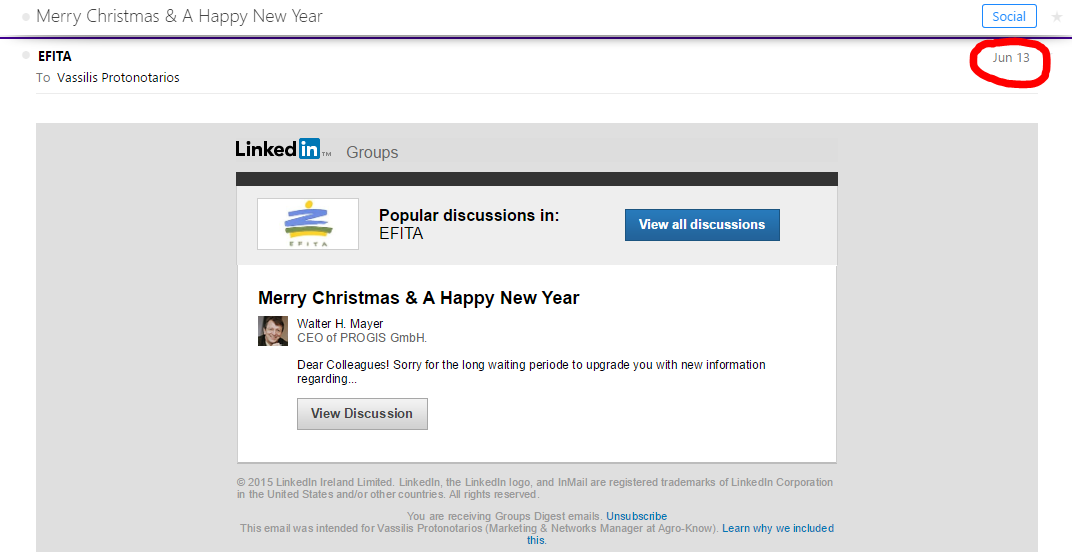
On providing timely wishes

Sometimes we get carried away and our wishes come a little bit out of season...or we just forget to change the title of our topic!

Source: https://www.linkedin.com/grp/post/786957-6013050763981443072
Apparently there was some kind of issue with the specific post; it happens to everyone. I hope that nobody will be insulted/take this seriously, as this was only intended to make (at least some of) you smile :-)

Wednesday, June 17, 2015

Working on the TAPipedia report

As soon as I finished working on the GODAN Discussion Paper, I found myself involved in another important deliverable; this time it was a report to be delivered to the Tropical Agriculture Platform consortium.

About TAP

In developing countries, most of the challenges facing agriculture and natural resources management can be addressed through innovation. But many developing countries don’t have sufficient resources or capacities to develop their innovation systems effectively. The “capacity gap” is worse in the tropics, where poverty is pervasive. In fact, investments in agricultural innovation in low-income tropical countries are less than 10 percent of the total global investment in agricultural R&D.

In an effort to address this problem, the G20 Agriculture Ministers requested that FAO lead the development of TAP. The G8 leadership also endorsed the development of TAP. TAP was launched at the first G20-led Meeting of Agriculture Chief Scientists (MACS) in September 2012 in Mexico. (source).

How did I get involved in this effort?

To make a long story short, there was an open call for consultation services, my colleague (and Agro-Know CEO) Nikos Manouselis applied and he was selected as an experienced researcher to work on a report describing the conceptual architecture of TAPipedia, recruited to help by the FAO Research & Extension team that hosts the TAP secretariat. TAPipedia is one of the three envisaged services of TAP, aiming to be "a global information system for innovation outputs, success stories, socioeconomic impacts, lessons learned, and analyses of impacts. TAPipedia will use virtual collaboration tools and media, and could result in the identification of demands for new areas of agricultural research". Nikos asked for some help with this deliverable and I was really glad to jump in and start working on that!

What are we actually doing in this work?

What we are actually doing in this report is to define the conceptual architecture of TAPIpedia, which is expected to be a complex, multi-functional service consisting of several different components. These components will serve different purposes, such as content management, file sharing and collaborative content creation and editing, collaboration and communication of TAP partners and stakeholders etc., so we are talking about a platform that is expected to combine a content management system, a digital document repository, a wiki, a collaboration platform, an analytics component and a service for publishing content as linked open data, among others - all of them open source and freely available.

It is a pretty challenging work that requires literature review (including previous related work from TAP partners), desktop research, exploitation of available knowledge and information from colleagues as well as detailed and organized reporting in the deliverable. We are currently in an advanced phase of the report, which at this point covers about 80 pages (without the Annexes). Despite the high volume of information that needs to be evaluated, validated and reused in the report, we are confident that we will provide a high quality outcome that will provide the basis for the actual implementation of TAPipedia at a later stage. This alone looks really promising and it seems that this specific work will have significant impact at a global level.

GODAN during IODC 2015: The Storify case

I was not there, but thanks to numerous tweets I managed to get an image of what was happening during the International Open Data Conference 2015 (#IODC15). However, this Storify slideshow provides a great structured overview of the GODAN activities.

Bonus: Two Agro-Know tweets are included in the slides ;-)

Tuesday, June 16, 2015

GODAN Twitter network during the International Open Data Conference 2015

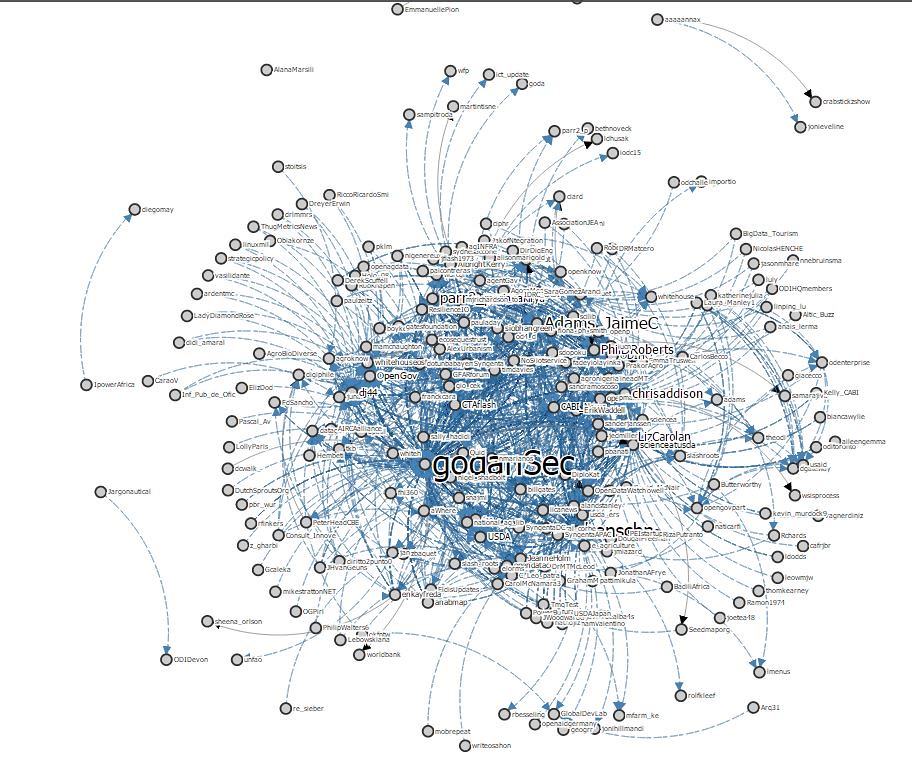
The GODAN Secretariat shared a visualization of the GODAN twitter network activity  (focusing on retweets) during the International Open Data Conference 2015 (#IODC15).
#GODAN retweet network @ IODC15
Click for full size

It is obvious that there has been a lot of activity, involving major GODAN actors like CABI, ODI and USDA, among others (such as individuals active on Twitter). Agro-Know did not participate to the event but still managed to get into this interesting visualization; can you spot the Agro-Know node?

Spoiler....


Not bad for a Greek SME, remotely attending the event :-)

Saturday, June 6, 2015

On the Open Culture of the Open Data Institute

I recently had the opportunity to collaborate with the ODI team in the context of the GODAN Discussion Paper. I am a curious person by nature and since we had a distant collaboration, I wanted to learn more about the people that I was working with (and I couldn't actually meet). Open data is about transparency and I would like to check out how transparent the ODI activities would be - and I was really surprised by the results!

First stop was the ODI team page; a fresh page with information about the ODI team members. Then the corporate Twitter account, which is really frequently updated and used for several purposes - a really alive communication tool! But this brought me to something much more interesting, funny and cozy: the #LifeAtTheODI hashtag! An ever-growing number of tweets by several (and I mean a lot) ODI team members who share moments from their life at the ODI workplace :-)

Some of the things I realized after checking out all these interesting tweets and photos are listed right below:
  • The ODI team members (at least most of them) are active Twitter users; their accounts show that they have a relatively high number of followers, they are following a lot of other accounts/people and they tweet. A lot.
  • They use Twitter for internal communication and chatting; even though they apparently have the opportunity to discuss face to face - this means that they openly share their discussions and they like it! It is obvious that they are not afraid to be exposed, as this is part of their culture.
  • They use Twitter even for internal or local events related to ODI; check out the #ODLmeetup hashtag for the Open Data London Meetup; this allows everyone to peek at what they are doing as a team/company.

  • They have a great time in the office and they share it with everyone; just check the #LifeAtTheODI hashtag for more! They are working as a team, they create opportunities for team bonding activities, they have ideas for having fun at the office, they even go out together :-)

  • At the same time, they have a really active blog, that I am really jealous of: Frequently updated but the most important fact is that everyone contributes (more or less); it is not a one-man show (like the Agro-Know one) as everyone contributes with topics on their expertise. These guys (and girls) like to expose their work; and they are doing a pretty nice job both at implementing and at promoting it!
What they achieve in this way is a great exposure of the ODI work and culture, in a really natural way; there is no need to define their values, as they are obvious through their tweets and posts. They communicate so well informally that they do not have to make official statements about their culture and values.

In Agro-Know things are rather different: We have our culture, values and a nice working environment, but these stay inside the office. Most of our team members are not active Twitter users (many of them do not even have a Twitter account; others do but they rarely use it), they use Facebook for personal purposes only and in several cases, they don't feel comfortable being photographed. In addition, most of our people do not blog. As a result, the Agro-Know blog is sometimes referred to as "Vassilis's blog" (while in fact I have two personal blogs and a Tumblr one that I maintain myself)! This might be due to several reasons (as well as a combination of them), including (but not limited to) lack of time, lack of interest and lack of knowledge on using social media.

Don't get me wrong; we are talking about a bunch of great guys and girls, with excellent skills and experience in their field, delivering high quality work for research projects and in the context of contracts, meeting strict deadlines and working overtime in order to meet the requirements of the work. They are just not fond of social media.

But this makes me wonder: Is it only a matter of (lack of) time, a lack of interest or just such a huge difference in culture between the ODI and the Agro-Know teams? Would it make sense if e.g. I spent some time coaching our team members on using their personal social media accounts (e.g. focusing on Twitter) for sharing bits and pieces about their work? Should I repeat a training on using the Agro-Know blog as a mean for promoting our work, both at a corporate and at a personal level? What if I defined a strategy on the coordinated use of social media (both corporate and personal), hoping that it would make things easier for those of them who are interested in supporting me promote the Agro-Know work and outcomes to a wider audience through social media? Would this bring some value back to the company or would it be a waste of (precious) time and effort? Does a company like Agro-Know need to "dive" deeper into social media?

Agro-Know COO Giannis Stoitsis will be visiting ODI for a week-long training on open data and he will have the opportunity to have this ODI culture experience at first hand. I hope that he will be able to bring back some ideas and a bit of this good aura, maybe helping push things in the right direction.

Wednesday, June 3, 2015

How can we improve agriculture, food and nutrition with open data?

At the same time that the GODAN Discussion Paper was presented during the International Open Data Conference 2015 (IODC15) , GODAN made a call for contributions on the theme of the Paper: "How can we improve agriculture, food and nutrition with open data?". The point is simple: What has been depicted in the report was the status of open data in agriculture and nutrition at a specific time, as seen by a limited number of people (the GODAN Secretariat, the ODI team and some more people, among others).

Due to the tight deadline, it was not possible to contact as many people as we would like to and have their opinions expressed in the report; on top of that, there was a clear limitation in the total size of the report (regarding the number of pages), as a typical, long report would not be as usable and efficient as we would like it to be - and we wanted the report to be easy to use!

However, it is quite important to include the opinions, views and feedback of as many stakeholders as possible, something that became obvious during the Conference as well. In this context, the GODAN Secretariat is now calling all stakeholders of Open Data in Agriculture and Nutrition to express their views on a single question:

How can we improve agriculture, food and nutrition with open data?


If you are interested in sharing your views with the rest of us, you can respond to this single question by completing a dead-simple online form, which is available here.

To my understanding and from my own point of view, what is urgently needed is a set of coordinated actions that will allow the reuse of what currently exists with what is further needed in order to enhance the adoption of open data in agriculture and nutrition and at the same time ensure the availability of the data needed for making an impact to various types of stakeholders, ranging from small farmers with limited access to information to policy makers and governments. In this context, I have tried to compile my ideas into a set of major interconnected activities, as shown below:

  1. Collection of requirements from actual open data "consumers", such as smallholders but also researchers, open data journalists - all types of stakeholders to see what their actual needs are, in terms of open data; 
  2. A mapping of all (if possible) open agri-food and nutrition data sources worldwide & the standards used by them, which should be mapped to existing standards used worldwide. There is still wealth of data and opportunities that we are not aware of;
  3. The development of a tool/framework (or an adaptation of an existing one) for the evaluation of the quality and status of data in terms of openness;
  4. Mapping of needs identified in (1) with existing data sources (2), so that we can identify the gaps and work on them;
  5. Engage experts (open data, researchers, policy makers, data journalists) in working on solutions needed in (4), applying the standards agreed in (2). Funding needs to be secured for the engagement of experts; such work cannot be based on a voluntarily/part-time basis;
  6. Disseminate the work and try to engage as many organizations and other bodies in GODAN as possible. Create material (and even courses?) to educate data producers/managers about the benefits of opening up their data and providing the tools and methodologies for helping them do so. Webinars, leaflets, blog posts, anything should be used for this purpose. Explore opportunities for collaboration (e.g. RDA Working Groups, existing Open Data initiatives and agri-food open access ones can contribute to this cause)

My impression is that a project consisting of the aforementioned Work Packages (rough ideas at this point) could provide substantial results in a relatively short time. The data and standards exist out there, the experts are already working on that (but in a not harmonized/organized way); we need to formulate the mean through which they will turn into useful information that will create impact to its end users.

If you have your own ideas, feel free to share them through the online form; your feedback is really appreciated!

Tuesday, June 2, 2015

"AgKnowledge Innovation" Process Share Fair: Social Reporting session

Some days ago, I had the opportunity (and pleasure) to participate in the Social Reporting to support innovation processes session organized by the International Livestock Research Institute (ILRI) and facilitated by Pierandrea Pirani and Pete Cranston from Euforic Services. It was a part of the "AgKnowledge Innovation" Process Share Fair, a two-days which took place in Addis Ababa, Ethiopia (ILRI premises) between 25-26 May 2015

The whole event consisted of both face to face and online sessions covering a wide variety of topics; however, the concept of the specific one draw my attention due to the fact that I find myself often reporting back from events (e.g. RDA meetings, project meetings, workshops & conferences that I attend etc.), so I wanted to make sure that what I am doing is the right way to do it and of course to get to learn more on how to report even better. Despite my packed schedule during these days, I managed to ensure that I will have a free 1.30-hour slot for this so I made an online reservation (thanks to Peter Ballantyne himself responding to my email; a person I really admire for the work that he has done and keeps doing in terms of agricultural information/knowledge management and communication) and joined the rest of the team!

Using the Adobe Connect software for participating to the workshop


The specific session took place using using Adobe Connect software (the tool proved to be fully appropriate for the specific purpose) on 25/5/2015, between 13.45-15.15. It consisted of a combination of plenary sessions with both online participants and workshop ones (the Addis Ababa participants), with breakout sessions of 3-4 persons in both virtual rooms and workshop location, reporting back using both mics and chat text; they even made use of a virtual whiteboard for sharing the feedback collected! It was quick, it was fun and it was educating! We started by trying to find a good definition of social reporting (e.g. see here) and shared it with the rest of the participants through Twitter (you can check out the #sfaddis #agprocess in Twitter for related discussions). We shared our previous experiences from social reporting and got to learn some interesting tips and new approaches for improving our work - all these in just 1,5 hour and through a blended session! There were cameras allowing us to see what was happening in Addis and people there could also see us and hear us so this made things really interactive.

The discussions were facilitated by Pierandrea Pirani (co-director of Euforic Services), who acted as the link between the online and face 2 face participants, coordinating discussions from Italy. If you ask me, it was a hard task but he did a great job ensuring that everyone would be included in the discussions and breakout sessions. At the same time Pete Cranston was in Addis, facilitating the workshop with the participants there. Great work from both and big thanks! In the end of the workshop, they even had prepared an online form for the participants to indicate what they like, what they didn't and what could be improved (which shows that the experience of the participants is valued ;-) )

Voice, text, video conferencing and even a virtual whiteboard; everything that a remote participant would need!


As a good use case, the Euphoric Services team has already reported back from the event through their blog, on which you can find additional information about the event and the formatting.

I was aware of the interesting events organized by ILRI's Communications and Knowledge Management team but it was just the first time that I managed to attend one of them (even remotely) and I was amazed. I would like to thank Peter and the rest of the team for the excellent organization, both before (amazing documentation, preparations and even registration forms) and during the event, as well as the Euphoric Services team for facilitating the event in such a professional way ;-)