I was involved in yet another Conference (4th GAIA Panhellenic Congress 2017) in terms of organizing the use of social media and I believe that it was a successful one in this sense.


To make a long story short, the challenging fact was that the audience of the Conference was highly heterogeneous, ranging from farmers and representatives of agricultural cooperatives to agricultural advisors, SMEs, various actors of the agrifood chain, members of EU projects related to agriculture and policy makers, to name a few. This heterogeneity reflected the differences in using and making use of social media during the Conference. It was obvious that we needed to prepare things in a way that would allow us to provide a feed of the Conference's outcomes adapted to the needs of different audiences with different needs and characteristics. But we were up to the challenge :-)
Preparation
First we had to select the most appropriate channel for sharing the news; Twitter was the winner, thanks to its nature which favors sharing short news items constantly, including media (e.g. photos, videos and even slides). On top of that, Twitter has a proven successful history of being used for the same purpose in numerous Conferences. On the other hand, using other media like Facebook (or even worse LinkedIn) for such purpose, creates an overload of information on channels that are used more
After selecting the medium, we spent time on organizing our resources: There were different organizations behind the Conference, each one with its own audience and each one had to share the outcomes of the Conference instantly, using the appropriate language. So we had the Twitter accounts of GAIA Epiheirein, GAIA's EU Office located in Brussels (@GAIA Epicherein EU), NEUROPUBLIC, along with our personal Twitter accounts. We also had people managing these accounts so that we could tweet individually.
We started with the definition of the hashtag for the Conference (#GAIACongress17), which we arranged to be displayed on the video wall of the conference even before it started, so that participants would know which hashtag to use when tweeting.
Then, we built a list of the Twitter account of the speakers and lists of hashtags which were of relevance to the Congress, so that we would maximize the impact of our tweets. This alone takes a lot of time and effort, since we need to be accurate - I still remember seeing tweets mentioning a totally different person than the one intended or a hashtag that is frequently used in other contexts (e.g. gaming).
Last but not least, we split the responsibilities among the different Twitter accounts; for example, sessions of interest only to Greek farmers would mostly be covered by the GAIA Epicherein account in Greek, sessions of interest (and with foreign speakers) to EU farmers would mostly be covered by the GAIA Brussels account in English while sessions and presentations/talks related to smart farming and technology in general would be covered by the NEUROPUBLIC account (also in English).
Implementation
Despite the fact that we had carefully organized things, it was obvious that one should be able to cover for the others; in several cases, we had our main Twitter managers running up and down for setting things up, moderating panels of the Conference and making last minute arrangements with panelists and participants. In this sense, we succeeded in using different accounts so that we would not leave any part of the Conference unreferenced.
The use (and display) of the Conference's hashtag allowed others to make use of it and be involved in the conversation, which was one of the most important aspects. We kept mentioning participants and their organizations in our tweets, so that they would also be engaged (and they did). We also mentioned non-participating organizations when tweeting something of interest to them, so that they would also keep an eye on the updates.
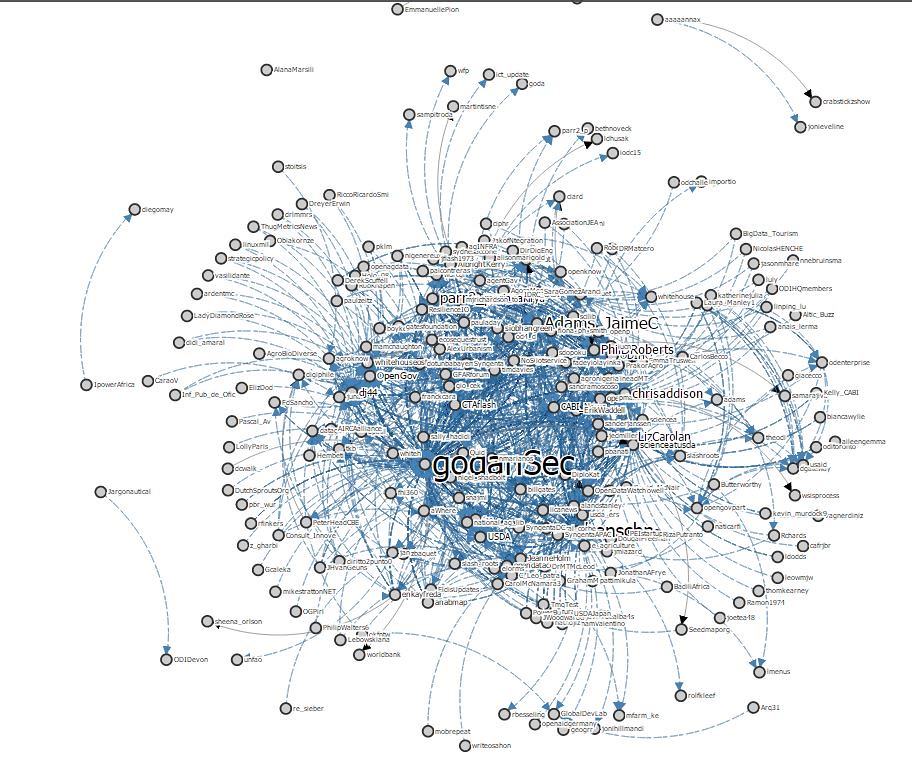
This resulted in various Twitter accounts being involved in the Conference's discussions which allowed us to spread the progress and outcomes of the Conference at a wider audience - much wider than the one consisting of only the participants. Apart from that, the intensive use of Twitter allowed us to create a simple documentation of the event for future reference, including quotes, images and other media.
Future #CAP: tackling the challenges of competitiveness, climate change & environment via a well targeted policy.— Farm Europe (@FarmEurope) November 10, 2017
Supporting farmers or agricultural land?
For Member States or for farmers? @TassosHaniotis @Gaia_Brussels #GaiaCongress17 pic.twitter.com/LlWHsu6p5M
The use (and display) of the Conference's hashtag allowed others to make use of it and be involved in the conversation, which was one of the most important aspects. We kept mentioning participants and their organizations in our tweets, so that they would also be engaged (and they did). We also mentioned non-participating organizations when tweeting something of interest to them, so that they would also keep an eye on the updates.
“Η εφαρμογή των νέων τεχνολογιών στην καθημερινότητα του αγρότη αποτελεί προτεραιότητα τoυ #MinDigitalGr”— MinDigitalGr (@MinDigitalGr) November 10, 2017
Ομιλία του Υπουργού ΨΗΠΤΕ στο #GaiaCongress17 pic.twitter.com/ySIDJLwlnN
This resulted in various Twitter accounts being involved in the Conference's discussions which allowed us to spread the progress and outcomes of the Conference at a wider audience - much wider than the one consisting of only the participants. Apart from that, the intensive use of Twitter allowed us to create a simple documentation of the event for future reference, including quotes, images and other media.