Monday, February 16, 2015

Crowdfunding: Current Status & Future Perspectives Workshop

Logo of the Greek National Documentation Center (EKT)On February 16th, 2015, the Greek National Documentation Center (EKT) organized a workshop titled "Crowdfunding: Current status & future perspectives" in the context of the Enterprise Europe Network-Hellas and supported by the European Commission, the European Crowdfunding Stakeholders Forum and the European Crowdfunding Network. I like to attend various events organized by EKT (and I would like to thank them for giving me the opportunity) and since Agro-Know considered this an interesting event as well, I managed to register on time in order to ensure my participation and bring some fresh ideas back to the office.
The workshop started with a short but interesting presentation of the Enterprise Europe Network Hellas by Georgia Tzenou (EKT, the coordinator of the Network in Greece) and consisted of three sessions:

Session 1: Crowdfunding in EU: Current Status & Good Practices

This session aimed to provide the current status of crowdfunding at a European level, through related networks and initiatives. It was facilitated by Georgia Tzenou (EKT) and consisted of the following presentations:
  • The European Crowdfunding Network (ECN): Oliver Gajda, the co-founder & Chairman of the European Crowdfunding Network AISBL and Executive Committee member at CF50 (the global think tank on crowdfunding) presented ECN and the issues related to the lack of  harmonized framework for defining crowdfunding  activities.
  • The Peer2Peer Finance Association: Samantha Ridler, the president of the Association presented the work of the association, focusing on the Peer-to-Peer Lending approach.
  • European Crowdfunding Stakeholders Forum (ECSF): Nikos Daskalakis, member of ECSF and IME/GSEVEE presented the role and activities of ECSF, a forum that aims to help the European Commission to "assist the Commission in developing policies for crowdfunding to flourish while taking into account the interest of contributors".
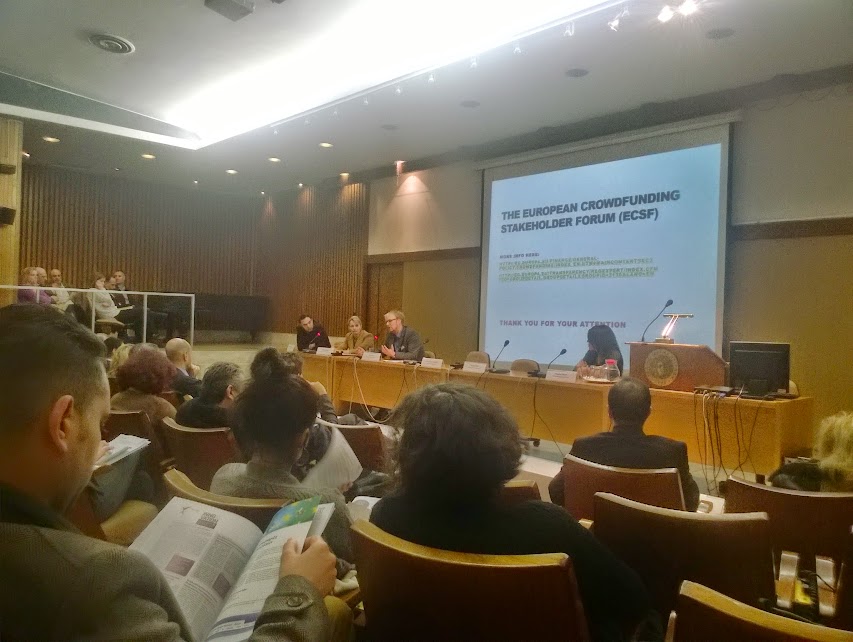
 
During the 1st session of the EKT Workshop on crowdfunding
During the 1st session of the Workshop

Session 2: Crowdfunding in Greece: Legal and Regulatory Framework

This session consisted of the following two presentations:
  • Nikos Kontizas presented the "Crowdfunding: Legal Challenges and the Situation in Greece", presenting the gaps regarding the legal framework of the crowdfunding activities in Greece
  • Dionysis Paraschis presented "Regulatory framework for the Crowdfunding market in Greece", representing the Hellenic Capital Market Commission and focusing on the Capital Market perspectives on this issue.

Session 3: Greek Crowdfunding Platforms

This session was facilitated by Iraklis Agiovlasitis (EKT) and was the most straightforward of all three; representatives of the 6 most active/well-known crowdfunding platforms in Greece were invited to present their platform and work and discuss the joint issues that rise due to the lack of a solid legal and operational framework, as discussed in the previous session. The following platforms were presented:
  • OpenCircle: The co-founder Xenophon Krokidis presented this advanced platform which aims to turn researchers into entrepreneurs. It works on the Equity Crowdfunding approach and aims mostly at investors wishing to invest their money in a commercial enterprise (e.g. a startup or a small business) or idea for a project as well as on entrepreneurs who wish to develop an innovative idea but they do not have the resources to do so. You will need a well-defined business plan and a strong team to support it in order to get through the initial steps. It seemed like the most professional and advanced solution, rendering it more suitable for more advanced ideas and investors.
  • Give & Fund: Giannis Chatzimpeis, the founder and Paralympian Athlete described the story behind the development of this platform and his own success story in raising funds for a specific food purpose. Give & Fund is a digital crowdfunding platform that allows everyone to create a fundraising page through a simple & safe process (and with no cost!). The platform also allows the interaction with social media, in order to further promote the project. The platform is based on donations from individuals.
  • Groopio: Dimitris Anagnostou, the founder of Groopio, the oldest crowdfunding platform in Greece presented the simple (and successful) approach of his platform, which aims to inspire and fuel creativity, by "raising capital in small amounts from a large group of people who want to support an idea or effort initiated by a person or organization". It seemed like the most informal but still more appealing and easy to use platform (along with Give & Fund).
  • Winnersfund: Konstantinos Parissis, the Founder of Winnersfund, presented the platform. His background as a Lawyer & Economist helped him understand the issues behind the crowdfunding activities and seems to have the solutions to them. The platform provides a complete solution to crowdfunding focusing on businesses; some of these seem to be in the agri-food production domain. I have the feeling that the specific platform is aiming at serious investors, having a similar (but not as advanced) as OpenCircle.
  • GreekFund: A Greek crowdfunding platform, presented by its executive partner Tasos Taskaris. The platform aims to support innovative business and societal initiatives that require funding,focusing on the Greek initiatives (something that becomes obvious not only from the intuitive Greek user interface but also from the lack of any information in English). What makes GreekFund special, is the involvement of a wide variety of groups that work collaboratively in the process including the creators (those with innovative ideas), the wise (those who produce new knowledge), necessary collaborators (experienced scientists and professionals, experts in marketing & advertising etc.) - you can read more here.
  • OneUp by Praxi: Pau Kidner, from the Praksis Business Coaching Center NGO, presented the OneUp initiative. The specific initiative has a strongly societal approach, aiming to provide the means to those with no funds and job to get the necessary tools through a 4-month program on entrepreneurship, in order to allow them stand back on their feet and be more competitive.
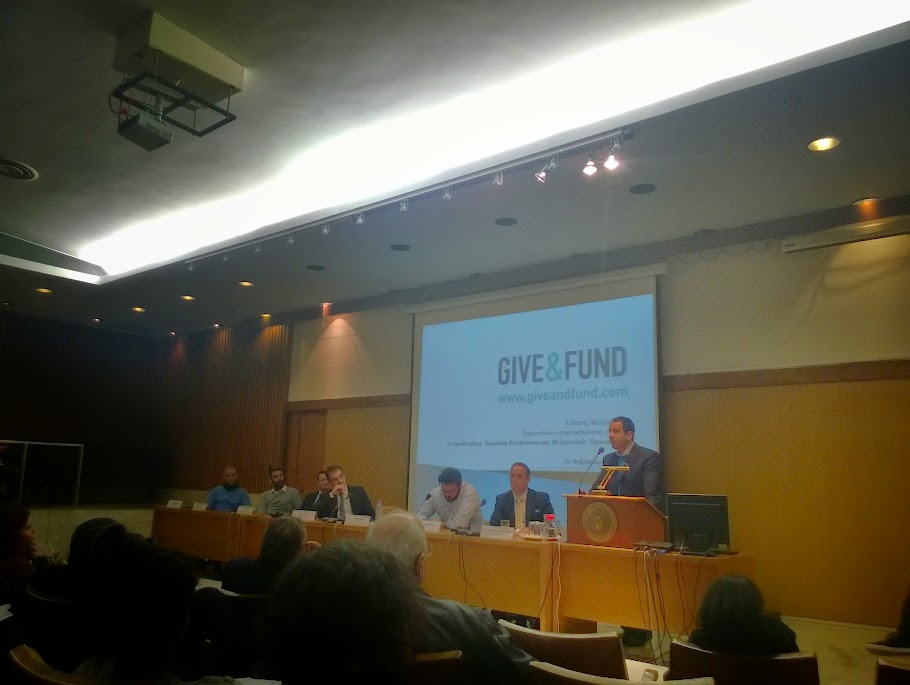
Presentation of the Give & Fund
On top of that, Stathis Athanasiou, a Greek director, presented his own successful story of raising funds for the development of his own film using Indiegogo; he presented both the advantages and the issues that he faced during the process.
Almost all speakers highlighted the common issues faced in the crowdfunding context, such as the lack of a clear framework for the proper operation of related activities, the risks that may be low but still exist (e.g. of funding a project that will not be completed) and the issues caused by the need of using online payment services (e.g. increased complexity and sense of insecurity). However, all founders agreed that there should be collaboration between the different platforms in order to support the development of a transparent and functional framework to meet the requirements of all different cases.
The event concluded with a discussion between the audience and the speakers of the last session, during which a lot of answers to practical questions were provided. It was really interesting to see the level of interest from the audience, especially after having the previous presentations setting up the context and raising the awareness about crowdfunding.
All in all, it was a really interesting workshop on an emerging topic. It successfully managed to provide all dimension to the subject (financial, legal, platforms and end-users) in a compact agenda, allowing at the same time interesting discussions and informing potential stakeholders about crowdfunding. It became obvious that even an SME like Agro-Know may benefit from related activities under specific conditions.
All presentations are already available through the event's web page.

Sunday, February 1, 2015

A really busy January is over

I can't believe that it has been more than one month since I last wrote something in my blog... it seems that my work absorbs most of my productive time and many of the things that I would blog about are already posted in the Agro-Know blog anyway (by me).

Well, January is officially over and there were a lot of work-related updates: First of all, there is a new team member in the Marketing team (that I am leading - or at least I try to); Alexandros seems like a talented and creative person that is currently doing his internship in Agro-Know, helping me out with marketing-related activities, such as the social media and the marketing material (which needs a face lift, I have to admit). It is a challenge for me to guide him through the team's needs and provide him with the knowledge and space that he needs in order to deploy his creativity and fresh ideas!

Apart from that, I have been focusing my work during January on the branding- and marketing-related activities of a new product that Agro-Know plans to deploy in the next weeks/months. These activities include:
  • the work on the product's logo with George, a talented, external (out of the Agro-Know team) graphic designer;
  • the development of a Drupal-based landing page for the product with the help of an external team of web developer;
  • the work related to the registration of the trademark of the new product (name and logo), in collaboration with the company's lawyer (Periklis, also a great guy);
  • the development of a methodology based on the AARRR (Startup metrics for pirates!) in order to measure the acquisition of new customers and the conversion funnel (?);
  • reading about SEO, conversion funnels, Call-to-action & conversion techniques, leads and copywriting and other unfamiliar terms and methodologies
This alone seems to be challenging, as it involves a lot of preparation related to work that I am not familiar with; however, getting to learn about such things helps me broaden my (already broad) knowledge obtained through my work with Agro-Know (including metadata & their management, digital repositories, information management, knowledge organization systems, linked data, big data, social media, open access & open data, etc.).

Last but not least, I am working on two publications (one for the Open Repositories 2015 Conference and another for the Open Knowledge in Agricultural Development (OKAD)) to be submitted in the next days and doing some work for the text for the website of the Wheat Data Interoperability Working Group of RDA (of which I am a member) and completed the Greek translation of the Pisa Declaration on Policy Development for Grey Literature Resources - a movement that I really endorse :-)

I have a feeling that February will be a key month for my work, as the deployment of this new Agro-Know product is expected and this will be affected in a high degree by my personal contribution. At the same time, my collaboration with my new team member is a stake that I need to win, as this will be a win-win situation for both sides; the team will gain a long-term new member and I will have more free time to focus on more high-level aspects of my work.

Thursday, December 25, 2014

So, what did I do during 2014?

Another year has come to an end - my 4th year in a row for Agro-Know. As usually, this was a year full of trips, events and interesting work and I would like to present an overview of what I did during this year. This time, I tried to experiment with infographics which I really love and you can see the results of this experimentation right below:


For those who still like a traditional list with links, here it is!

In chronological order

- Organic.Lingua 7th Project meeting (14-17/1/2014, Birmingham, UK)
- Organic.Lingua Greek user trial (12/2/2014, Athens, Greece)
- Webinar@AIMS:“Knowledge Organization Systems (KOS): Management of Classification Systems in the case of Organic.Edunet” (21/2/2014, online)
- Short trip to Alcalá de Henares, Spain (26-28/2/2014)
- Participation in EDF 2014 (19-20/3/2014, Athens, Greece)
- RDA 3rd Plenary Meeting (25-28/3/2014, Dublin, Ireland)
- Participation in in SEMIC 2014 Conference (9/4/2014, Athens, Greece)
- CIARD-GODAN Joint Consulation Meeting (22-24/4/2014, Rome, Italy)
- Organic.Lingua 3rd Review Meeting (28-30/4/2014, Luxemburg)
- ARIADNE Foundation General Assembly (5/5/2014, Athens, Greece);
- EdReNe 11th Conference (6/5/2014, Athens, Greece)
- LRE Subcommittee meeting (7/5/2014, Athens, Greece).

- I was assigned the role of Marketing & Networks Manager of Agro-Know (1/6/2014)

- Herbal.Mednet 4th project Meeting (4-6/6/2014, Bucharest, Romania)
- "Agriculture for Life, Life for Agriculture" International Conference (6/6/2014, Bucharest, Romania)
- SemaGrow 2nd Hackathon - Introductory Course (presentation on agri-food big data (4/7/2014)

- ICARDA meeting for defining the Open Access plan based on the CGIAR Mandate (Amman, Jordan, 3-9/9/2014)
- Agro-Know internal training: Using the Agro-Know blog (2/10/2014)

- Reached 100 (personal) posts in the Agro-Know blog (5/11/2014)

I am really curious to see what 2015 is going to bring and if I will manage to create a similarly large list of highlights like this one...

Monday, November 24, 2014

Seminar on social media, marketing and campaigns

I am the Marketing & Networks Manager of Agro-Know since June 2014; mostly due to my involvement in the social media in general but mostly blogging and tweeting. I am self-taught for both, I (hope that I) am good at it because I really like it and I always try to find ways to perform even better in using social media effectively. I often find myself downloading related e-books and watching presentations on optimizing the use and effectiveness of social media.

In this context, a couple of weeks ago I had the opportunity to attend a face-to-face, 12-hour seminar on the use of social media (mostly at a corporate level) and marketing, focusing on the use of campaigns for promoting corporate events and activities in general. The seminar took place on two days (20 & 22/10/2014, 6 hours each), it was organized by Seminaria.gr and delivered by Arsenis Paschopoulos, e-Commerce & Internet Marketing Expert and Digital Marketing Manager of Just On Line with a long experience in social media and teaching this subject. The seminar took place in a cozy meeting room of Golden Age Hotel (Athens, Greece), pretty close to a metro station, making it really easily accessible.

A photo posted by Vassilis (@vprot) on
The seminar was addressed to both novice and advanced users of social media (it was attended by about 15 people) and this was a tricky part, as the trainer needed to make sure that everyone would get the basics of the social media presented (novices) without having a part of the audience getting bored (the more advanced users). Considering myself a more advanced social media user than the average, I have to admit that not only I did not feel bored but I indeed learned things that I was not aware of regarding the social media that I am using. The social media covered by the seminar during the first day were the following:
  1. Facebook and Google+ (I also consider them in the same league);
  2. YouTube;
  3. LinkedIn;
  4. Twitter;
  5. Pinterest (a pretty bizarre choice at first, but the use cases presented were convincing)
The time available for these was marginally sufficient but we more or less managed to cover everything, including information from creating an account and linking to other social media to using them for corporate purposes.

The second day was devoted to the use of campaigns using the aforementioned social media; Facebook was obviously the most well-covered medium but still alternative options for campaigns using the rest of the social media were presented. I realized that running a campaign using e.g. Facebook is not as expensive as I initially thought and it might be pretty effective, too.

My overall impression was rather positive; I managed to learn some things that I was not aware of, Mr. Paschopoulos helped me address some issues that I had with specific social media, I got to learn a lot of new stuff about the campaigns and got some basic information about SEO and the interpretation of analytics for each tool. He proved to be good at communication and had a deep knowledge of the social media presented.

Apart from the training, I also got to get a high number of slides presented during the seminar (but not limited to it - I got much more than that) as well as a book authored by Mr. Paschopoulos on Social Media Marketing (hardcopy) which contains a lot of useful information and can be used as a reference, documenting more or less what was already presented during the seminar.

My attendance to the seminar was another example of the training opportunities that Agro-Know offers to its team members; these are not limited to internal trainings but also include external opportunities as well.

Saturday, November 1, 2014

Changes in the Agro-Know team

Over the last six months there have been several changes regarding the Agro-Know team; Giota, Angeliki and Thodoris left the team during the summer of 2014 for different reasons; it was a friendly break-up and we still have a great time when we meet (usually with a round of beers!) even though time is limited and opportunities for meeting outside the working hours are scarce due to personal obligations. None of them was a team member since the beginning but still their departure left gaps that we had to work on; on the other hand Mada stopped working for Agro-Know by the beginning of October while Nikos (+Nikos Palavitsinis) has already published his farewell to Agro-Know. Both of them were in the team since it all started, and this was something different. These departures were also planned but still...

At the same time, the Agro-Know team was enhanced with several new members during the same period:
  • The Project Management team was enhanced with two new project managers (Apostolos and Katerina);
  • The Data team welcomed a new intern, Patrycja (data management assistant);
  • The Business Development team grew by two members, with the addition of Thodoris and Thanos;
  • The Technical team was enhanced with the recruitment of Giorgos (data ingestion associate) and Panagis (UX/UI expert);
  • The Admin team welcomed Athina (Administrative Assistant) and Popi (Culture & Talent Development Assistant)
  • Two new interns joined the AK team for helping us with the Food and Water Quality themes (Lito and Maria respectively)
You can find information about the Agro-Know team in the Agro-Know wiki.
The Agro-Know team, October 2014. We are missing Giannis and Laura (both of them traveling at the time of the photo shooting)

This means that a lot of new blood runs in the veins of Agro-Know now; of course we miss some of our experienced ex-colleagues but we hope that the new team members will make up for it with their fresh ideas and enthusiasm. The new situation is challenging, as a lot of new people need to be trained not only in terms of their work tasks but also in terms of the mentality and culture of Agro-Know; a factor that is actually more important than it looks/sounds as there is also the possibility that some people might not fit.

There used to be a special "chemistry" among the Agro-Know team members; especially those of us who started together when we got in the Agro-Know offices for the first time in January 2011 went through some hard times, a fact that brought us closer. We managed to evolve a rather unorganized team into a well-defined organization throughout , with well-defined processes, where a lot of time-consuming processes are now automatically taking place and are taken for granted. As the team grows bigger with new members joining, we tend to lose our chemistry due to growing responsibilities, lack of time and the fact that processes now are more formal and "professional". New members are not aware of all that and all they see is this new, well-defined and organized situation; this does not allow them to see the background behind everything but only the strictly professional side.

However, this is a bet that we need to win, as the proper functionality of the team is heavily based on this special relation between us all. We need to embrace our new colleagues and help them understand things, integrate quickly and help them understand and integrate in the Agro-Know culture in order to ensure that the team will remain strong and work as it used to do for the last years. This is mostly a responsibility of the initial members (to help our new colleagues on and of course of the new members to understand and respect in order to keep things going as they should...

Friday, October 24, 2014

CGIAR Open Access mandate: Work in progress in the case of ICARDA

Agro-Know has a long time involvement in Open Access through its participation in related EU-funded projects (such as VOA3R and agINFRA), its participation and contribution in related initiatives and events and more lately through our active involvement in the FAO AGRIS Network (Agro-Know is hosting & responsible for the Data Processing Unit of the traditional AGRIS service) but also through the expertise and experience of each team members (such as agricultural domain experts, information scientists and librarians, software engineers and web developers etc.). In this context, almost five months after the CGIAR presentation, Agro-Know made a contact with the International Center for Agricultural Research in the Dry Areas (ICARDA), one of the 15 CGIAR Centers and it was agreed that Agro-Know would be responsible for the following:
  • Provide an overview of the current situation of ICARDA and the Dryland Systems program regarding information available, repositories and related processes and workflows;
  • Recommend the optimal approach for ICARDA and Dryland Systems, in terms of technology, skills, processes and responsibilities in the organizations;
  • Taking responsibility to prepare the ICARDA and Dryland Systems Open Access Plan, following the Guidelines set out by the CGIAR Consortium.
ICARDA staff during the briefing session on OA

First meeting

The first step of this process was a week-long visit (between 3-9 of September 2014) to the ICARDA headquarters, which are now in Amman, Jordan. During this visit, Johannes Keizer from FAO and me had the opportunity to meet with the Communications, Documentation and Information Services (CODIS) team led (then) by Mr. Michael Devlin. The aim of this first visit was:
  1. to meet the CODIS team and other ICARDA/Dryland Systems staff that would be involved in the processes related to the Open Access implementation plan;
  2. to evaluate the current status of the ICARDA/Dryland Systems metadata management workflows and infrastructure;
  3. collect as much information as possible related to the structure, the status and the requirements related to the design of the open access implementation plan;
  4. to provide all the necessary initial information for setting up the basic workflows and tools and initiate some basic processes;
  5. to inform ICARDA directors and other key staff about the benefits of Open Access, discuss any objections they had and briefly describe their involvement in the new processes;
  6. to inform the ICARDA staff about our initial findings and suggestions for the next steps through a briefing session on the last day of our visit.
(L-R) Me, Jack Durrell (ICARDA), Johannes Keizer (FAO) & Michael Devlin (ICARDA)
Indeed, during the visit, we had the opportunity to arrange focused, individual meetings with several of the staff members of ICARDA, including program directors, information managers as well as with people with a more technical background and role (but still currently involved in the information management processes), and inform them about the CGIAR Open Access Policy and plans, providing at the same time information on the advantages of Open Access as well as responding to any questions. At the same time, through focused interviews, we collected feedback needed for compiling our report, such as the structure of the teams, the types of information products available, the thematics covered by the information products of ICARDA and Dryland Systems etc. All feedback received was documented and was taken into consideration, along with the related CGIAR guidelines, in the preparation of the workflows and documentation for the implementation of the Open Access policy for the case of ICARDA. Our visit concluded with an Open Access briefing presentation to the ICARDA staff, during which we briefly presented our findings and considerations for the next steps of the OA implementation.

Working on the Open Access plan for ICARDA & Dryland Systems

After getting back to the Agro-Know office, a working group (Development Team, as we like to call it) was formed, that would focus on the specific task; the group consists of information managers with experience in agricultural information management, people with experience in Open Access, agricultural domain experts and a project manager for coordinating all activities within the team. By sharing all notes and related documentation from the visit to ICARDA, we completed the first part of the requirements' collection and moved to the next phase, which was the documentation of the current status and our proposed revisions regarding the set up of the infrastructure and workflows to support the implementation of the Open Access policy in the case of ICARDA and Dryland Systems. So far, we have collaboratively worked (with the precious help and feedback from the CODIS team) on the development of a first draft version of the document that was shared some days ago, and we are currently working on the next steps, including the definition of the metadata elements and controlled vocabularies to be used in the case of the ICARDA and Dryland Systems repositories.

The next steps

The next steps include regular communication with the CODIS team and other people to be involved in the process (for clarifying aspects that are not clear to us yet), completing all missing information and polishing the document, as well as a second visit to the ICARDA headquarters (supporting the testing phase of our proposed workflows) that will focus on the following:
  • a number of face-to-face meetings with key ICARDA staff, for fine-tuning the information already available in the plan;
  • meetings with the CODIS team for hands-on sessions and testing of the proposed metadata management workflows;
  • a hands-on seminar with the focal points from each ICARDA team to be involved in the OA implementation processes (e.g. information managers), clarifying the tasks that need to be done from their side as a part of their work.
These will help us finalize the design of the processes involved in the OA implementation plan and ensure their proper functionality of the proposed workflows before the deadline which is set by the CGIAR Consortium by December 15th, 2014. After that, everything will be properly set up for the actual implementation of the CGIAR Open Access mandate in the case of ICARDA, which is expected to be start even before this deadline. In the meantime, Jack Durrell from the ICARDA CODIS team has prepared a related presentation regarding the needs and status of the Open Access status and progress in the case of ICARDA and Dryland Systems.


Thursday, October 16, 2014

Workshop on Wheat Data Standards and Interoperability

A really interesting workshop on Wheat Data Standards and Interoperability, titled "Bringing together the building-blocks of a common framework" took place between October 1-2, 2014 at Versailles, hosted by INRA. The Workshop aimed to continue the work that takes place in the context of the RDA Wheat Data Interoperability Working Group towards providing a common, open-standard framework for describing, representing, linking, and publishing wheat data.

Even though I was participating in the previous RDA Plenary Meetings on behalf of Agro-Know, this time I did not make it to the 4th Plenary meeting in Amsterdam (it was a good thing that my colleague +Andreas Drakos did!) nor to the INRA Workshop; for the latter, the hosts were kind enough to include my colleague Effie among the invited attendees so we had the opportunity to have a closer look on the progress of the group; of course I am still keeping an eye on everything related to the Group and participate (even remotely). However, I missed the chance to meet my good friends +Odile Hologne , Esther Dzale and Richard Fulss, with whom we usually have interesting discussions during the RDA Plenaries (and not limited to these events!).


Even though I miss travelling as much as I used to, I have to admit that I like the fact that my colleagues have the opportunity to contribute to the networks that Agro-Know is a member of and represent Agro-Know in such important events!

Thursday, October 2, 2014

Agro-Know internal training: Using the Agro-Know blog

Following up on the AK trainings' topic, my time came for organizing and delivering a seminar to my colleagues. The seminar was about using the Agro-Know Wordpress-based blog, in an effort for me to persuade my colleagues to start sharing their news and updates through this corporate blog. The effort for delivering the course was a long story but for several reasons it was always postponed. This time we managed to organize everything in only a couple of days and on Moday I found myself presenting my slides before nine of my colleagues who expressed interest in attending the seminar - I would like to thank each one of them for their interest in the specific training.
The process was the usual one: Describing the seminar through a Trello card in the dedicated board for the AK trainings, deciding on the most appropriate day and time through a Doodle poll and delivering the seminar face to face in the Agro-Know meeting room.


Through my slides I tried to provide a short introduction to blogs and blogging, describe our Wordpress installation and then went straight to the point: How could one get ideas to write about in the blog and how to actually use the Wordpress environment for transforming his/her ideas into an interesting blog post. As I am currently maintaining three blogs (one personal, one professional and the Agro-Know blog), apparently I have no issue finding topics for my posts but still I understand anyone who gets stuck in this part so I tried to provide some ideas on getting ideas for a blog post. In addition, I demonstrated how a boring text-only post can be much more interesting through the embedding of multimedia files (e.g. images, presentations, videos, even tweets and Facebook posts).

vprot_Wordpress_seminar

The presentation was nothing special or fancy; each slide was mostly based on my personal experience while I got some ideas from related posts and websites I have visited during the last years. However, I hope that through this presentation my colleagues will be motivated to be more actively involved in the blog, contributing their own parts both as blog posts and comments in existing posts, leading to creative discussions. I have to admit, that encouraging my friends to start blogging is one of the biggest challenges I face as I am really keen on seeing the Agro-Know blog being even more frequently updated with the contribution of everyone in the team!

P.S. Special thanks to Dimitra for pushing me with that (I was rather disappointed from my previous attempts to organize the training) and for taking the only photo from the event as well as to Athina who took care of the practicalities and helped me a lot!

Friday, September 12, 2014

Using the Asus Transformer Book T100 during a bussiness trip

I recently had the opportunity to visit Amman, the capital of Jordan, for the first time for a meeting hosted by the International Center for Agricultural Research in the Dry Areas (ICARDA), one of the 15 CGIAR centers. The trip was challenging for various reasons, including its duration; I had to be there for a total of seven days, which was rather longer than my average trip. Packing was one of the aspects that had to be carefully planned as I always try to travel light but at the same time I need to make sure that I have everything needed with me.

My main concern was the laptop that I would take with me. I had more or less the following options:

  1. My work laptop: My Toshiba Satellite C670D-1C1 is fine to work with at the office thanks to its large, 17.3-inch screen and decent specs for office use - at the same time, its size and weight (almost 3 Kg!) render it a burden during business trips - let alone its limited battery lifetime (usually less than 3 hours with normal use). I usually end up with pains at my back or neck after carrying it around for more than a couple of days.
  2. My netbook: A rather retired now, after many years of use, Acer Aspire One 751h is currently running Peppermint OS 5 Linux as it doesn't get along well with Windows - it is obviously too old and slow (1.3 GHz Atom Z520 CPU, 1GB RAM, slow HD) for running Windows 8 or even 7 and I wouldn't trust Windows XP (its original OS) now that they are officially discontinued. While it is not that slow with Linux, it still is not 100% compatible with MS Office (which I would obviously need to use during a business trip) nor with other Windows apps which might not be available for Linux. It is fine to use for leisure or when not actual work is needed but when it comes to business trips, I'd rather avoid that...
  3. My home laptop: A 15-inch Lenovo G550 running Windows 8.1, heavily abused by my two kids and used also by my wife at home was not the best option; apart from the fact that some of the keys are missing and the screen has some lines all over it (both left as a souvenir by my kids), it would also mean that I would leave my family without a decent machine to use (e.g. kids to watch YouTube cartoons and wife to kill some time surfing in websites). 

The solution to my problem was provided by a colleague of mine who offered his newly acquired Asus Transformer Book T100 for helping me out with the issue. T100 was one of the gadgets that I always wanted to get my hands on and probably get one of them; a 10,1-inch tablet with a detachable keyboard looked like the ideal solution for a trip The question was: Would such a tiny machine actually meet the requirements of a daily work in a new environment?

Asus Transformer T100 on top of my Toshiba Satellite C670D-1C1


Its specs were promising, as under its tiny body, it featured a 1.3GHz quad-core Atom processor (Z3740, a real workhorse compared to the crappy Z520 that under-powers my netbook), 2 GB of RAM, 32GB flash storage (expandable to 64 with the addition of a microSD card), a micro-USB 3.0 port and a battery life of about 10 hours of actual work combined with a usable keyboard which offered one additional USB port (2.0). T100 was running Windows 8.1 (full version, not RT!) with MS Office 2013.

My impressions from using the T100 during the trip are pretty positive:
  1. During the flight, I had to do some preparations by reading documentation downloaded just before the flight; I just detached the keyboard and I used the tablet as an ebook reader;
  2. After about 3 hours of light use (including WiFi usage), I still had about 80% battery
  3. During the first day of the meeting (09.30-17.30), I had no access to power plugs but still I had to keep notes using Evernote. With WiFi usually off and about 1.5 hour break, I still managed to reach my hotel room with about 30% battery left which was amazing!
  4. Using the T100 with WiFi on, 4-5 tabs in Chrome open, Skype, 1-2 MS Word documents and a PDF reader was no problem; I did not notice any kind of lag/delay. I cannot understand how this hardware manages to keep up with such tasks with no lag and such a long battery life.
  5. At first I was afraid that the tiny keyboard would be the bottleneck and it would take me a long time to write texts / keep notes. This was not true, as I got used to it in a short time and I managed to keep perfect notes with only a few mistakes throughout the document - keep in mind that I have relatively fat fingers.
  6. Using MS office was indeed necessary so the existence of MS Office 2013 in the T100 was much appreciated; I managed to revise a presentation I downloaded from Google Drive and work on some documents in MS Office without a problem. However, I should note that the use of a mouse instead of the touchpad made things a tad faster.
  7. The spare USB 2.0 port on the keyboard was handy e.g. for using a mouse. The touchpad was nice but a mouse makes things faster in many cases.
  8. The flexibility of attaching the keyboard (e.g. for note-taking) and detaching it (e.g. for reading or sharing something around the table with colleagues) was really handy, too!
  9. The tablet's screen is magnificent: bright, clear and responsive to usage as a touch screen; however, it is still 10-inch one.
My workflow consisted mostly of keeping notes using Evernote Desktop app, checking PDFs and other documents, web browsing, emails, social media etc. Nothing too intensive but still T100 performed way much better than my netbook.


My working space at the Bristol hotel in Amman

However, I also had some issues while using T100:
  1. I had my emails stored along with Mozilla Thunderbird Portable (we are talking about full portability here!) in an external HD, a USB 3.0 WD My Passport Essential 500GB (WDBACY5000A), a disk properly functioning in USB 2.0 ports. I tried to use the keyboard's USB 2.0 port but despite the fact that the disk's light went up and I heard the disk spinning, the disk was not recognized by the T100. I tried downloading the SES drivers from the WD website but it made no difference; I had to use the micro-USB to USB adaptor for the USB 3.0 port of the tablet.
  2. The tablet can only be charged only by using the micro-USB port so when the tablet was charging I could not use my external HD.
  3. Charging and using the tablet at the same time was rather slow; I suspect that it might be due to the type of power outlet (in Amman you may find a UK, a EU and other types of outlets) but in any case, I tried to charge the tablet during the night (for a good, long charge).
  4. Why didn't I just copy the inbox and Thunderbird to the T100? Because my inbox is > 18,5 GB at this point, so I would waste more than half of the available storage space (there was additional software stored and space allocated to other files as well).
  5. All my work files are stored in Dropbox and they currently occupy about 7,5 GB; due to the limited storage space, I had to copy the entire Dropbox folder to my external HD and use files from there. This means that the files were not synced with Dropbox so I will have to copy the folder back to my work laptop and sync them from there with Dropbox and my other machines. (Note: I could just have synced specific folders instead of the whole Dropbox, which I later realized that it could have been a saver...)
  6. The USB cable provided for charging the tablet was too short so even when I had access to a power outlet, it was not possible to work while charging unless I was sitting next to the outlet (which was not possible). A longer cable could be purchased individually but there may be issues with slow charging as I read in several fora.
  7. Last but not least; working long hours in a 10-inch screen might be hard for your eyes; the solution would be the use of a micro-HDMI to HDMI or VGA cable so that I could connect T100 with the large flat TV available in my hotel room but I was not prepared for something like that.

My overall impressions? Definitely positive! I managed to do what I had to do with a tiny machine of just about 1 Kg of weight instead of carrying around my 17.3-inch laptop (which would be my second option). On top of that I had the flexibility to use the T100 as a tablet when needed just by removing the keyboard. I did not miss my large laptop at any time, even when I had to work with the presentation. Even though I had to change my workflow a little bit (e.g. see the issue with the inbox and Dropbox) the T100 made up for that thanks to its flexibility and long battery life, which proved really important. This should definitely be in my wish list ASAP!


Sunday, August 17, 2014

Summer 2014 - Working under hard conditions...

This year I got two weeks of summer vacations starting early August and I planned to be totally disconnected from the internet, having 100% family vacations - this is why I did not opt to get any data plan for the specific period. However, something unexpected came up and I had to do some work during these days, so I had to slightly revise my plans. Since we had already booked ferry tickets and made arrangements, the only thing that I could do was to slightly revise my plans, including my packing plan - only to realize that I would need to get an additional backpack with me. After checking out the options I had and making a draft plan of the work I had to do, I decided to take the following stuff with me in my retired but still functional Trust 600B-15 Urban Notebook backpack, on top of the stuff that I would normally take with me during my vacations (ok, I would take some of them with me anyway!):
  • Acer Aspire One 751h netbook: My old and slow netbook, currently powered by Peppermint OS 5 Linux, served two main purposes; I used that for connecting to the internet, downloading emails and doing some work (as planned) while the kids could also watch some cartoons saved before the trip in the external hard disk. Its battery still holds more than a couple of hours, making it usable for trips. Carrying around my 17-inch laptop that I use at the office was not an option, due to its size, weight and limited battery capacity.
  • Nokia Lumia 720: It was totally exploited during the trip; not only it served as my mean of communication with the rest of the world through voice calls, but it was also my internet hub, sharing a 3G internet connection with the netbook (there was no wifi available at all times but unfortunately there was no mobile network as well!). It also served as a digital camera supporting my Olympus E-PM1 & used for taking videos (when my Olympus was not handy) and also for alternative internet usage such as emails, web browsing, social media (Twitter, Instagram, Facebook), checking out places worth visiting (sights, restaurants etc.) mainly through TripAdvisor and even creating lists and taking notes with Evernote. It was frequently charged with its own micro-USB charger.
  • Olympus E-PM1: My small mirrorless digital camera, mostly used with the Panasonic Lumix 14mm/F2.5 pancake lens. Wide enough to capture everything and lighter/more compact/brighter than the kit 14-42mm/F3.5-5.6 which I also carried with me. The camera was backed up by a 2nd battery and a charger as well as a 8GB microSD card with SD adapter.
  • Paper documents, related to the work that I had to do during my holidays and a paper notebook for keeping notes on the road/when away form the netbook/mobile;
  • Wallet with cash and debit cards; the latter are not always accepted in Greek islands (e.g. cafes, some restaurants, bakeries etc.);
  • Philips Sound Dot MP3 player: Was mostly used mostly at the beach and while the rest of the family was asleep. My oldest son also proved to be a fan of the playlist that I had made, so he used the MP3 player for some time, keeping him busy.
  • Credit Card Survival Tool; proved to be really useful for opening beer bottles and other stuff;
  • Klean Kanteen 20oz (592ml) Insulated Water Bottle: I cannot imagine going to summer vacations (and not only) without this stainless steel water bottle; it might be a little heavier than an aluminum one, but it has vacuum double walls for insulation, it does not have internal linings from dangerous substances, it is durable and wide mouth=easily washable and easy to fill with ice! It can be used as a drinking cup as well, in cases where no glasses are available (e.g. in rooms to let) or when you don't want to constantly open the fridge for getting cold water.
My digital camera and water bottle

What did I expect to find at my destination? Best case scenario included an unlocked WiFi network (which was rather impossible, due to the remote location of the village) with basic connection speed or at least a good mobile network signal (e.g. 3G).

What did I actually find? Indeed an unlocked WiFi network but with about 50% signal strength and slow speeds as well as a really bad mobile network signal - 3G was out of question! What I did most of the times was try to find locations were the signal for both networks was better, so  that I could send/receive emails and open some web pages I needed. Alternatively, I tried to work to the WiFi network early in the morning or late in the night, when the network was less used. In any case, I tried to do most of the work offline, while it was not possible for all tasks assigned...

All in all, I managed to performed at least the basic tasks within the deadline, while the ones requiring an active internet connection were planned for the next week, when I will be back in the office. It was a hard two-weeks period, but I think I managed to keep everything under control. :-)