Saturday, February 27, 2016

Working on the OpenMinTeD dissemination & training activities

OpenMinTeD is having a user meeting between 24-25/2/2016, hosted at the premises of Athena Research Innovation Center. Partners involved in the dissemination and training Work Packages (WP2 & WP3 respectively) had the opportunity to work collaboratively on the joint activities to be undertaken within the next months in the context of these two WPs on the day before - 23/2/2016. Partners from Athena RC (hosts of the meeting and coordinators of the project), LIBER (the WP2 leader), Open University (WP3 leader) and Agroknow attended this pre-meeting.

The discussions focused mainly on the dissemination tools that are already used (such as the project website, Twitter account and blog, for the time being) as well as the envisaged one for the next months (such as a potential Facebook page and the under-preparation project newsletter); the events and workshops that can be considered for dissemination purposes. Potential revisions and ideas for improvement were discussed, mostly on the OpenMinTeD website and blog (powered by Wordpress). This is where our experience with Wordpress, based on the Agroknow blog, was considered useful and may provide some quick fixes for open issues.

Events were also discussed in details, mostly LREC 2016 Conference and the RDA 7th plenary meeting. The project will be represented in both events, while additional ones will also be considered

As regards the training activities (WP3), they will focus on the OpenMinTeD platform and the services provided by the project. In addition, training sessions on more generic topics (introductory sessions on the TDM methodologies, advantages for various types of stakeholders, legal and interoperability aspects etc.) will also be considered, especially when training communities that are not exactly familiar with text mining and what it can do for them. In this context, I am excited that Agroknow (and therefore me personally, as I am representing Agroknow in these two WPs) is going to work on a report that will aim to provide the basics of the work to take place within the next months, such as the mapping of the communities to be trained, the curriculum for the trainings (e.g. thematic areas to be covered; it's been quite a long time since I was last involved in something like that but it would be great to apply my past experience in a new context), means to be used for the delivery of the trainings and other parts.

This work will take into consideration the work that has already taken place by Agroknow in WP4, in terms of the analysis of the research communities within the project and will feed the next steps of the Training WP. The deadline for this task is the end of March so I'd better stop blogging and start working on the report!

Thursday, February 25, 2016

Social media for agricultural extension and advisory services


I am passionate about social media; it is the way that they can be used as a mean for sharing information and knowledge with friends, colleagues and customers - the way that a message can be shared, re-shared and reach a wide variety of recipients that you probably don't know but still they are interested in it. I feel lucky to have the opportunity to contribute to the Agroknow social media to an extend and I believe that the use of social media by an agri-food data powered SME like Agroknow makes a difference - it allows us not only to share/promote all these interesting things that we work on as a company but also to share information about news and updates of interest to us. This allow our followers to create a better view of Agroknow, seeing what we consider interesting in our ecosystem of services, content and solutions in the agri-food research (and not only) sector.

I recently came across two interesting publications by GFRAS - the Global Forum for Rural Advisory Services:

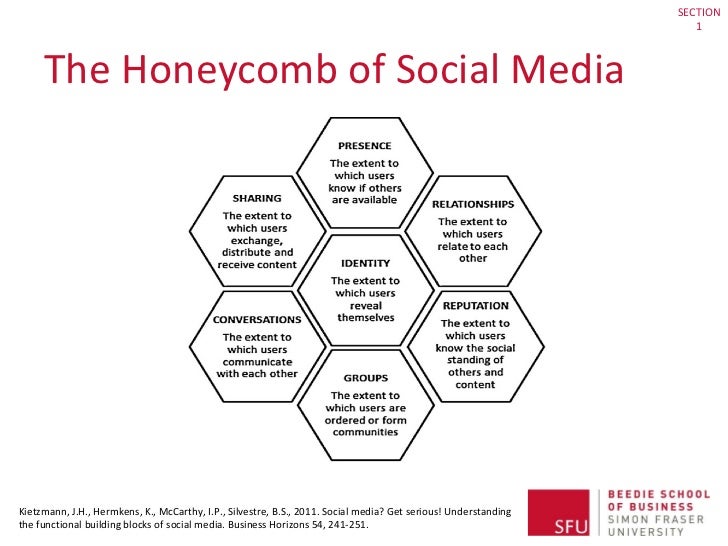
1. Social media policy guidelines for agricultural extension and advisory services (PDF): This is a really short document providing some well-though and useful guidelines for the selection and use of social media on behalf of an organization,

The Honeycomb of Social Media Kietzmann, J.H., Hermkens, K., McCarthy, I.P., Silvestre, B.S., 2011. Social media? Get seri...


2. Social media: Shaping the future of agricultural extension and advisory services (PDF). This is a 38-page study that discusses the role of social media in the context of agricultural extension and advisory services. By defining the context, the authors are able to provide useful insights on the use of social media in information and knowledge sharing in the agri-food sector.

As I am using social media for various purposes - not only for my own professional purposes but also on behalf of an SME like Agroknow, I found both publications to be really useful for anyone working with social media in the agrifood sector - and not only. What makes them so useful is the fact that they do not address marketing and business-related challenges that social media aim to address; there are plenty of publications providing this perspective - instead, they focus on the use of social media for serving information and knowledge sharing purposes, which is the scope of the extension and advisory services.

Wednesday, February 17, 2016

Aggregating content from multiple sources - and how to manage information overload

I had the pleasure to attend a webinar titled "How to read updates from hundreds of websites and blogs, fast and easily?", organized by GFAR and facilitated by Peter Casier, the GFAR Social Media Coordinator. Despite the fact that I am no longer working as a Marketing & Networks manager for Agroknow, I still have a personal interest for social media and the way that they are used for information and knowledge sharing - this interest is then applied in my daily work and transformed into tweets, blog posts and other means of sharing. On top of that, I am still contributing to Agroknow's social media presence in various ways.


Peter has a really long experience in social media and he managed to deliver the webinar in a really casual way, engaging participants, making jokes and being really friendly (as opposed to typical, serious webinars where the presenter remains strict and focused throughout the webinar). Questions were posed through the chat box and Peter responded on the fly with the help from Tania Jordan who was moderating the webinar.

The webinar focused on how to manage and read news from multiple sources, using the Feedly service as the main tool; even though I was already aware of Feedly (and in fact heavily using it on a daily basis), I still learned some things that I didn't know and also got some nice new ideas like the Feed Informer. I was glad to see Agrifeeds used as an example of agrifood news feed aggregator; we use Agrifeeds with the Agroknow blog for sharing RSS feeds of interest to the blog's readers - at the same time, we have registered the blog's RSS feed through AgriFeeds, so it is available to anyone browsing through the numerous feeds included.

To make a long story short, Feedly allows users to collect RSS feeds of their interest and organize them in categories through an easy to use interface. At the same time, it provides a feed of its own, which can be used by RSS readers. This allows its users to create a custom list of RSS feeds, organize them and have them delivered in their RSS feed reader.


I was also affected by this information management overload as I wanted to peek news and updates from numerous online sources, such as blogs, websites and portals. My personal workflow is the following:

  1. Add my favorite feeds in my Feedly account.
  2. Organize them in categories (e.g. social media, information management, tech/gadgets, science etc.).
  3. Use Flux, a user-friendly RSS reader, on my Lumia 735 mobile phone to connect with Feedly
  4. As I do not currently use a mobile data plan, I download all new RSS feeds through Flux (actually refreshing the feeds) to my Lumia before I leave home in the morning and before I leave office in the afternoon.
  5. While commuting to the office/back home, I have all the news items I need in my mobile phone and can browse through them very quickly and effectively.
  6. If I find an article that I want to read on a full screen, including images (that are not displayed when offline) or share with friends and colleagues, I just use the share functionality embedded in Flux and I send the article through email; when I connect to a wifi network, emails are automatically sent to their recipients. Each email consists of the article's title (as the email's subect) and a link to the actual article.
  7. Bonus: When I want to share one of these articles through social media when I reach office, I just send an email to myself from another email account (always using my mobile phone) so that I get this link in my Agroknow email inbox when I arrive at the office :-) 
This workflow allows me to get up-to-date with what I would like to check out and get some fresh material to share through my personal and Agroknow set of social media without spending too much time online.

So, big thanks to Peter Casier and everyone involved in the design and implementation of the webinar; I am already looking forward to the next one, titled "How to define and measure your social media performance?"; an issue that has already concerned me in the past.


Saturday, December 26, 2015

Work laptop gets a facelift

My work laptop is a Toshiba Satellite C670 - a basic but sufficient 17-inch laptop with some minor drawbacks (such as the lack of HDMI & USB 3.0 ports, as well as the existence of only 2 USB 2.0 ports) which does a great jo at the office. It came with Windows 7, soon upgraded to Windows 8.1 through a Microsoft offer offering the new OS for just 20 euros (or something like that) and recently upgraded to Windows 10 - all these without a format since 2012. As it was not getting the Windows 10 November update, I considered the Christmas holidays as a great opportunity to spend some time with it and making sure it has the latest version of the OS, fix some bug and clean things up.

So I spent some time the other day preparing everything, such as:
  1. Getting rid of obsolete stuff taking up precious space of the hard disk;
  2. Getting an image of the current system, using the built in functionality of Windows 10 on my external hard disk (so that I could go back to the current state of the OS in case something went wrong);
  3. Moving stuff that I needed (such as my user folder) to my external hard disk, so that I could copy them over my fresh installation, if all went well.
  4. Preparing a bootable USB flash drive with Windows 10 Pro 64-bit (the OS that my Toshiba currently has)
After everything was prepared and done, I just started a fresh install of the OS by booting from the USB and formatting my system partition (C:). Installation was pretty fast (the specs of the laptop are not exactly bad, with a Pentium B960 with 4GB RAM and an Nvidia GPU and all hardware was correctly recognized I only had to manually update the touchpad drivers to the latest ones from Synaptic, update Windows and the Store apps to the latest versions - after a couple of reboots everything was ok.

I took some time to reinstall some favorite apps like MS Office, Google Chrome, Skype, Acrobat Reader, Dropbox etc., set up OneDrive and fine tune some settings to bring the experience closer to my needs. I also copied back some of the data that I previously had, such as photos, music and documents (so not the whole user folder, as it still contained some obsolete stuff).

Performance seems to have been slightly improved and some delays (e.g. when right-clicking on the desktop or a file) seem to be fixed. I also got rid of some of the Toshiba pre-installed apps that came with the laptop back in 2012 (including the Nero suite, that I never used during all these years). So far so good, and my work laptop is ready to face the challenges of the new year quite refreshed!

Tuesday, November 17, 2015

Report from the Community Workshop on the Open Science Cloud


On November 13th, 2015, a community workshop on the Open Science Cloud titled "Shaping the Open Science Cloud of the Future" took place in Bari, Italy. Agro-Know was invited as a data-powered SME in order to contribute its expertise in serving the agri-food research community - other communities were represented as well.

This provided us with excellent opportunity to present how three different user types could benefit from the envisaged Ope Science Cloud:
  1. Agri-food researchers: I have have spent 13 years in the Agricultural University of Athens; two of them for my MSc. and almost 5 for my PhD. I didn't have any kind of infrastructure suporting me as a researcher back then: I recall copying my data from the lab desktop computer - no laptops back then - using an external parallel Zip drive using 100MB disks (a painfully slow process) or an almost faulty SCSI CD recorder which frequently provided us with lemon copies of the data. When I wanted to share data with our Austrian colleagues I had to create copies of the CDs, check their integrity and then send them to Austria using regular postal service...this makes me (and researchers like me who may have access to the necessary tools and platforms but they do not know how to make use of them) a potential user of the Open Science Cloud, as
    an individual researcher.
  2. A data-powered SME: Agro-Know is working closely with agri-food researchers; we understand their needs and serve them by developing data-powered services. Our AKstem product is a fine example, as it provides a cloud-based web app that supports e.g. content providers who wish to publish their research publications through the FAO AGRIS bibliographic database; both the help desk and the metadata ingestion processes are supported by AKstem. In addition, researchers who wish to apply for funding through any of the Horizon 2020 agri-food calls can get support in terms of describing, developing and implementing the mandatory Open Access and Data Management Plan through AKstem. Such services require cloud-based hosting, storage and data services thus making Agro-Know an SME that is a potential customer/user of the Open Science Cloud offerings.
  3. A global research data hub: AK is only one of the entities behind agINFRA, which currently involves major players in agri-food research at a global level, including (but not limited to) UN FAO (Global), CGIAR (Global), CABI (UK), GODAN (Global), USDA NAL & AGRICOLA (US), OADA (US), CAAS (China) and EMBRAPA (Brasil). INFRA has evolved from an FP7 project to a global atlas of agri-food research. It embraces all types of information related to agri-food research, such as research data and publications, profiles of researchers, organizations and projects activated in specific research contexts, domain-specific standards, software tools, platforms, thematic repositories, registries and indexes and anything else. However, agINFRA does not aim to be yet another registry or catalog of services and entities: instead, it creates a semantic layer providing rich information about each one of these entities and uses vocabularies for classifying them. In this way, these resources are not only more easily retrieved by queries but related heterogeneous resources are linked and therefore presented together after related queries. agINFRA embraces all types of data providers, no matter how big or small they are - the latter usually have limited technical technical and financial capacity for publishing and sharing their data and this is where agINFRA and its dedicated help desk shines.


A large and ever growing network of agri-food data managers, the FAO AIMS community, supports researchers by openly sharing their knowledge through the AIMS platform in blog posts, webinars, discussion as well as in meetings, such as the ones of the Agricultural Data Interoperability Group of the Research Data Alliance. As a result, agINFRA can test, validate and deploy data usage scenarios that include heterogeneous data types from various data sources all over the world. You should keep in mind that agriculture is a complex science, covering thematic areas that range from traditional crop/animal/food science to food safety, food security, forestry, viticulture and wheat research etc. - all these thematic areas produce and make use of a wealth of heterogeneous data such as physical measurements, sensor data, environmental parameters, weather and soil data, soil maps, images, outcomes of DNA/RNA/protein analysis, antibodies, agricultural trials. These highlight the increased need for cloud and grid-based services for these communities to be served and this highlights the role of agINFRA as a potential customer/user of the Open Science Cloud offerings.

After presenting the big picture, I went back to describing the work of a researcher, who apart from conducting his research, he needs to spend time looking for information on the following:
  • Guidance on publishing his research as Open Access; what are the institutional and project policies, what are the available domain-specific repositories to deposit his publications and aggregators etc.;
  • Help on where and how to store his data online using a free cloud service for sharing, managing and preserving his data;
  • Identify other researchers working on the same research area, related organiations and initiatives/projects etc.
  • Funding opportunities to support his research;
  • Other...
Searching for such information and ensuring that he always has the latest versions in his hands, consume valuable time that he could dedicate to his work.


So our vision as Agro-Know and agINFRA in terms of implementing the Open Science Framework in our case is for us to be able to support agri-food researchers in the aforementioned activities using cloud-based, customized and open services, thus saving them time that can be allocated in what they know how to do well: their research.

Thursday, November 12, 2015

The European Open Science Cloud for Research & agINFRA

Some of the major EU-funded initiatives/networks, and more specifically EUDAT, LIBER, OpenAIRE, EGI and GEANT agreed to join forces and work on a common vision for the European Open Science Cloud for Research which includes eight elements of success for a concrete contribution to the Digital Single Market:
  1. Open in design, participation and use
  2. Publicly funded & governed with the 'commons approach'
  3. Research-centric with an agile co-design with researchers and research communities
  4. Comprehensive in terms of universality and inclusiveness of all disciplines
  5. Diverse & distributed empowering network effects
  6. Interoperable with common standards for resources and services 
  7. Service-oriented as well as protocol-centric 
  8. Social connecting diverse communities
(for more info, you may refer to the Position Paper at Zenodo).

By joining forces, these networks will be able to identify and address existing overlapping in terms of infrastructure and services provided to the end users and meet the requirements of research communities in terms of infrastructure and tools - but they will need to understand the actual needs of each community that will be served (including our agri-food research one).

These news are extremely important for the research community in various disciplines, as biodiversity (see LifeWatch), agriculture and food security (see agINFRA), marine and aqua (see iMarine & BlueBridge), which have been funded through various calls and have allowed researchers to move on with their research.


agINFRA, an ex-FP7 project and currently a research data hub for the agrifood community, engages some of the biggest players in the agri-food research context - at a global level:
  • The Food and Agriculture Organization of the United Nations (UN FAO)
  • CGIAR, with its fifteen (15) research centers all over the world
  • CABI (UK)
  • Wageningen UR
  • The Global Open Data for Agriculture & Nutrition (GODAN)
  • Open Agricultural Data Alliance (OADA)
  • The Agricultural Data Interoperability IG (IGAD) of the Research Data Alliance (RDA)
  • The Chinese Academy of Agricultural Sciences (CAAS)
  • EMBRAPA (Empresa Brasileira de Pesquisa Agropecuária)
  • USDA NAL and AGRICOLA
  • ...and many more
Through these collaborations, agINFRA is working on the following:
  1. Enhancing discoverability of agri-food research by building a global atlas / index of agricultural research;
  2. Building a semantic layer that will allow the combination, enrichment and enhancement of heterogeneous information from multiple sources;
  3. Supporting research projects and organizations that (need to) publish their outcomes through a dedicated help desk service;
  4. Engaging a very active community that consists of all agri-food data managers as well as information and knowledge managers at a global level (FAO AIMS & IRDA GAD)
  5. Developing, deploying and testing data-rich and complex agri-food research applications and systems on various thematic areas, such as food safety, agricultural trials, forestry, viticulture research etc.


What do users of a hub like agINFRA need (among others)?
  • Well informed data & knowledge managers in their institutions (e.g. universities);
    • to guide them through the process of open access publishing in the appropriate repositories, data management and hosting services, use of domain-specific standards etc.
  • Online help desk to ask more complex questions:
    • Where should I deposit my open access publication?
    • How can I be compliant with the Horizon 2020 Open Access Policy?
    • Which are the licenses that apply to my research outcomes?
    • Where can I find data management services for storing, organizing and sharing my research data?
    • Where can I find data of interest to me as a researcher?
    • What are the funding opportunities in my domain? Where can I contact researchers working on the same research context as I do?
  • Simple cloud service: A Dropbox for researchers, to store, share and find online their research data.
Let's see if and how such requirements will be met by the Open Science Cloud in the near future; the envisaged services look really promising but they will need to be fine-tuned after consultations with the research communities. Tomorrow I will have the opportunity to present the agri-food use case (of agINFRA) during the Open Science Cloud workshop that takes place in the context of the EGI Community Forum 2015 in Bari, Italy :-)

Wednesday, November 11, 2015

It's one of these days...

...where people just disappear from the office, traveling at the same time and participating in (interesting!) events all over Europe:

...and I am packing my stuff for Bari, Italy, where I will participate in the Community Workshop on the Open Science Cloud: Shaping the Open Science Cloud of the Future on Friday 13/11.

It's been quite a long time since I last saw this happening and a long time since my last business trip (it must be more than one year, if I exclude a domestic one).

I am sure that the Agro-Know office will be fully packed again on Monday. :-)

A photo posted by Agro-Know (@agroknow) on

Tuesday, November 3, 2015

ODI Summit 2015 & Agro-Know

The ODI Summit themed "Celebrating Generation Open" takes place today, 3/11/2015 at London, UK - obviously organized by the Open Data Institute. If you ask me (and many more), it is the biggest Open Data event of the year. Globally. It provides the opportunity to a wide variety of stakeholders to gather and shares their views, updates and ongoing work on open data.


Agro-Know is there, represented by our CEO Nikos Manouselis, who was really excited after attending the Summit last year. Since then, we had the opportunity to get to know the work of ODI better and even got the chance to work with their lovely team on the GODAN Discussion Paper (see also here). On top of that, our COO Giannis Stoitsis successfully completed ODI's Train the Trainer course, becoming a certified Open Data Trainer and since then he has delivered a number of courses on the topic. Last but not least, we have been working on joint project proposals with ODI during the last months and we are really looking forward to see them accepted and start working on their implementation. :-)

I am sure that Nikos will make the most of of this event, and he will come back to the office full of ideas and new connections, among others - any memorabilia from the event will also be more than welcome!

P.S. Did I mention that Agro-Know has recently become an ODI member? :-)


Saturday, October 31, 2015

Big Data apps for food safety; where are they?

We frequently refer to the highly important role of big data in the agri-food context, food & food safety but which are the big data-powered applications that already exist and serve real needs in this context? Agro-Know recently received a related question through a tweet:

The response is surprisingly not easy and a recent blog post by Nikos Manouselis (Agro-Know CEO) also poses the same question: Is there really a substantial purpose for using big data in this context or is this work taking place in the context of academic exercises?

I have described one of the really promising efforts in this context (the collaboration between IBM and Mars Inc.) but if we are looking for something even more publically available, then we should look for alternatives.


If you happen to be aware of any big data-powered apps for food safety, please leave a comment below! :-)

Saturday, October 17, 2015

On the concept of staleholders

The other day I had a pretty urgent task to complete: Two of our EU projects needed feedback from potential end users of their approaches and outcomes in order to help us understand if we have produced something meaningful and useful to them; one of them is looking at the existing gaps between education and actual professional needs while the other is focusing on the competences required in the same context (both of them activated in the agriculture and green contexts in general). In this context, both projects had online surveys prepared and ready to be completed by potential recipients of an email invitation.

Such projects usually aim to provide solutions to real problems of a predefined target group. In this context, they usually get the initial information and current status from desktop research, they validate these issues through initial workshops that aim at the elicitation of actual user requirements, they start building solutions based on them, they validate these solutions through trials and then, as soon as the solution seems mature enough, this goes public in the form of a public consultation.


What I had to do was to compile two lists of recipients of the corresponding email invitations (one for each case) and prepare a short invitation text for the email, customized for each case. Since I am a big enemy of spam (I receive an awful lot of them on a daily basis), the recipients of my lists were carefully selected, so that only people that might be interested in each survey were included. The invitations were sent to about 15 and 35 recipients respectively (some of them were common). I did not require a response in my email and I have not checked the responses yet. In addition, none of my emails bounced back, so they were all sent to valid email addresses. In the first couple of days, I only received one (kind) response to my email, mentioning that they will complete the survey and that they would also forward the invitation to potential stakeholders.

Have you ever contacted friends, colleagues and other contacts asking for their feedback on something that may be of interest to them but never hearing of them?

My experience from similar efforts in the past shows that the response rate is really-really low; we only get a low number of responses to similar questionnaires from people that ideally should be interested in the specific topic. Why this happens, I don't know: it might be due to lack of time for completing the survey, lack of interest in the specific topic, ignorance in general - maybe it is the way the are presented to them (dull/boring) or the fact that they already receive a lot of similar requests so they have stopped responding to them.


This is when a typo I made in a report I was preparing gave me the idea of the concept; were are referring to staleholders, meaning potential stakeholders that have stop being interested or responsive about a topic that should be of interest to them. I guess that such people should have been interested at first, but for any reason (like the aforementioned ones) they are not interested in it anymore. Stale may refer to both the status of the user as well as to the information that he/she receives. Sounds funny but true at the same time!


The point is that since such projects are working on providing solutions for these users, and they spend time and effort for this purpose, then we need to find ways to actually raise their interest and engage them. Of course this is not possible to take place at 100% but the response rate needs to be improved and since face to face meetings have obvious restrictions (number of seats, time and place limitations), an alternative approach should be identified.

According to the Merriam Webster Dictionary, stale is defined as "not interesting or new; boring or unoriginal"

If you have any ideas about that, please let me know (through a comment) and I will be eternally grateful to you!