Showing posts with label agINFRA. Show all posts

Tuesday, November 17, 2015

Report from the Community Workshop on the Open Science Cloud


On November 13th, 2015, a community workshop on the Open Science Cloud titled "Shaping the Open Science Cloud of the Future" took place in Bari, Italy. Agro-Know was invited as a data-powered SME in order to contribute its expertise in serving the agri-food research community - other communities were represented as well.

This provided us with excellent opportunity to present how three different user types could benefit from the envisaged Ope Science Cloud:
  1. Agri-food researchers: I have have spent 13 years in the Agricultural University of Athens; two of them for my MSc. and almost 5 for my PhD. I didn't have any kind of infrastructure suporting me as a researcher back then: I recall copying my data from the lab desktop computer - no laptops back then - using an external parallel Zip drive using 100MB disks (a painfully slow process) or an almost faulty SCSI CD recorder which frequently provided us with lemon copies of the data. When I wanted to share data with our Austrian colleagues I had to create copies of the CDs, check their integrity and then send them to Austria using regular postal service...this makes me (and researchers like me who may have access to the necessary tools and platforms but they do not know how to make use of them) a potential user of the Open Science Cloud, as
    an individual researcher.
  2. A data-powered SME: Agro-Know is working closely with agri-food researchers; we understand their needs and serve them by developing data-powered services. Our AKstem product is a fine example, as it provides a cloud-based web app that supports e.g. content providers who wish to publish their research publications through the FAO AGRIS bibliographic database; both the help desk and the metadata ingestion processes are supported by AKstem. In addition, researchers who wish to apply for funding through any of the Horizon 2020 agri-food calls can get support in terms of describing, developing and implementing the mandatory Open Access and Data Management Plan through AKstem. Such services require cloud-based hosting, storage and data services thus making Agro-Know an SME that is a potential customer/user of the Open Science Cloud offerings.
  3. A global research data hub: AK is only one of the entities behind agINFRA, which currently involves major players in agri-food research at a global level, including (but not limited to) UN FAO (Global), CGIAR (Global), CABI (UK), GODAN (Global), USDA NAL & AGRICOLA (US), OADA (US), CAAS (China) and EMBRAPA (Brasil). INFRA has evolved from an FP7 project to a global atlas of agri-food research. It embraces all types of information related to agri-food research, such as research data and publications, profiles of researchers, organizations and projects activated in specific research contexts, domain-specific standards, software tools, platforms, thematic repositories, registries and indexes and anything else. However, agINFRA does not aim to be yet another registry or catalog of services and entities: instead, it creates a semantic layer providing rich information about each one of these entities and uses vocabularies for classifying them. In this way, these resources are not only more easily retrieved by queries but related heterogeneous resources are linked and therefore presented together after related queries. agINFRA embraces all types of data providers, no matter how big or small they are - the latter usually have limited technical technical and financial capacity for publishing and sharing their data and this is where agINFRA and its dedicated help desk shines.


A large and ever growing network of agri-food data managers, the FAO AIMS community, supports researchers by openly sharing their knowledge through the AIMS platform in blog posts, webinars, discussion as well as in meetings, such as the ones of the Agricultural Data Interoperability Group of the Research Data Alliance. As a result, agINFRA can test, validate and deploy data usage scenarios that include heterogeneous data types from various data sources all over the world. You should keep in mind that agriculture is a complex science, covering thematic areas that range from traditional crop/animal/food science to food safety, food security, forestry, viticulture and wheat research etc. - all these thematic areas produce and make use of a wealth of heterogeneous data such as physical measurements, sensor data, environmental parameters, weather and soil data, soil maps, images, outcomes of DNA/RNA/protein analysis, antibodies, agricultural trials. These highlight the increased need for cloud and grid-based services for these communities to be served and this highlights the role of agINFRA as a potential customer/user of the Open Science Cloud offerings.

After presenting the big picture, I went back to describing the work of a researcher, who apart from conducting his research, he needs to spend time looking for information on the following:
  • Guidance on publishing his research as Open Access; what are the institutional and project policies, what are the available domain-specific repositories to deposit his publications and aggregators etc.;
  • Help on where and how to store his data online using a free cloud service for sharing, managing and preserving his data;
  • Identify other researchers working on the same research area, related organiations and initiatives/projects etc.
  • Funding opportunities to support his research;
  • Other...
Searching for such information and ensuring that he always has the latest versions in his hands, consume valuable time that he could dedicate to his work.


So our vision as Agro-Know and agINFRA in terms of implementing the Open Science Framework in our case is for us to be able to support agri-food researchers in the aforementioned activities using cloud-based, customized and open services, thus saving them time that can be allocated in what they know how to do well: their research.

Thursday, November 12, 2015

The European Open Science Cloud for Research & agINFRA

Some of the major EU-funded initiatives/networks, and more specifically EUDAT, LIBER, OpenAIRE, EGI and GEANT agreed to join forces and work on a common vision for the European Open Science Cloud for Research which includes eight elements of success for a concrete contribution to the Digital Single Market:
  1. Open in design, participation and use
  2. Publicly funded & governed with the 'commons approach'
  3. Research-centric with an agile co-design with researchers and research communities
  4. Comprehensive in terms of universality and inclusiveness of all disciplines
  5. Diverse & distributed empowering network effects
  6. Interoperable with common standards for resources and services 
  7. Service-oriented as well as protocol-centric 
  8. Social connecting diverse communities
(for more info, you may refer to the Position Paper at Zenodo).

By joining forces, these networks will be able to identify and address existing overlapping in terms of infrastructure and services provided to the end users and meet the requirements of research communities in terms of infrastructure and tools - but they will need to understand the actual needs of each community that will be served (including our agri-food research one).

These news are extremely important for the research community in various disciplines, as biodiversity (see LifeWatch), agriculture and food security (see agINFRA), marine and aqua (see iMarine & BlueBridge), which have been funded through various calls and have allowed researchers to move on with their research.


agINFRA, an ex-FP7 project and currently a research data hub for the agrifood community, engages some of the biggest players in the agri-food research context - at a global level:
  • The Food and Agriculture Organization of the United Nations (UN FAO)
  • CGIAR, with its fifteen (15) research centers all over the world
  • CABI (UK)
  • Wageningen UR
  • The Global Open Data for Agriculture & Nutrition (GODAN)
  • Open Agricultural Data Alliance (OADA)
  • The Agricultural Data Interoperability IG (IGAD) of the Research Data Alliance (RDA)
  • The Chinese Academy of Agricultural Sciences (CAAS)
  • EMBRAPA (Empresa Brasileira de Pesquisa Agropecuária)
  • USDA NAL and AGRICOLA
  • ...and many more
Through these collaborations, agINFRA is working on the following:
  1. Enhancing discoverability of agri-food research by building a global atlas / index of agricultural research;
  2. Building a semantic layer that will allow the combination, enrichment and enhancement of heterogeneous information from multiple sources;
  3. Supporting research projects and organizations that (need to) publish their outcomes through a dedicated help desk service;
  4. Engaging a very active community that consists of all agri-food data managers as well as information and knowledge managers at a global level (FAO AIMS & IRDA GAD)
  5. Developing, deploying and testing data-rich and complex agri-food research applications and systems on various thematic areas, such as food safety, agricultural trials, forestry, viticulture research etc.


What do users of a hub like agINFRA need (among others)?
  • Well informed data & knowledge managers in their institutions (e.g. universities);
    • to guide them through the process of open access publishing in the appropriate repositories, data management and hosting services, use of domain-specific standards etc.
  • Online help desk to ask more complex questions:
    • Where should I deposit my open access publication?
    • How can I be compliant with the Horizon 2020 Open Access Policy?
    • Which are the licenses that apply to my research outcomes?
    • Where can I find data management services for storing, organizing and sharing my research data?
    • Where can I find data of interest to me as a researcher?
    • What are the funding opportunities in my domain? Where can I contact researchers working on the same research context as I do?
  • Simple cloud service: A Dropbox for researchers, to store, share and find online their research data.
Let's see if and how such requirements will be met by the Open Science Cloud in the near future; the envisaged services look really promising but they will need to be fine-tuned after consultations with the research communities. Tomorrow I will have the opportunity to present the agri-food use case (of agINFRA) during the Open Science Cloud workshop that takes place in the context of the EGI Community Forum 2015 in Bari, Italy :-)

Saturday, December 21, 2013

1st International e-Conference on Germplasm Data Interoperability: Overview

Germplasm_e-Conf_web

The 1st International e-Conference on Germplasm Data Interoperability is now over. It consisted of four (4) sessions which took place between 6 and 20 of December 2013 and was co-organized by Bioversity International, the Food and Agriculture Organization of the United Nations, Agro-Know Technologies and supported by the agINFRA EU project.  The aim of the e-Conference was to bring together stakeholders in the area of plant germplasm and traits. The participants were encouraged to discuss the current status of the interoperability between the different data sources and resources, such as the metadata schemas and classification systems used. In this direction, the e-Conference aimed to focus on the Linked Data approach to be followed in order to enable the linking of data from heterogeneous data sources and in various data formats.

Indeed, the e-Conference managed to bring together various stakeholders including:

The e-Conference had the following structure:
  1. Session 1 (6/12/2013, Synchronous): The vision of Linked Germplasm Data (Video, Google Event page)
  2. Session 2 (11/12/2013, Synchronous): Data providers' perspective on current status & use of data and metadata for germplasm (Video, Google event page)
  3. Session 3 (19/12/2013, Asynchronous): Set up an infrastructure for germplasm data (Google event page)
  4. Session 4 (20/12/2013, Synchronous): Standard and metatadata for bringing germplasm data to breeding/in situ/on farm data (Video, Google event page)

All presentations are available at the website of the e-Conference. The AK team was actively involved in the organization of the event (both Giannis and me were in the Organizing Committee, which had a lot of work to do: from creating the program for the four sessions to finding the most appropriate tool/platform for the deployment of the e-Conference, let alone numerous emails/invitations/testing etc.!) as well as the actual implementation (I made three presentations in the first three sessions/Giannis also made one, and the introductions in Sessions 1 & 2!). The participation of AK was focused on the aims, objectives and outcomes of the agINFRA Germplasm Working Group, which has been working towards the harmonization of the germplasm standards as well as the development of a linked germplasm data approach.


The e-Conference was implemented using Google Hangouts, which allowed the presenters to share screens/slides and discuss while the audience could show a live stream of the presentations and comment in the page of the video or the event. We had some technical issues during the sessions (e.g. screen sharing not always working, full-screen sharing of presentations not working etc.) but in the end it was the content that mattered.

The comments received led some really interesting discussions and in fact there have been some of them which are going to drive things in the next months and move some steps forward towards the linking of the existing germplasm data sources and the work towards the adoption of common standards in all cases (where possible).

Overall, it was a really interesting and fruitful experience, which I hope that will enable the collaboration between the various stakeholders who actually participated in the meeting and will provide a "vehicle" for repeating the e-Conference during 2014, probably in a less formal way, enabling the frequent meeting of the stakeholders (e.g. in the form of e-seminars or workshops). As I mentioned during the e-Conference, I felt really privileged to have the opportunity to sit (at least virtually) next to such important people, who have been actively involved in the biodiversity and germplasm context during the last years and I feel that I have a lot to learn from them.

Thursday, December 12, 2013

1st International e-Conference on Germplasm Data Interoperability: Session 2

Session 2 of the 1st International e-Conference on Germplasm Data Interoperability themed "Status of data and metadata for germplasm" included presentations on the metadata standards used in the various germplasm data sources, presentations of germplasm data providers and aggregators of germplasm data as well as people who have been working with germplasm metadata. It was deployed using Google Hangouts, thanks again to +Luca Matteis who made all the necessary preparations and organized the Hangout. Despite the fact that it was the second time that we used this platform, we still had some issues like desktop sharing not working, participants disconnecting etc.

The session started with a very quick introduction to the Conference (again) by me; this time I was better prepared and had some more time to introduce participants to the scope of the Conference and the presentations of this 2nd session. The first presentation was made by +Matija Obreza from Global Crop Diversity Trust, who made a presentation of the GENESYS Germplasm Data aggregator. The next presentation (more in the form of discussion) came from +Theo van Hintum and +Milko Škofič who presented the case of the EURISCO germplasm data aggregator and the experience related to metadata adn data sharing between European genebanks. The next presentation was to be delivered by +Maria Antonietta Palombi, (from CRA) about the Italian National Germplasm Database; however, this was not possible due to constant connection issues. +Dag Endresen made a presentation of the Global Biodiversity Information Facility (GBIF) followed by my presentation about the germplasm metadata analysis that we did in the context of the agINFRA project.


What I found really interesting about this session (apart from the presentations themselves) was the elaborated discussion among (mostly) the presenters; this was expected, as interesting issues were raised during the presentations. In addition, thanks to the use of the Google Event page, there were a number of comments and links shared between the participants, which was also useful and drove the discussion.

The recording of the 2nd Session is available through YouTube as it was automatically recorded; another convenience provided by Hangouts, while the presentations are available through the event's website.


I believe that this 2nd session was more well-implemented than the 1st one, despite the issues that we faced. Session 3, which will take place on 19/12/2013, will be asynchronous, meaning that presentations will be recorded as videos and shared with the participants of the Conference - there will be no live streaming or coordination. We hope that there will be some comments related to each presentation. Until then, stay tuned!

Friday, December 6, 2013

1st International e-Conference on Germplasm Data Interoperability: Session 1

Session 1 of the 1st International e-Conference on Germplasm Data Interoperability themed "The vision of Linked Germplasm Data" is now over. It was deployed using Google Hangouts, thanks to +Luca Matteis who set everything up for us. It was the first time that we used this platform for deploying a Conference, so we came across with some issues but they were solved on the fly.

The session started with a very quick introduction to the Conference by me; I felt really lucky to be able to participate to the same meeting with people who have spent many years in the biodiversity and germplasm domain and I was really honored to be asked to make the introduction to the e-Conference (and obviously too nervous to do so!). Then +Eliza Arnaud from Bioversity International made a keynote speech on "Interoperability of Agricultural Diversity Data". The next presentation came from +Michael Marus (CGIAR) (ICT Manager of CGIAR) who presented the "Data Management Landscape", sharing the CGIAR experiences on the topic. It was really interesting to know that CGIAR has adopted Open Access policy for its data, and of course related to the linked open data approach proposed by the e-Conference. Next was +Donald Hobern, (GBIF Director), who made an interesting presentation of the Global Biodiversity Information Outlook and discussed several data sharing issues in the biodiversity area. Then it was my turn to present the agINFRA Germplasm Working Group, a group which aims to enhance the interoperability between different germplasm data sources by developing and deploying a linked data approach. The links of the group with the Research Data Alliance (RDA) related groups were highlighted and the next steps were presented. 


The last presentation of the 1st Session was made by +Luca Matteis from Bioversity International, who presented the TDWG group of interest on ‘Semantics for Biodiversity’.

Session 1 closed with a short discussion on topics related to the theme of the session, driven by questions posed by the participants/audience of the e-Conference. The recording of the 1st Session is available through YouTube as it was automatically recorded; another convenience provided by Hangouts, while the presentations are available through the event's website.


I admit that I was pretty pleased with the result, despite the fact that I was rather nervous for sever reasons (e.g. the use of a platform that we haven't used in the past, my participation in a Conference about biodiversity and germplasm for the first time etc.). I believe that all went well in the end and that we will all be more prepared and relaxed during the Session 2, which will take place on 11/12/2013. Until then, stay tuned!

Thursday, September 19, 2013

RDA 2nd Plenary Meeting: Day 1

The first day of the 2nd Plenary Meeting of RDA is over. It was dedicated to interesting key-note speeches, presentations on the status and progress made during the previous months, affiliation/liaisons with other organizations / initiatives. More specifically, the meeting started with a nice buffet breakfast, which also provided the opportunity to the participants to get to know each other and start matching faces to names. I was surprised to see and get to talk to Phil Archer from W3C, as I have been using the W3C documentation on Linked Data as a prototype for the work done towards the publication of the agINFRA data as Linked Data. We had a really nice discussion about the fact that publishing data as Linked Data is not as easy as it should be; we both expect that things will change for the better in the next period.

The National Academy of Sciences

The meeting was hosted at the National Academy of Sciences and started with Plenary I, which consisted of keynote speeches from various people activated in the context of the Research Data Alliance. After the first coffee break, Herman Stehouwer chaired a session (Plenary II) dedicated to the progress of RDA during the last months, such as the progress of the various Working and Interest Groups of RDA. The networking lunch provided another opportunity for chatting and networking, as well as tasting the tasty dishes.

Plenary III included discussions related to affiliation between RDA and various related organizations and initiatives. It started by an interesting discussion led by a panel which included, among others, a really important Greek person; Kostas Glinos, the Head of the e-Infrastructure division of the European Commission. During the coffee break we had a short discussion, only to realize that we both come from the same Greek island (Naxos)! What a coincidence, especially if one takes into consideration that the introduction was made by Natalia Manola from the OpenAIRE project who also comes from Naxos! We are not talking about the Greek lobby, but a more specific one ;-)

The discussion was followed by discussion of representatives from affiliated organizations and initiatives, such as W3C, CODATA, DataCite and ESIP. The first part of the meeting ended with Plenary IV, which included the Technical Advisory Board (TAB) in a discussion about WGs and IGs, as well as a nice presentation of the candidates who are interested to become members of TAB.

Nice animation automatically created by Google, by merging a number of my photos

After a short 1 1/2 hour break, we moved to Washington Marriott for the poster session. There we were provided with space for putting up our posters and brochures and had the opportunity to check what each one of the RDA meeting participants was actually involved in. The agINFRA team was represented by +Johannes Keizer (FAO), Devika Madalli (ISI) and me. The poster session was collocated with a well-thought reception. The drinks and light atmosphere allowed the participants to enjoy themselves and get engaged to discussions not limited to the RDA meeting. The reception was sponsored by Microsoft and in fact there was a short speech by Tony Hey, Vice President of Microsoft Research Connections. I was really hoping that there will be a pack of Microsoft Surface Tablets in the room as well, to be distributed to the participants (at least the ones who use Windows Phones!) but of course this did not happen... :-S

That was the end of the day - and there were still things to be done for the next day! I have uploaded some photos from the 1st day of the meeting here. You can also check out the heavy tweeting that took place during the Plenary using the hashtag #rdaplenary and of course by following RDA at Twitter: @resdatall

The full program of the RDA 2nd Plenary Meeting is available here.

Monday, September 16, 2013

RDA 2nd Plenary Meeting Part 1: Background and getting to Washington D.C.

The 2nd Plenary Meeting of RDA is taking place in Washington D.C. (U.S.)  between 16-19/9/2013. This time I was invited to participate as an agINFRA project member of the UAH team and in this direction, I applied for the grant which was available for this purpose; I feel lucky to have been selected for that. In addition, the trip was approved by the agINFRA project officer, so everything was confirmed and ready to be planned. There were the practicalities to be arranged (e.g. flight tickets, accommodation, registration etc.) during the last week of August; however, that was a rather inactive period so everything was arranged during the first days of September. much faster than I initially expected.

Despite the long trip (more than 12 hours pure flight time) and delays (due to heavy traffic at the Philadelphia airport security check-points) I managed to miss my connecting flight to Washington and had to wait for an additional 3,5 hours at the airport, I hope that I will finally manage to reach my hotel (I am still at the Philadelphia Airport, waiting for my flight to WAS).

Even though the whole concept of the Research Data Alliance is really interesting, I am mainly focused on the sessions dedicated to Agricultural Data (supported by the Agricultural Data Interoperability Interest Group of RDA), including the discussions of the Wheat Data Interoperability Working Group, where our efforts are currently focused on. Apart from the agINFRA partners involved in these groups (Johannes Keizer from FAO and Devika Madali from the Indian Statistical Institute), colleagues from other partner like INRA will also be present. Linked Data seems to be a really hot topic of the Conference and this comes at a time where a similar effort is taking place in the agINFRA project, where we expect to publish all metadata schemas, Knowledge Organization Systems used by the agINFRA data providers as well as metadata as linked data, following standards already established in the context of the Semantic Web. Additional sessions on metadata and data sharing in general seem really interesting and could provide ideas to be adapted for our purpose.

I have to admit that I am excited to participate in such a big event where so many key persons will be attending and will be available (?) for interesting discussions. I expect that fresh ideas discussed in the RDA meeting will be adapted by agINFRA while at the same time, the agINFRA methdologies and workflows could be adapted and reused in the effort done by the Wheat Data Interoperability group. agINFRA has already developed a methodology for the metadata management, the data integration and is working towards the publication of data and metadata as linked data.

Wednesday, May 29, 2013

Talking about data silos and data pools

Yesterday I was invited to participate and present in a meeting about networking projects about climate change. It was a meeting organized in the context of the OLIVE CLIMA - LIFE11 ENV/GR/000942 project and the participants (about 40 people) were mainly Greek agricultural researchers working in the same or related LIFE-funded projects, as well as representatives from the Ministry of Rural Development and Food and the Ministry of Environment, Energy and Climate Change. The meeting was hosted at the lovely premises of the Forest Research Institute, at Ilisia, Athens, Greece located within a large hill park.

During the introduction to the meeting, my friend Dr. George Koubouris highlighted the fact that the audience consisted of researchers who are working in the same context, share the same or similar research interests but still they were not familiar with each other. This was one of the points that I would like to highlight in my presentation, focusing on efforts like the VOA3R portal for networking agricultural researchers and of course AgriVIVO. During the presentations made by the project partners, I also realized the need for a centralized repository to host all their research outcomes (at least the ones developed in the context of their projects) so that they could be more easily accessible by a wider audience.

George Koubouris presenting
 My presentation was based on existing material developed for the dissemination purposes of agINFRA and was focused on the need for moving from the existing data silos (e.g. the individual and not (inter)connected web sites of the projects hosting the project's outcomes) to data pools (which would provide the opportunity for these outcomes to be reached by a much wider audience). There was also a short demonstration of the VOA3R portal, as a mean for Greek researchers to find a virtual space for sharing, creating their own community/communities and finding a common ground to for further collaboration. Unfortunately it had to be really short, it was the last one in the programme and there was already a significant delay in the original schedule.
The advantages of having the last presentation; your last slide remains there for longer!
The participants seemed to be interested in the contents of the presentation, as it was pointing exactly to their needs; I expect that to happen in each agINFRA presentation anyway, as the project is really promising. During the round table session, which was the last part of the meeting, agINFRA was proposed as the mean that they could use for making their collection publicly available in case they are interested. Specific questions were raised, mainly related to the licenses and rights that should be used for sharing their research outcomes, so CC Licenses as well as the existence of Data Exchange Agreements and Memorandi of Understanding.
Presenting the agINFRA approach on data pools

Sunday, March 31, 2013

agINFRA users' meeting, 26-27/3/2013

AK hosted the agINFRA users' meeting in Athens, between 26 and 27 of March, 2013. The meeting was attended by the majority of the agINFRA data providers and gave the opportunity for discussion about the next steps in the context of WP5, which is related to data aggregation. I was really involved in this meeting, as it was an excellent opportunity for me to collect feedback on the D5.2 "agINFRA data integration methodology and workflow" and D5.3 "Conceptual specification of linked agricultural data integration layer", which were ongoing during this period but still there was input missing.

Hands-on session during the meeting
As regards D5.2, we had a great time with the data providers trying to depict their own (meta)data management workflows using flipchart sheets and markers and at the same time trying to see which of the collections we could use at this first metadata ingestion step. In D5.3 things were less fun, as we had to discuss about any type of Knowledge Organization System (KOS) such as controlled vocabularies, ontologies and thesauri which is used by the data providers for the classification of the resources but has not been published yet. This will be a challenging task, requiring a cloud-based installation of a KOS management tool and guidance of the partners in uploading their KOSs and linking to existing KOSs, which are already published, in order to facilitate the mapping between the different KOSs.

On top of that, we got to discuss about the tools which may be used for the uploading and puiblication of KOS as well as about the agINFRA integrated services from the users' point of view. As a user I found all discussions to be really useful :-)

The meeting was also an excellent opportunity for me to see again old friends like +Imma Subirats but mostly to meet new people like Davika, +Giovanni L'Abate, Ivana, David and +Valeria Pesce, with whom I have exchanged a lot of emails during the last months but never got to meet them in real life. Even though I was pretty ill during the two days of the meeting (high-fever, probably a flu), I got the chance to get to meet everyone slightly better. On the other hand I missed the opportunity to get to meet Guntram and Jane who did not finally make it to the meeting, people with whom we have exchanged a lot of emails but never had the chance to meet.

A big thank you goes to all those who got involved in the organization of the meeting (I know how hard it is) as well as to those who managed to travel to Athens and provided their feedback during the tow days of the meeting!

Saturday, October 20, 2012

VOA3R 6th project meeting and Open Access Workshop


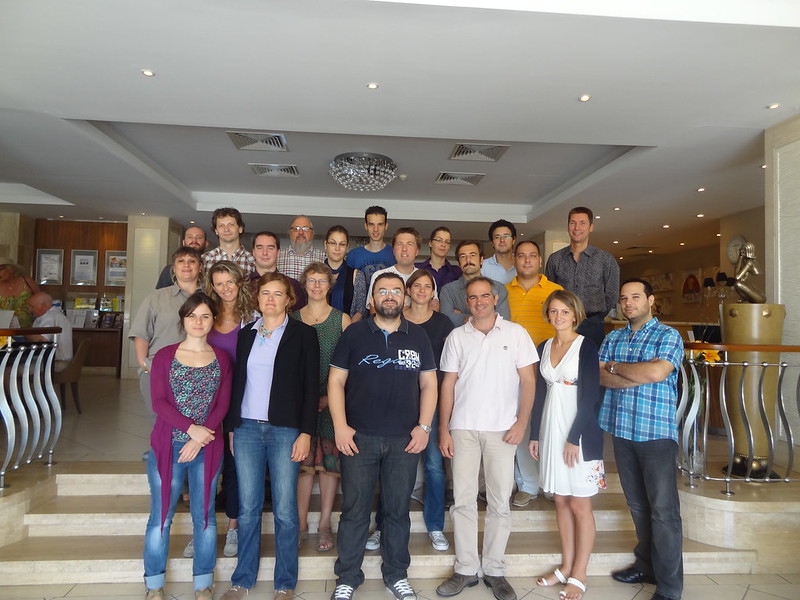
VOA3R Family Photo @ Cyprus
I had the opportunity to visit Cyprus for the first time during October 15-17, for the 6th project meeting of the VOA3R project. In addition, we have worked closely with George Adamides, the local host from Agricultural Research Institute (ARI) and we managed to organize a Workshop on "Open Access and Agricultural Repositories Workshop" right after the meeting, on October 18th, 2012.
The meeting was successful, since there was active participation and long discussions on pending issues, in order to make sure that everything will be on time, just 8 months before the end of the project.

Workshop participants working
on the VOA3R portal
The aim of the Workshop was to bring in touch stakeholders from Cyprus (researchers, students, practitioners etc. in the area of agriculture and agricultural research) in order to create and support a network, as well as to present the tools and services developed by related EU projects, like VOA3R and agINFRA, that could be used in order to facilitate the daily research work of the participants. It was rather successful, as it was attended by about 10 Cypriot stakeholders, mainly (if not all) researchers. I was facilitating the Workshop, making an introductory presentation and introducing each presenter before his presentation, which was really nice since all speakers were colleagues and friends of mine.
Imma Subirats from FAO/AIMS made a long but really interesting presentation about Open Access, which was followed by two case studies of Open Access repositories: The SLU Epsilon repository (presented by Urban Ericsson from SLU) and Organic Eprints (presented by Ilse Rasmussen from ICROFS), both based on Eprints software. Then there was a presentation of the repository tools used in Open Access repositories, like the AgriOcean DSpace (by Dirk Leinders from University of Hasselt) and Eprints (by Alejandro Engelmann from SLU). The following session was a hands-on session on the VOA3R portal, as a networking platform for researchers, practitioners and students in the agricultural context. For collecting the feedback we used both the online questionnaire as well as some additional focused ones provided by the UAH team. After a really interesting lunch break (I really loved the buffet lunch at Atlantica Miramare Hotel!), it was time for another interactive session, supported by the agINFRA project, which included a short presentation of the project and its expected outcomes as well as a discussion during which we tried to identify the needs of the participants as regards the tools, services and infrastructure used, barriers they face regarding the open access to content and other aspects. You may find additional information about the Workshop in my post in the FAO/AIMS website.

In general it was a fruitful workshop and I feel really grateful to the people who got involved in it and dedicated their time in order to prepare and present their presentations. I felt really glad that we had the opportunity to engage some stakeholders from Cyprus in such a discussion about Open Access and repositories and I really enjoyed the related discussions that we had with the brave ones who stayed until the end of the Workshop. I also hope that I will have the opportunity to visit Cyprus again in the near future, as due to the lack of time I did not have the opportunity to go around and see things!

Saturday, June 23, 2012

agINFRA technical meeting in Athens

A one-day meeting for the technical partners of the agINFRA project took places at the premises of Agro-Know on 21/6/2012. The meeting was attended by the majority of the technical partners of the project and since some parts of it were closely related to my work (such as the content population and the workflows that could be used during the project for the connection of new repositories), I took some time participating in it.
Nikos Manouselis presenting (photo by Jaakko)

It was a nice opportunity to meet colleagues from Serbia, Spain, Hungary etc., with whom we have never communicated in the past (since my tasks in the project are not exactly technically-oriented), but still it was nice watching these presentations and getting to know how (technical) things are moving in the project.

Short lunch break (photo by Jaakko)
Jaakko Lappalainen from UAH has already made a short blog post describing the event, which is really interesting (and contains more photos of the event)!

Friday, May 18, 2012

2nd BioVeL Workshop

I recently had the opportunity to attend the 2nd BioVeL Workshop on taxonomic and phylogenetic workflows titled "Developing interdisciplinary methods for conservation biology and ecosystem research – taxonomic and phylogenetic workflows in biodiversity research". It was a joint effort of the BioVeL EU project and the Swedish LifeWatch initiative, and it took place at the University of Gothenburg, Sweden at the Wallenberg conference center between 10-11 May 2012. The workshop was attended by a number of project partners as well as external stakeholders, such as members of the affiliated EU projects ViBRANT and agINFRA (David King and me), along with representatives from other initiatives and natural history museums.

Yeap, that's me taking notes during the workshop.
The aim of the workshop was to bring together researchers in the area of biodiversity along with technical people working with related tools and infrastructures, discuss about tools and workflows used and share experiences and ideas in order to optimize these.

I was lucky to attend the social dinner held at the Gothenburg Natural History Museum, as it provided me with a nice opportunity to meet some of the participants even before the workshop (it would be my first time among the biodiversity researchers so there were no familiar faces among them). The museum is really interesting, packed with well-organized specimens and exhibits. The dinner was based on traditional recipes and dishes, which were previously unknown to me; however I have to admit that most of them were really tasty! There was a really friendly atmosphere and I also managed to make contact with the director of the museum, towards the collaboration with the Natural Europe project, through its affiliation program.

The workshop was also interesting, featuring a big number of presentations that helped me understand the way that this specific community works and the needs raised regarding tools and workflows. Some of the presentations were too technical or too focused for me, but still there were interesting points in almost all of them. On the other hand, the social events provided an opportunity for networking and getting to know each other. My impressions of the BioVeL workshop have already been described in the Agro-Know wiki page.


Trivial stuff about my trip to Gothenburg:
  1. It was my first trip to Sweden; I had this trip in my mind since I was a teenager!
  2. My luggage was left in Paris (did not follow my connection flight) and only reached my hotel at midnight, so I had to be really informal during the social dinner and visit to Gothenburg NHM, wearing a rather tight pair of shoes...
  3. As usually, the weather was cloudy and drizzling almost all the time. This weather is really common for my business trips all over Europe, no matter the season...
  4. As there was no flight to Athens after the end of the Workshop on Friday, I had to spend the evening in Gothenburg and catch an early flight on Saturday morning. Unfortunately my feet were hurt so badly (see 2) that I could not go around the city. This was the only time that I saw the sun in Gothenburg - an excellent application of Murphy's law!
  5. I faced a number of practical issues during my last evening at Gothenburg (such as bad estimations leading me to lack of local currency - exchange shops were closed).
  6. I woke up really early and hungry on Saturday, waiting for breakfast before I had to leave, only to find out that breakfast was to be served 1 hour later during weekends (so after I left the hotel)!
  7. KLM breakfast/snacks/meals suck big time: They were really poor and in all cases insufficient and not  according to the (high) price of the ticket.