Showing posts with label Research Data Alliance. Show all posts

Tuesday, March 27, 2018

Participation in the RDA Interest Group on Agricultural Data (IGAD) Pre-Plenary Meeting 11

The meeting of Research Data Alliance's Interest Group on Agricultural Data (IGAD) took place between 19-20 of March 2018 in Berlin. I was excited to be able to join the meeting - my first RDA meeting after quite a long time - and see how things are moving in the IGAD, a group that I have spent quite a long time working with; both the Interest Group and its Working Groups.

The first day of the meeting was dedicated to the theme “The FAIR principles to all elements of the research process in agricultural sciences and related disciplines”. I represented NEUROPUBLIC and presented the way in which our H2020 Big Data Lighthouse project DataBio project takes into consideration the FAIR Principles in its data management workflows and more specifically, in the case of the smart farming pilots that NEUROPUBLIC is coordinating. Apart from that, I had the opportunity to see the approach of other organizations in adopting the FAIR Principle in their cases, which was extremely interesting.


(the slides are also available through the GODAN Gateway of F1000 Research)

During the second day of the meeting, parallel sessions took place, focusing on different aspects of the IGAD main themes - most of them being the ongoing work of its Working Groups. I started by attending the first part of the AgriSemantics discussion but was curious to see the work of other groups so I also participated to the discussions of the Capacity Development for Agriculture (which blends my interest in Open Data with training activities) and the On-Farm Data Sharing (which I found really interesting and close to NEUROPUBLIC's work with smart farming) Working Groups.

Now, I guess that what I have to do is to align the work that I am doing with NEUROPUBLIC with all these advances taking places at a global level - and this might be a challenging task but it will worth the effort.

All in all, I felt like being home meeting all this long-time friends and collaborators from global organizations like UN FAO (Imma, Caterina and Karna), CGIAR and its research centers (Richard from CIMMYT), GFAR (Valeria), Wageningen UR (Hugo Besemer), INRA (Odile, Esther and Sophie), GODAN (Martin and Suchith), Johannes Keizer and Armando Stellato (I hope I am not forgetting anyone) and get to meet people passionate about their work in agricultural information and knowledge management like Ilkay (FAO - she did a wonderful job regarding the documentation of the meeting!), Chipo (CTA), Diane (GODAN) and Cynthia (USDA) - they were too many to name them all. It was great discussing with these passionate people about how access to open data in agriculture can be improved, how we can better organize all this wealth of information, knowledge and data and how we can build meaningful data-powered solutions for agriculture at a global level.

Tuesday, March 10, 2015

RDA 5th Plenary Meeting

The 5th Plenary Meeting of the Research Data Alliance (RDA) is taking place at San Diego, CA, USA between 9-11 of March 2015. Following the tradition, Agro-Know is represented for once more at this great event by our colleague Giorgos Papoutsis, our  Data Ingestion Associate who is participating as a representative of the Big Data Europe Η2020 Project and he will focus his contributions to the Agricultural Data Interoperability Interest Group meeting, where he will present the case of the agINFRA project as a mean for connecting agricultural data through an open and participatory data infrastructure. It should be noted that Giorgos is also actively involved in the data ingestion processes of AGRIS.
Giorgos with RDA participants
Giorgos Papoutsis with Prof. Toshihiro Ashino (left) and our agINFRA partner Dr. Xuefu Zhang (right)
I have personally participated in the 2nd (Washington D.C.) and 3rd (Dublin, Ireland) RDA Plenary Meetings but for various reasons I was not able to attend this specific one. It came during a period were we were all busy with the development of our new solution for the Horizon 2020 Open Access Policy (aiming at both proposals and projects) so I missed the opportunity to get in touch with my colleagues attending the 5th meeting. From my previous experience, I can only say that the RDA Plenary meetings are a great opportunity to collaborate with great people all over the world, work on common issues, get updated on topics of interest and of course network!
Despite that fact, I am still closely following (and supporting remotely) the work of both the Agricultural Data Interoperability Interest Group (mostly through the agINFRA project contributions) but also the Wheat Data Interoperability Working Group, where a great handbook for people working with wheat research data is under preparation :-)

Saturday, March 29, 2014

RDA 3rd Plenary Meeting - Day 2

Day 2 of the RDA 3rd Plenary Meeting started with new discussions and introductions between new partners.

Plenary Session
Among the interesting presentations/speeches, I specifically enjoyed the presentation from Dr. Tony Hey, Vice President of Microsoft Research Connections. He discussed about Open Data and Open Science, the use of the MS Tools for using Big Data for Modeling, Azure Cloud Services etc., providing a practical perspective to his ideas. You can view the recoding here.

Another really interesting and useful presentation came later from Beth Plale on the RDA structure in IG/WG and the work done into restructuring the RDA, filling the gaps and taking care of overlapping. I believe that there was a message in the right direction regarding the relation between the existing IGs/WGs and the re-organization that might need to be suggested by RDA. You can view the recording here.


Domain Repository IG
After the lunch break, I decided to participate in the Domain Repository IG meeting, aiming to share my experience with working with agricultural repositories during the last 5 years. The main point of the discussion was that domain-specific repositories may have specific needs related to curation, quality, management and other aspects that need to be taken into consideration. On the other hand, they share a lot of attributes, so it would be interesting to share experiences and best practices from various sectors.
A publication titled "Sustaining Domain Repositories for Digital Data: A White paper (2013)" (available as a PDF file here) could be used as a basis for further discussions and exchange of ideas.
The issue of connecting/linking different domain repositories was raised, especially in the cases where no controlled vocabularies are used for the classification and it was agreed that using langstrings instead of URIs is an important barrier towards linking different data sources.

Poster session
Thanks to a last-minute online application I did as soon as I reached Dublin, the help from Hilary Hanahoe and the kind support from the local organizers, I managed to arrange a last-minute placement for the agINFRA project posters (in fact our application was the last one to be accepted, as I was told) - it was not the best possible one, but taking the limitations into consideration, it was much better than nothing! In addition, we got to share the same space with the iMarine poster, which was really relevant.

Proudly posing next to the agINFRA posters


Wheat Data Interoperability Working Group
The meeting of the group was chaired by Esther Dzale (INRA) and Richard Fulss (CIMMYT)The meeting started with a short introduction of the participants and a presentation of the WG, including:
  • the objectives of the group;
  • the data types to be taken into consideration;
  • a list of the deliverables to be developed in the context of this WG;
  • adopters of the aforementioned deliverables etc.
The discussion was focused on the upcoming deliverables, like the online survey to be used for collecting the user requirements and the structure of the cookbook to be developed. In addition, practical issues, such as the funding options for the work done in the context of this group were discussed, along with ideas about the next face to face meeting. The discussions were followed by a demonstration of the CropScape platform by Dr. Liping Di from the George Mason University, USA. The platform is using satellite data and providing users with information about crop cultivation in specific areas of the US (county, state), size of each field, allocation of cultivations in a specific area and other crop stats. This was followed by another demonstration of the Global Agricultural Draught Monitoring and Forecasting System (GADMFS), again by Dr. Di. 


Further discussions
During the 2nd day of the meeting, I had the opportunity to be involved in discussions with the following:

  • David King (OU) about next tasks of the OU in agINFRA WP5 (related to data integration mainly from Mendeley and BHL);
  • Eamonn O Tuama (GBIF) about germplasm linked data, the excellent work that he has already done in the context of GBIF and the related stuff that he is currently working on;
  • Yde de Jong (University of Eastern Finland, ex-ViBRANT), about the Biodiversity Data Integration IG outcomes and their relation to our work in the Agricultural Data Interoperability IG and Wheat Data Interoperability WG;
  • Dimitris Koureas (NHM London), mostly about biodiversity data interoperability (but not limited to it) and Scratchpads
I am pretty sure that I have left some of the interesting conversations outside this list...

The day ended with a cash bar (time for a nice, cold Guiness!) and the social dinner, which was really classy and included some amazing pieces of traditional Irish music and dancing!

The special RDA menu!

Friday, March 28, 2014

RDA 3rd Plenary Meeting - Day 1

The 3rd Plenary Meeting of the Research Data Alliance (RDA) took place between 26-28/3/2014 in Dublin Ireland. It would be my 2nd participation in a row to an RDA plenary meeting and I managed to organize my trip (even at the last moment) and be there. It was not an easy trip, as I had to travel to Dublin from Athens on a Greek national holiday/celebration but still I did that. The trip itself was nice, reaching Dublin through Copenhagen (with SAS) and then reaching Athens through Frankfurt with Lufthansa; it was my first time in Dublin but due to the packed schedule of the meeting and the moody weather I did not get to see anything outside my 20 min walk from the hotel to the meeting place (at lovely Croke Park) and back.


Statistics about the 3rd RDA plenary
477 participants registered and attended the meeting. The overall RDA membership is 1,585 from 71 countries (64% from academia; 49% EU, 37%US; 2% policy makers).

About the venue
The meeting was hosted at the Croke Park, which is a nice combination of a football stadium and an exhibition center - a fully equipped one I have to admit; the plenary sessions took place at a large hall which fitted the almost 500 RDA meeting participants nicely while coffee and lunch breaks took place right outside the hall. I wouldn't want to know more about the logistics (taking care of such a big number of participants for catering etc. must be a hard task) but the organizers did a great work. There were some issues with the wifi connection but the technicians were working on them as well as lack of power outlets in the big hall (which left a high percentage of the laptops used by the participants for tweeting etc. off after the first couple of hours!) but in the end everything was fine.


Agro-Know was there, with folders including interesting brochures and company profile 1-pagers. In addition, the agINFRA project was disseminated through discussions and the brochures; I also managed to arrange having the 3 small agINFRA project posters to be placed in the poster session just a couple of hours before the poster session, When there's a will there's a way, as they say ;-)


Day 1 Plenary Session
The plenary session started with keynote speeches and greetings; I personally enjoyed more the Keynote Address by Prof. Ian Chubb AC, Australia's Chief Scientist. Some of his key-points, as extracted by various tweets were the following:

  • We need national, international and inter-disciplinary collaboration in research and innovation;
  • We need research and data to be able to feed 9 billion people, producing carbohydrates and fiber while climate moves;

You can also watch his presentation recording here.

Additional presentations/speeches took place afterwards, mostly highlighting the fact that data exist and it is up to the users to find a meaningful way to use them and that infrastructure is already here, waiting for useful applications. The highlight was a cartoon presented by Dr Ross Wilkinson, Executive Director, Australian National Data Service, showing a donkey, a cart and a carrot; an image really familiar to many of us. This led to nice and funny discussions as well as an explosion of related tweets!

Day 1 WG/IG sessions

I opted to attend the "BoF Education and skills development on Data Intensive Science" organized by Yuri Demchenko and Wouter Los, which aimed to identify opportunities for the new field of data scientists. My colleague Miguel-Angel Sicilia from the University of Alcala was also there, proposing his approach on the subject and discussing the possibility of an interest group, a proposal of which has already been submitted. Discussions were interesting and focused on the existing curricula all over the world.

Next was the meeting of the Agricultural Data Interoperability IG, which was chaired by agINFRA colleagues Johannes Keizer (FAO) and Devika Madalli (Indian Statistical Institute, Bangalore). There I made a presentation titled "Global RDF Descriptors for Germplasm Data", describing the work done in the context of the agINFRA project and the RDA WG towards the exposure and publication of germplasm data as linked data (always based on the work already done by other experts in this field).


It was followed by another presentation by Esther Dzale from INRA, about the Wheat Data Interoperability Working Group and then there was a discussion on various topics affecting the group.

Reception sponsored by Irish Research Council gave us some time to get to meet new people and have interesting discussions; I managed to meet

  • Nikos Houssos from the Hellenic National Documentation Center who are working with the aggregation of metadata from various Greek repositories, among others;
  • Nuno Freire, Chief Data Officer at The European Library, with whom we discussed about the role of a CRM tool in the metadata aggregation workflow
  • Stephane Goldstein from the Research Information Network (UK), with whom we had an interesting discussion about the proposed IG on Education for Data Scientists
  • Odile Hologne, Head of Scientific Information Dept. of INRA, who has been in long communication and collaboration with AK but we never had the opportunity to meet in the past;
  • Phil Archer from W3C (the previous time was in the 2nd RDA Plenary in Washington D.C. last September), who was disappointed by people not following the existing standards for linking their data! 

In addition I got to see again old time friends like Johannes Keizer from FAO, David King from Open University (last time we met was back in May 2012 in the 2nd BioVeL workshop in Gothenburg, Sweden!), Esther Dzale from INRA and others. It's always nice to be among friends in such big events!

More info about the 3rd RDA Plenary:


Friday, October 18, 2013

Data management policies - which ones are most important to you?


The Research Data Alliance (RDA, https://rd-alliance.org/) Practical Policy Working Group solicits your input on the policies used to manage data collections by your project / institution. Please vote for the policies that you believe are most important or add more policies to the list.

The form is very short and will take only less than 5 min. You input will be used to identify best practices and promote automated policy-based management systems. Thank you!


Thursday, September 19, 2013

RDA 2nd Plenary Meeting: Day 3

The third and last day of the meeting was also split between the National Academy of Sciences (morning sessions) and Washington Marriott (afternoon sessions). More specifically, the morning session started with a nice breakfast and a presentation of the outcomes of the break out sessions of the previous day. Johannes presented the outcomes of the Agricultural Data Interoperability Interest Group. I have to admit that I had not realized by then how many IGs and WGs exist in RDA!

The presentation of the WGs outcomes

After that, it was Mark Parsons, the Managing Director/Secretariat of RDA and responsible for the organization of the 2nd Plenary Meeting, who took the floor and presented an overview of the meeting and provided some statistics. He then introduced Andrew Treloar, Director of Technology of the Australian National Data Service who announced the venue of the 3rd Plenary Meeting (Dublin, Ireland), with the help of the DRI (Digital Repository of Ireland) team and a really nice video presentation of Dublin.

No lunch was provided this time but this gave me the opportunity to discuss some pending issues with Johannes while walking back to the Washington Marriott hotel for the afternoon sessions. This time, I attended the Libraries and Research Data session, which was fully packed and to my surprise was also attended by Mark Hahnel, the founder of Figshare. The discussion was rather generic and an overview of things already discussed in other sessions; however, the chairing of Wolfram Horstmann made things more interesting. In any case, it was obvious that everyone was exhausted after three days of intense meetings and participation.

My overall impression of the meeting was really nice; not only I got to follow the advances taking place in various interesting areas, but also gave me the opportunity for some networking and meeting new people (such as Keith Jeffery, a man actively involved in CERIF, a standard developed by EuroCRIS). In addition, it provided me with the opportunity to be more actively involved with both the Agricultural Data IG and the Wheat Data InteroperabilityWG.


The end of the meeting gave me the opportunity to get something to eat (at last - it was 18.00 and did not have lunch yet!) as well as get some things for the road/office/home. I also managed to go for a short walk at the Lincoln Memorial and Potomac river bridge. Last but not least - pack my staff and be ready for departure tomorrow morning!

My photos from the 3rd day of the meeting are available here.

RDA 2nd Plenary Meeting: Day 2

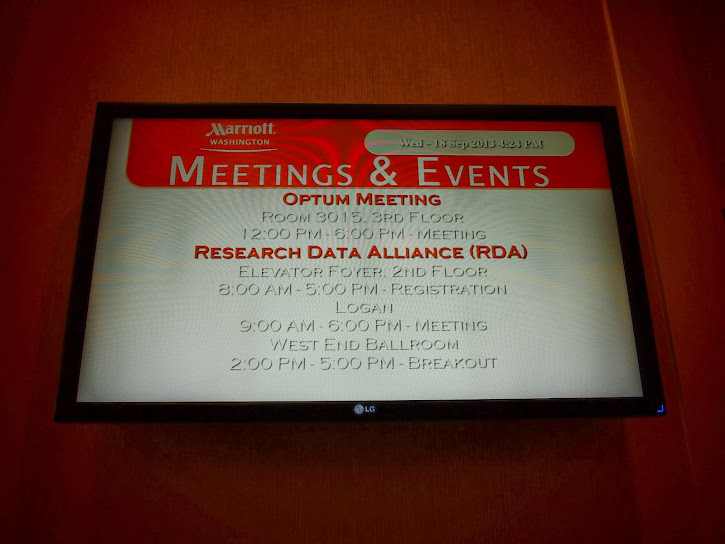
The second day of the RDA Plenary took place at the Washington Marriott hotel. It consisted of break out sessions dedicated to each Interest Group of RDA. I participated in the session of the Agricultural Data Interoperability WG. Each session was located at a different meeting room, which allowed the participants to focus on the topic and contribute to the progress of the Group - however, at the same time one could not attend two sessions of interest, if they were scheduled in the same time slot.

The Agricultural session consisted of about 25 people, including Johannes Keizer (Chair), Devika Madalli (co-Chair), Esther Dzale Yeumo Kabore (INRA) and me. There were people from various organizations, but the ones that come to my mind right now are Luz Marina Alvare from IFPRI and Martin Carr from CABI. Unfortunately I could not see all participants of the meeting, as I was standing at the end of the (long) table. The discussion was based on the proposed agenda and brought up some really interesting issues, including the suggestion for creation of a new Germplasm working group among others.  The outcomes of the meeting are available here; however, there are no photos from the meeting, as I was focused on both participating and keeping notes...

After the lunch break, it was time for a new round of break out sessions; this time (and since our session was over) I decided to attend the session dedicated to metadata. There were some interesting discussions there as well, including some really interesting for the Agri IG. The main idea was about a registry of metadata standards and schemas based on the Digital Curation Center (DDC), as well as the option to have a machine-readable export of the existing information. Unfortunately, the internet connection was not consistent, leading to constant disconnections and issues with the presentations which included links and live demos - let alone twitting!

The last session I attended was dedicated to Data Citation; unfortunately that was a continuation of a previous session (which I did not manage to attend) so it was rather hard to follow but still I found some interesting stuff there. In addition, I got to meet Fotis Karagiannis and Yiannis Ioannidis (University of Athens & ATHENA Research Center), who work with Natalia Manola in the OpenAIRE project and the Athena Research and Innovation Center.


The day ended with a Conference Dinner on the Odyssey Dinner Cruise; however, I was so tired (not fully recovered from the jet lag) that I decided to go for a walk around Washington and then get some rest. I managed to walk until the Capitol passing through the White House and took some really nice photos, which are available here.

In addition, there are photos from the RDA Plenary meeting at the RDA website.

Monday, September 16, 2013

RDA 2nd Plenary Meeting Part 1: Background and getting to Washington D.C.

The 2nd Plenary Meeting of RDA is taking place in Washington D.C. (U.S.)  between 16-19/9/2013. This time I was invited to participate as an agINFRA project member of the UAH team and in this direction, I applied for the grant which was available for this purpose; I feel lucky to have been selected for that. In addition, the trip was approved by the agINFRA project officer, so everything was confirmed and ready to be planned. There were the practicalities to be arranged (e.g. flight tickets, accommodation, registration etc.) during the last week of August; however, that was a rather inactive period so everything was arranged during the first days of September. much faster than I initially expected.

Despite the long trip (more than 12 hours pure flight time) and delays (due to heavy traffic at the Philadelphia airport security check-points) I managed to miss my connecting flight to Washington and had to wait for an additional 3,5 hours at the airport, I hope that I will finally manage to reach my hotel (I am still at the Philadelphia Airport, waiting for my flight to WAS).

Even though the whole concept of the Research Data Alliance is really interesting, I am mainly focused on the sessions dedicated to Agricultural Data (supported by the Agricultural Data Interoperability Interest Group of RDA), including the discussions of the Wheat Data Interoperability Working Group, where our efforts are currently focused on. Apart from the agINFRA partners involved in these groups (Johannes Keizer from FAO and Devika Madali from the Indian Statistical Institute), colleagues from other partner like INRA will also be present. Linked Data seems to be a really hot topic of the Conference and this comes at a time where a similar effort is taking place in the agINFRA project, where we expect to publish all metadata schemas, Knowledge Organization Systems used by the agINFRA data providers as well as metadata as linked data, following standards already established in the context of the Semantic Web. Additional sessions on metadata and data sharing in general seem really interesting and could provide ideas to be adapted for our purpose.

I have to admit that I am excited to participate in such a big event where so many key persons will be attending and will be available (?) for interesting discussions. I expect that fresh ideas discussed in the RDA meeting will be adapted by agINFRA while at the same time, the agINFRA methdologies and workflows could be adapted and reused in the effort done by the Wheat Data Interoperability group. agINFRA has already developed a methodology for the metadata management, the data integration and is working towards the publication of data and metadata as linked data.