Thursday, April 10, 2014

Agro-Know in SEMIC 2014

The SEMIC 2014 Conference (Semantic Interoperability Community), titled "Metadata Governance & Management" was held on 9/4/2014 in Athens, Greece at the premises of the National Center of Public Administration and Local Governance, as another one of the related events in the context of the Greek Presidency of the Council of the European Union in collaboration with the Greek Ministry of Administrative Reform and e-Governance. It engaged about 199 participants from almost all EU member states (there were about 220 registrations) plus the 24 speakers (also from USA and Japan, among others), and aimed to explore how Public Administrations can use semantic technologies to make information exchange efficient and effective, allowing them to operate at lower costs and provide better services.

In this direction, the Conferfence consisted of 2 large sessions, each one of which consisted of smaller sessions:

  1. Introduction / Keynote speeches: Included, among others, a presentation from Vassilios Peristeras from the European Commission (and one of the people behind the Rural Inclusion ICT-PSP project that we were working on under the GRNET umbrella) ho highlighted the fact that there are already enough vocabularies and approaches developed so there is no need to develop new ones; instead, the existing ones should be reused. The outcomes are publicly available through the JOINUP web site
  2. Session 1: Metadata Governance and Management
  3. Session 2: Semantic Interoperability
The full program of the Conference can be found here, while the presentations will also be available shortly from the same link.

Skipping the details from each presentation (most of which I found really interesting), it was obvious that everyone highlighted the need of using existing standards and reusing existing work instead of duplicating effort and working from scratch. Most of the solutions presented were based on existing standards and identified the need for linking publicly available e-Gov data. Good practices and recommendations were presented in several cases, such as the use of persistent and unique identifiers (URIs), documenting all developments such as standards, providing both a human- and a machine-readable format of the data/metadata.


Muriel Foulonneau, one the reviewers of the now over VOA3R project was also there, presenting the really interesting approach of re-using existing "building blocks" = components from other projects instead of developing additional standards, in the context of the e-SENS project. I am really fond of reusing existing material instead of developing new ones, so I vote for the approach presented in Muriel's presentation. Her presentation was followed by the one by Ralph Hodgson, CTO of TopQuadrant, a person and a company heavily involved in semantic interoperability and standards, not limited to the public sector and e-government. I also enjoyed the presentations of John Sheridan titled "Linking Legal Data" and the one by Martin Le Vrang which presented a really practical application of semantic interoperability in the context of online job search in EU - really close to what we are working in AK in the context of projects like CerOrganic & AGRICOM.

Of course I also enjoyed the last presentation of the Conference, provided by Johannes Keizer about AGROVOC, VocBench and AGRIS, as case studies of the semantic interoperability between different systems in the agricultural sector. This was by far the most closely related presentation to my interests.

The main outcomes of the Conference were the following:

  • Using unique, persistent URIs; 
  • Avoid using machine non-readable formats (PDF) when publishing data; instead use formats such as HTML (human-readable) and XML/RDF (machine readable);
  • Reusing existing standards instead of developing new ones, such as the ones already available through the JoinUP portal, the eGov Core Vocabularies, the DCAT AP for describing datasets etc.; 
  • Define and develop sustainability plans for each new project and workflow; 
  • Share all developments, standards etc. and keep them open;


During the Conference I had the pleasure to get involved in discussions with long-time friend and colleague in projects +Johannes Keizer (also here), Muriel Foulonneau (about both the VOA3R and agINFRA projects), Nikos Loutas (ex- Rural Inclusion project member) and Vassilis Peristeras (also about the background of the Rural Inclusion project), as well as Maria Kardami, Information Systems Developer at Publications Office of the EC. I also had the chance to meet again Charalampos Koutouris from NCSR Demokritos, which was one of the participants of the Big Data School which we organized some months ago - he provided some really interesting feedback and his experience.

Overall the Conference was a really useful experience, keeping us updated on the use of the semantic standards in the public sector as well as providing opportunities for networking and dissemination.

SEMIC 2015 will probably take place in Latvia, so keep tuned!

Saturday, April 5, 2014

Meeting Christopher Brewster

As mentioned in my previous post, I had the pleasure to meet Dr. Christopher Brewster at the European Data Forum 2014, which was held in Athens, Greece between 19-20/3/2014. Dr. Brewster is a lecturer at Aston Business School, UK and among the variety of his research interests, there are two that we share; Knowledge Representation , Semantic Web and Agriculture and Food Supply Chains (well, it seems that they are at least three!). Among others, he was actively involved in the Smart Agri-Food project  and is currently involved in the FI Space project.

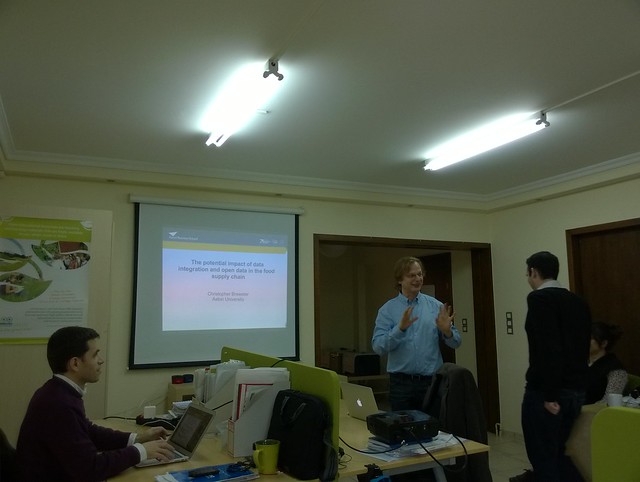
Dr. Brewster during the presentation

Dr. Brewster was kind enough to accept our invitation and visit the AK offices on Friday 21/3/2014, where he made a really interesting presentation, titled "The potential impact of data integration and open data in the food supply chain". The presentation discusses the issue of food supply chain data, taking into consideration aspects such as open food data, mentioning data platforms, initiatives and standards, legislation, the status in various EU countries etc. After the presentation we had the opportunity to spend some time talking about the issues highlighted in his presentation and present our feedback on these and I hope that we will have the opportunity to collaborate in the near future.

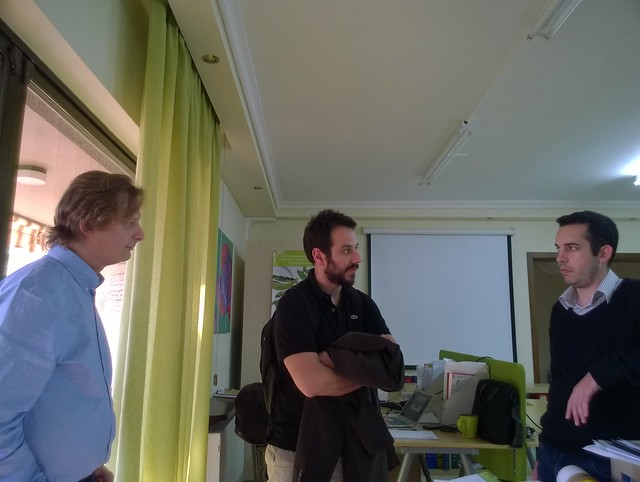
Dr. Brewster, Nikos and Andreas exploring possibilities for collaboration

Friday, April 4, 2014

Agro-Know in the EDF 2014

The European Data Forum (EDF) 2014 took place between 19-20 of March 2014 and it was only one of the data-related events that would take place during the 6-month Greek presidency of the EU Council. According to the website of the event, "The European Data Forum (EDF) is an annual meeting place for industry, research, policy makers, and community initiatives to discuss the challenges and opportunities of data in Europe, especially in the light of recent developments such as Open Data, Linked Data and Big Data". This is at the heart of what we are currently working on in AK; we are getting deeper and deeper in the open, linked and big data, always in the agricultural context. This means that there was no way that the AK team would not be represented at the event.

The event was collocated with the Europeana Cloud Plenary, which was attended by my colleagues +Theodore Mathioudakis+Effie Tsiflidou and +Andreas Drakos who are contributing to this effort. Andreas also helped with the Agro-Know booth that was setup at the EDF2014 and which was full of brochures of Organic.Lingua, as the sponsoring project of this activity, agINFRA and of course Agro-Know ones.

Andreas & Vassilis @ EDF2014
(source: https://www.flickr.com/photos/lod2/13433089254/in/set-72157642967653084/)
Even though I did not have the time to actually attend the speeches of the first day of the forum (unfortunately I could not attend the second day - the full programme is available here), I had a great time being there and meeting people who were interested in the AK products; at the same time, I had the time to take a look around and see what the other booths were about, finding interesting people, projects and products. I had the pleasure to meet Karel Charvat again (after the EFITA 2011 Conference), one of the most active persons that I know, actively involved in several initiatives. Among  the other participants, I got engaged in a discussion with Natalia Manola from Athina Research Center, a person actively involved in several data-related projects like DRIVER, OpenAIRE and OpenAIREPlus. Our first meeting was during the RDA 2nd Plenary Meeting in Washington D.C., last September. Last but not least, I had the pleasure to meet Dr. Christopher Brewster from the Aston Business School of the Aston University, UK - we had the opportunity to meet again during the next day at the AK office.


Created with flickr slideshow.


I also got to see +Sarven Capadisli, one of the people I admire for their work in linked data; this was the same case with Deirde Lee from DERI, Ireland, an old time acquaintance from a joint project with GRNET back in 2010. Both of them were engaged in conversations almost during the whole day so I did not find the appropriate time to get to know them better.

Overall it was a really interesting experience which provided us with the opportunity to expose our work to a related and wide audience (yes, the AK booth got busy at some points!) and to get to know interesting people working in similar topics and with whom we could establish collaborations in the near future. Andreas and Elena were there during the 2nd day of the event which was as useful as the first one.

Post-processing EDF2014 (info from the official web site)

Thursday, April 3, 2014

Food for thought: Agricultural Knowledge and Innovation Systems Towards 2020

(blog post initially posted at the Agro-Know blog)

We recently came across a really interesting publication by the European Commission’s Standing Committee on Agricultural Research (SCAR), titled "Agricultural Knowledge and Innovation Systems Towards 2020". The publication is available through the EU Bookshop, which is always a valuable source of  policy documents and reports.
SCAR was established back in 1974 and is responsible for the coordination of agricultural research efforts across the European Research Area, including questions of advisory services, education, training and innovation. SCAR set up a Strategic Working Group (SWG) of civil servants from the European Commission and the EU Member States to reflect on the Agricultural Knowledge and Innovation Systems (AKIS) - you can find a really interesting publication on AKIS, titled "Agricultural Knowledge and Innovation Systems in transition Findings of the SCAR Collaborative Working Group on AKIS" in the OECD iLibrary. SCAR consists of more than twenty (20) Collaborative Working Groups (CWGs) and Strategic Working Groups (SWGs) formed by Member & Associated State representatives. The role and the structure of the WGs are described in the report that we are referring to.

Cover of the "Agricultural knowledge and innovation systems towards 2020" report
The report itself is based on the need for revisions to be implemented in the current approach followed by AKIS, in order to ensure that it will meet the requirements for actually feeding an increased number of people in the following years making the best use of the available resources. In this direction, the repost reflects on "how innovation could be organised in the European research and innovation policy, using the framework of the European Innovation Partnership for Agricultural Productivity and Sustainability, and how this could be connected to agricultural policy and the Horizon 2020 research framework programme". The role of ICT in this context is really important and highlighted through the document, along with the role of the innovation which is a necessary component of the whole process. The report is providing interesting aspects on topics such as agricultural research policies and innovation in agricultural research, proposes approaches for engaging the agricultural researchers in targeted research & innovation, discusses alternative approaches and revisions to the existing ones, proposes approaches for stimulating the entrepneurship; all these filtered through the experiences of the 37 member countries represented in SCAR. However, the most relevant part for what we are working on in Agro-Know is presented in Chapter 6 of the document.
Chapter 6 is developed by the International Centre for Research in Organic Food Systems (ICROFS), co-authored by Ilse Rasmussen, an Agro-Know long-time friend and colleague in projects. The chapter focuses on the role that ICT in general and more specifically the social media may have in the transformation of AKIS and the innovation approaches proposed throughout the document. In fact, this chapter provides a useful overview of the hardware (e.g. mobile devices such as smartphones and tablets), software (such as software tools and platforms) and other aspects, which are described and analysed in some cases.  I am always interested to see commonly used platforms like Facebook, Flickr, Slideshare and Twitter used for serving agricultural knowledge sharing purposes - in some cases in a unique way, such as AgChat. In Agro-Know, we massively use such tools for the dissemination of the projects that we participate in and apart from that, for the dissemination of the AK-related news and events - and it seems that even these free (but widely used) tools are doing a great work. Additional ICT tools, such as the Flash Meeting platform, Google Hangouts and other platforms are also frequently used for virtual project meetings, online Workshops and delivering presentations; the Webinars @ AIMS series is a fine example of using an online platform for such purposes. Apart from that, there are platforms serving online course management and delivery for various levels of education, such as the agriMoodle platform, which is also developed by Agro-Know - in fact this refers to a number of Moodle components developed by AK for meeting the requirements of the agricultural learning communities.
The VOA3R platform for networking agricultural researchers, students and practitioners, providing virtual space for creating user communities, sharing resources and networking and on top of that access to million of agricultural research publications is another example mentioned in the report. We feel proud as AK to have been involved in each development, adaptation (under the GRNET umbrella) and also have plans to adapt it to meet specific requirements of existing communities and reuse it in this way.
agINFRA_logo_newThe low adoption of the ICT tools in agriculture, which is highlighted in the report, was something that we have also faced in the projects that we have been involved. For example, in at least two cases, there were agricultural training curricula developed, organized and made available through online course management platforms; however, access to the courses by the end users was usually limited due to various reasons including the lack of appropriate equipment, the lack of a stable internet connection and last but not least the lack of basic knowledge of using a computer and/or the software used for the delivery of the courses. Other issues such as the language barriers which did not allow users to access resources in other languages than their own were solved by solid solutions proposed by projects like the Organic.Lingua, which transformed the Organic.Edunet Web portal into a fully-multilingual portal which serves a relatively high number of languages through automatic translation features and cross-language information retrieval through a fully multilingual user interface. Other issues, such as the agricultural information scattered in several different databases, repositories and websites is currently being investigated (and solved) by the aggregation and linked agricultural open data approach and the integrated cloud/grid based services proposed by the agINFRA project. This is being taken one step further by the SemaGrow project, that aims to enhance the real-time performance of the global agricultural data infrastructures, by proposing a linked data-based approach. Agro-Know is actively involved in these projects and the last two have been discussed during the G8 conference on open data for agriculture about one year ago, as two of the most promising ones funded by the European Commission.
Agro-Know is also involved in initiatives such as the Global Open Data for Agriculture and Nutrition (GODAN), the Coherence in Information for Agricultural Research for Development (CIARD) and the Global Food Safety Partnership (GFSP), while it also closely follows other related networks and initiatives, such as the Research Data Alliance (RDA) and more specifically the Agriculture Data Interoperability Interest Group and the Wheat Data Interoperability Working Group. All these initiatives have more or less a common goal; to identify the requirements of the agricultural community related to access to agricultural data and to allow and/or to enhance access to open and linked data, making use of infrastructures that can support the management of large volumes of information and knowledge and disseminate related open access policies and information between stakeholders. CIARD aims to "to develop common standards, share knowledge and contribute to coherent, effective and open institutional approaches to agricultural knowledge" and could be the link between the individual agricultural data providers, individual researchers, policy makers and other stakeholders, and the data infrastructures that are available for facilitating access to agricultural resources. In this direction , the CIARD R.I.N.G. (Routemap to Information Nodes and Gateways) acts as a global directory of web-based information services and datasets for agricultural research for development and could provide this link that could also be a key component of the processes proposed by the report. More information about the RING can be found in the CIARD RING handbook (PDF).

These are only some examples of existing tools, services and initiatives which can be used in this large-scale effort towards the reformation of the AKIS mentioned in the report. It is really important that all these initiatives previously mentioned are taking into consideration the previous work done in this context so that existing material can be adapted, adopted and reused in order to meet the requirements of the constantly growing sector of the agricultural information and data management. The upcoming "Global Consultation on Open Agricultural Knowledge for Development", a  joint CIARD/GODAN meeting in Rome (22-24/4/2014), will provide an opportunity for the members of these two large initiatives to meet, exchange ideas and find some common ground for joining forces and working toward opening up access to agricultural knowledge and information.

Saturday, March 29, 2014

RDA 3rd Plenary Meeting - Day 2

Day 2 of the RDA 3rd Plenary Meeting started with new discussions and introductions between new partners.

Plenary Session
Among the interesting presentations/speeches, I specifically enjoyed the presentation from Dr. Tony Hey, Vice President of Microsoft Research Connections. He discussed about Open Data and Open Science, the use of the MS Tools for using Big Data for Modeling, Azure Cloud Services etc., providing a practical perspective to his ideas. You can view the recoding here.

Another really interesting and useful presentation came later from Beth Plale on the RDA structure in IG/WG and the work done into restructuring the RDA, filling the gaps and taking care of overlapping. I believe that there was a message in the right direction regarding the relation between the existing IGs/WGs and the re-organization that might need to be suggested by RDA. You can view the recording here.


Domain Repository IG
After the lunch break, I decided to participate in the Domain Repository IG meeting, aiming to share my experience with working with agricultural repositories during the last 5 years. The main point of the discussion was that domain-specific repositories may have specific needs related to curation, quality, management and other aspects that need to be taken into consideration. On the other hand, they share a lot of attributes, so it would be interesting to share experiences and best practices from various sectors.
A publication titled "Sustaining Domain Repositories for Digital Data: A White paper (2013)" (available as a PDF file here) could be used as a basis for further discussions and exchange of ideas.
The issue of connecting/linking different domain repositories was raised, especially in the cases where no controlled vocabularies are used for the classification and it was agreed that using langstrings instead of URIs is an important barrier towards linking different data sources.

Poster session
Thanks to a last-minute online application I did as soon as I reached Dublin, the help from Hilary Hanahoe and the kind support from the local organizers, I managed to arrange a last-minute placement for the agINFRA project posters (in fact our application was the last one to be accepted, as I was told) - it was not the best possible one, but taking the limitations into consideration, it was much better than nothing! In addition, we got to share the same space with the iMarine poster, which was really relevant.

Proudly posing next to the agINFRA posters


Wheat Data Interoperability Working Group
The meeting of the group was chaired by Esther Dzale (INRA) and Richard Fulss (CIMMYT)The meeting started with a short introduction of the participants and a presentation of the WG, including:
  • the objectives of the group;
  • the data types to be taken into consideration;
  • a list of the deliverables to be developed in the context of this WG;
  • adopters of the aforementioned deliverables etc.
The discussion was focused on the upcoming deliverables, like the online survey to be used for collecting the user requirements and the structure of the cookbook to be developed. In addition, practical issues, such as the funding options for the work done in the context of this group were discussed, along with ideas about the next face to face meeting. The discussions were followed by a demonstration of the CropScape platform by Dr. Liping Di from the George Mason University, USA. The platform is using satellite data and providing users with information about crop cultivation in specific areas of the US (county, state), size of each field, allocation of cultivations in a specific area and other crop stats. This was followed by another demonstration of the Global Agricultural Draught Monitoring and Forecasting System (GADMFS), again by Dr. Di. 


Further discussions
During the 2nd day of the meeting, I had the opportunity to be involved in discussions with the following:

  • David King (OU) about next tasks of the OU in agINFRA WP5 (related to data integration mainly from Mendeley and BHL);
  • Eamonn O Tuama (GBIF) about germplasm linked data, the excellent work that he has already done in the context of GBIF and the related stuff that he is currently working on;
  • Yde de Jong (University of Eastern Finland, ex-ViBRANT), about the Biodiversity Data Integration IG outcomes and their relation to our work in the Agricultural Data Interoperability IG and Wheat Data Interoperability WG;
  • Dimitris Koureas (NHM London), mostly about biodiversity data interoperability (but not limited to it) and Scratchpads
I am pretty sure that I have left some of the interesting conversations outside this list...

The day ended with a cash bar (time for a nice, cold Guiness!) and the social dinner, which was really classy and included some amazing pieces of traditional Irish music and dancing!

The special RDA menu!

Friday, March 28, 2014

RDA 3rd Plenary Meeting - Day 1

The 3rd Plenary Meeting of the Research Data Alliance (RDA) took place between 26-28/3/2014 in Dublin Ireland. It would be my 2nd participation in a row to an RDA plenary meeting and I managed to organize my trip (even at the last moment) and be there. It was not an easy trip, as I had to travel to Dublin from Athens on a Greek national holiday/celebration but still I did that. The trip itself was nice, reaching Dublin through Copenhagen (with SAS) and then reaching Athens through Frankfurt with Lufthansa; it was my first time in Dublin but due to the packed schedule of the meeting and the moody weather I did not get to see anything outside my 20 min walk from the hotel to the meeting place (at lovely Croke Park) and back.


Statistics about the 3rd RDA plenary
477 participants registered and attended the meeting. The overall RDA membership is 1,585 from 71 countries (64% from academia; 49% EU, 37%US; 2% policy makers).

About the venue
The meeting was hosted at the Croke Park, which is a nice combination of a football stadium and an exhibition center - a fully equipped one I have to admit; the plenary sessions took place at a large hall which fitted the almost 500 RDA meeting participants nicely while coffee and lunch breaks took place right outside the hall. I wouldn't want to know more about the logistics (taking care of such a big number of participants for catering etc. must be a hard task) but the organizers did a great work. There were some issues with the wifi connection but the technicians were working on them as well as lack of power outlets in the big hall (which left a high percentage of the laptops used by the participants for tweeting etc. off after the first couple of hours!) but in the end everything was fine.


Agro-Know was there, with folders including interesting brochures and company profile 1-pagers. In addition, the agINFRA project was disseminated through discussions and the brochures; I also managed to arrange having the 3 small agINFRA project posters to be placed in the poster session just a couple of hours before the poster session, When there's a will there's a way, as they say ;-)


Day 1 Plenary Session
The plenary session started with keynote speeches and greetings; I personally enjoyed more the Keynote Address by Prof. Ian Chubb AC, Australia's Chief Scientist. Some of his key-points, as extracted by various tweets were the following:

  • We need national, international and inter-disciplinary collaboration in research and innovation;
  • We need research and data to be able to feed 9 billion people, producing carbohydrates and fiber while climate moves;

You can also watch his presentation recording here.

Additional presentations/speeches took place afterwards, mostly highlighting the fact that data exist and it is up to the users to find a meaningful way to use them and that infrastructure is already here, waiting for useful applications. The highlight was a cartoon presented by Dr Ross Wilkinson, Executive Director, Australian National Data Service, showing a donkey, a cart and a carrot; an image really familiar to many of us. This led to nice and funny discussions as well as an explosion of related tweets!

Day 1 WG/IG sessions

I opted to attend the "BoF Education and skills development on Data Intensive Science" organized by Yuri Demchenko and Wouter Los, which aimed to identify opportunities for the new field of data scientists. My colleague Miguel-Angel Sicilia from the University of Alcala was also there, proposing his approach on the subject and discussing the possibility of an interest group, a proposal of which has already been submitted. Discussions were interesting and focused on the existing curricula all over the world.

Next was the meeting of the Agricultural Data Interoperability IG, which was chaired by agINFRA colleagues Johannes Keizer (FAO) and Devika Madalli (Indian Statistical Institute, Bangalore). There I made a presentation titled "Global RDF Descriptors for Germplasm Data", describing the work done in the context of the agINFRA project and the RDA WG towards the exposure and publication of germplasm data as linked data (always based on the work already done by other experts in this field).


It was followed by another presentation by Esther Dzale from INRA, about the Wheat Data Interoperability Working Group and then there was a discussion on various topics affecting the group.

Reception sponsored by Irish Research Council gave us some time to get to meet new people and have interesting discussions; I managed to meet

  • Nikos Houssos from the Hellenic National Documentation Center who are working with the aggregation of metadata from various Greek repositories, among others;
  • Nuno Freire, Chief Data Officer at The European Library, with whom we discussed about the role of a CRM tool in the metadata aggregation workflow
  • Stephane Goldstein from the Research Information Network (UK), with whom we had an interesting discussion about the proposed IG on Education for Data Scientists
  • Odile Hologne, Head of Scientific Information Dept. of INRA, who has been in long communication and collaboration with AK but we never had the opportunity to meet in the past;
  • Phil Archer from W3C (the previous time was in the 2nd RDA Plenary in Washington D.C. last September), who was disappointed by people not following the existing standards for linking their data! 

In addition I got to see again old time friends like Johannes Keizer from FAO, David King from Open University (last time we met was back in May 2012 in the 2nd BioVeL workshop in Gothenburg, Sweden!), Esther Dzale from INRA and others. It's always nice to be among friends in such big events!

More info about the 3rd RDA Plenary:


Friday, March 7, 2014

Some thoughts on linking data sources / Bringing down the data silos

Agriculture and silos are two terms which play nice together, when referring to agricultural products; silos provide a nice mean of storing large volumes of harvested crops and provide a controlled environment for their post-harvesting management. However, when referring to agricultural data, one may safely claim that the data silos are dead. In fact, they exist but it is only a matter of time before they are either linked with existing backbones or they eventually disappear. Nikos Manouselis has already presented this "data silos" issue very nicely in a really interesting presentation - don't you agree?


Let me express my personal experiences here: My first contact with EU funded educational and research projects was the Organic.Edunet eContentPlus project, which managed to create a network of content providers on organic agriculture, agroecology and other green topics. These content providers followed a unique methodology for creating metadata records for their educational resources (=harmonization) and these metadata became available through a single point of access, which is the Organic.Edunet Web portal. This was a case of harmonization, networking and public exposure.


Then other projects (ICT-PSP, FP7) came in which I was also involved, like VOA3R, Organic.Lingua and agINFRA. What do these projects have in common? All of them were based or at least included large volumes of work on metadata harmonization, linking between different data sources, making data and metadata public. They managed to interconnect various digital data sources like institutional repositories, digital libraries, databases and educational repositories, applying a harmonization layer (e.g. the application of a common metadata standard/schema, the use of common vocabularies and other KOSs etc), providing a linked data layer for linking heterogeneous data sources and aggregating data and metadata from the homogeneous ones. In fact, this linked agricultural data layer is in my opinion one of the most interesting and important outcomes of the agINFRA project. Using KOS (Knowledge Organization Systems) as the backbone, various heterogeneous data sources can be linked as long as they are published online. Another related case was the mapping between the Organic.Edunet ontology and the AGROVOC thesaurus, which took place in the context of the Organic.Lingua project, which was another step in the direction towards linked data. I also feel really glad to be (even partially) involved in a work that it taking place towards the publication of germplasm and other biodiversity data as linked data, something that will allow the linking of these resources to other types of data like bibliographic and educational resources.


There are also cases of linking on a higher, global level compared to the project-based one; the case of the Research Data Alliance (RDA which aims to enhance the accessibility of research data and enable all stakeholders to get access to them. RDA provide a mean for projects like the ones mentioned earlier and other initiatives (like FAO, CIARD, IFPRI and INRA, just to mention a few) to join their forces, share the effort and resources and make a leap forward. Another case is the Global Food Safety Partnership (GFSP), which aims to provide a centralized mean of access to food safety capacity building, by engaging stakeholders from both the public and the private sector. Global Open Data for Agriculture and Nutrition (GODAN) is another global initiative which aims to support global efforts to make agricultural and nutritionally relevant data available, accessible, and usable for unrestricted use worldwide through the participation of public and private sector bodies. The G8 International Conference on Open Data for Agriculture which took place in April 2013 boosted the development and progress of such initiatives by highlighting the need for opening access to data related to agriculture by setting the landscape and define possible next steps in this direction. It managed to identify the needs and engage key stakeholders, among others.


Taking all these into consideration, it is hard for anyone to believe that in this era of linking and interlinking there is still space for data silos. While there are also cases where data cannot be publicly exposed and shared (e.g. patents, privately funded research work, personal data to name a few), the approach of linking and openly publishing/exposing data seems to be the only way towards ensuring the sustainability of these data and the involvement of all stakeholders. In the end, it is up to each data manager individually to decide if he/she will jump on the train and be a part of the future or just remain a part of the history. ;-)

Sunday, March 2, 2014

Short trip to Alcalá de Henares

It has been quite a long time since I last visited Alcala de Henares; it must have been last February, in the context the Organic.Lingua 5th project meeting. This time I had the opportunity to make a short trip to Alcala (26-28/2) and I admit that each opportunity to visit Alcala is more than welcome! Direct flights from Athens to Madrid are only a few and rather expensive so the trip to and from Madrid takes little bit longer than it should: it usually takes about 8 hours, through Munich, Rome, Istanbul or Zurich, depending on the flight selected; even Sofia and Bucharest can serve as intermediates for these flights. Despite this fact, the destination usually makes up for the long trip.
The entrance of the University of Alcala (UAH)

Reaching Alcala de Henares used to be a little bit hard, as the most common (and cheap) way was to take the metro from the airport until one station and then get the suburban railway to Alcala. However, a new bus line, 824, was recently introduced which takes you directly from the Madrid airport to Alcala. At 3,60 euros, it is also a budget-friendly way to get directly to Alcala and a hassle-free one, as it picks you up just outside the Terminal 2 and drops you off at the same spot.

This was my 3rd time in Alcala, a town which I really like; it is so alive (mostly due to its traditional Spanish character and lots of students) but at the same time it has kept its medieval character; I can almost feel such vibes each time I visit the town. Apart from that, it is always nice to get to meet the UAH team in their own territory - they are always a nice company but I feel that they feel more comfortable in Alcala. Let alone that they are excellent hosts and guides of their own town.

Is he Don Quixote or what?

During my first visit in Alcala for the Herbal.Mednet Kick Off meeting I had the opportunity to see the main building, where the Rectorate is. The meeting took place in a magnificent room, with large paintings on the walls. The second time I got to see another building of the University, in walking distance from the first one. It was modern and well-equipped, probably closer to a meeting place. This time I got the chance to visit the actual base of the IERU team at the Polytechnic building, which is located outside the town of Alcala. Access is easy; one just has to take the Bus No 2 towards the Hospital/Polytechnic building of UAH which takes about 20 mins (depending on traffic) and only 1,30 euros.

Timetable of Bus No2 

During my stay I had the opportunity to meet my UAH colleagues, including Salvador, Miguel-Angel and Elena Garcia Barriocanal (for the first time after all these years), David Martin Moncunill, Enayat, Paulo and Alberto Nogales, with whom I had discussions about the Organic.Lingua 3rd and Final Review Meeting, the ODS metadata aggregation tasks and the agINFRA user trials, respectively. I also had the pleasure to meet Meritxell, with whom we had a long communication through emails during the last months but never got the chance to meet, Rutilo from Mexico and Eydel from Cuba; we are talking about a truly multicultural group there, if one also adds Paulo from Colombia and Enayat from Iran. I personally find this amazing! In fact I managed to spend some time actually working in the lab with the guys and it seems that there more than enough space for everyone here.

I also had the opportunity to vote for the UAH rector (as I am an employee of the University) as well as to visit the Birthplace of Miguel Cervantes which was a really interesting experience; unfortunately no photos were allowed from the well-re-innovated interior of the house. Last but not least, I had a great discussion with Paulo during my last evening in Alcala, over a number of beers and tapas at the lovely Indalo cerveceria.

Lunch with the IERU team

P.S. My trip ended with a nice surprise: I was upgraded by Aegean to Business class on my flight back to Athens; this means that I enjoyed a full 3-course meal and special care from the flight attendants! I don't know how this happened but it was well-appreciated and I would love to see this happening again! :-)


Tuesday, February 25, 2014

About the Agro-Know blog: First three months

It was about three months ago (end of November 2013) when we had a discussion with +Nikos Manouselis about various AK-related stuff and I was delighted to hear that he was in fond of starting our corporate blog - not only that, but he would leave everything to me to design and implement. It seems that Nikos has been following my blog (the one that you are reading now) for the last months, he liked it and he would like to see something similar for AK.

In about 10 days we had everything up and running, with the precious technical help of my colleague Stauros Gkinis: the latest version of Wordpress was installed in one of the AK-owned servers and an FTP was setup for installing themes and plugins. Since we opted for a self-hosted blog, we had to skip my favorite Blogspot or even the promising and easier to use Tumblr. It took me some days to set up and customize the Wordpress installation by selecting a green theme (related to the scope of the blog), install plugins for sharing posts through social media, set up an analytics account for the blog etc. On November 27th, 2013 the blog was online and public! Of course a number of revisions were performed until now, based on the actual use of the blog, and more are expected to take place eventually. I like to experiment with new interfaces and plugins and as an admin of the blog, I have the opportunity to do so every now and then.


The content of the blog consists of posts about AK-related events, reports from project meetings and trips, interviews with friends of AK as well as interviews with the AK team members (who are asked to expose themselves in the "Know Agro-Know" series!). I should not leave out the really interesting posts with personal views, usually on topics that the AK team is working on, like open and linked data, green topics etc.

I was recently informed that the blog had to be placed in a more powerful server due to increased traffic which caused issues to the proper functionality of the other services hosted in the same server; that was good news! Indeed, in less than three months from its launch, the blog has 48 blog posts from 9 different authors and 37 comments. It has received almost 1,500 visits and more than 3,200 pageviews from about 500 unique visitors coming from 34 different countries. The best part: More than 66% of the visitors are returning ones, meaning that they like what they see and they come back to check!


I am proud of what the blog has achieved so far and I am sure that it will get better and better day by day with the precious help of all collaborators; the more it will be used, the better it will be. You can check out the Agro-Know blog here.


Saturday, February 22, 2014

Webinar@AIMS:Organic.Edunet ontology evolution and management

A couple of weeks ago I received an invitation from the FAO AIMS team to make a presentation on the management of Knowledge Organization Systems (KOSs), as a part of a series of Webinars. Many people know how I feel when it comes to FAO: as a student of agricultural sciences I used to consider FAO as the centre of agricultural decision making and I still remember my recent visit to the FAO HQ in Rome (during the VOA3R 7th Project Meeting) which sent shivers down my spine each time I walked up and down the building.. I felt honoured to receive the invitation and could not refuse of course; I still have a crush on FAO!

Despite the fact that I do not have a background in knowledge management or ontology engineering, I have found myself involved with ontologies and KOSs rather often mainly as a domain expert; my first attempt was with the Organic.Edunet ontology back in the years of the Organic.Edunet project, then I got the opportunity to be involved in the development of a number of small, domain-specific ontologies for the VOA3R project (aquaculture, viticulture, organic agriculture and ICT in agriculture) and recently contributed to the corresponding agINFRA deliverable describing the publication of KOSs as linked data, along with an analysis of the KOS used by the agINFRA data providers. At the same time, I was heavily involved in the Organic.Edunet ontology evolution which took place in the context of the Organic.Lingua project and included a significant update/revision of the ontology in several aspects, like multilinguality (translation of concepts in additional languages), deprecation of existing concepts and refinement of existing ones (depending on their usage) etc.


In any case, I thought that the best approach for this case would be to make it a presentation on the Organic.Edunet ontology management/evolution, a case that I know pretty well and I could present in details. Indeed, the Webinar on the Organic.Edunet ontology management and evolution, titled “Knowledge Organization Systems (KOS): Management of Classification Systems in the case of Organic.Edunet” took place on 21/2/2014 using the Adobe Connect platform of FAO AIMS. Despite the connection issues I faced throughout the Webinar (I think I got disconnected 2-3 times, a fact which disorganized me...), everything went pretty well and you can see the recording of the webinar below (as well as through the FAO AIMS page of the webinar).


The presentation included a short introduction to KOS and some of the open source tools used for the management of KOS before focusing on the Organic.Edunet ontology evolution and the MoKi tool used for this purpose.

The next steps in the ontology evolution, as described in the slides as well include additional translations, minor revision of concepts and their publication as linked data; we still have to define a valid namespace and fine tune some details. At the same time, we are working on a similar approach in the agINFRA project but with different "raw" material.

Overall, the webinar was a really nice experience and provided an opportunity for us to expose a part of the work that took place in the context of the Organic.Lingua project. Additional webinars in collaboration with FAO AIMS are in the plans for the next months, equally interesting and related to the agricultural metadata and KOS standards so... stay tuned!